MLT | Week-3 | Session-2
Keywords
Summary
144 words
Critical Evaluation
Value of the Information & Strength of the Argument
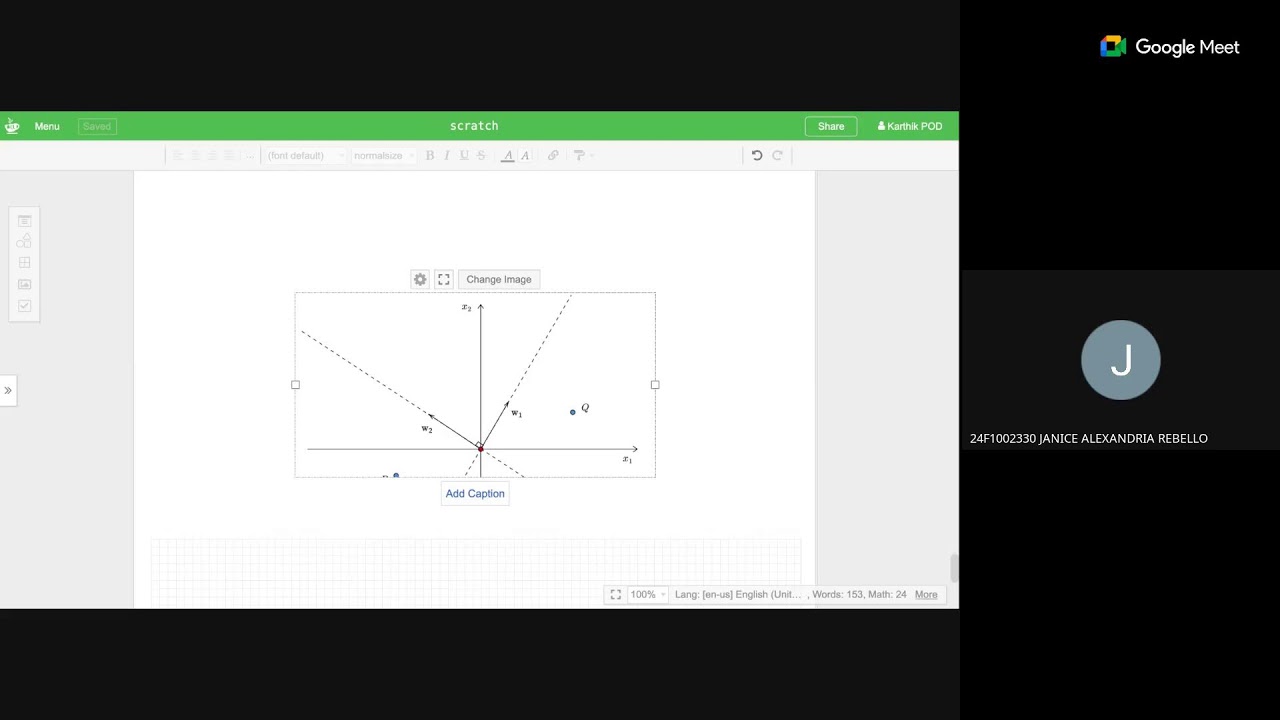
The session provides a clear and rigorous explanation of K-means convergence, breaking down the proof into two key reasons: strict decrease of the objective function and finite number of configurations. The argument is logically sound and well-articulated. The geometric discussion of Voronoi regions is also valuable, as it connects the algorithm to fundamental concepts in computational geometry and convexity. The instructor effectively uses visual aids and interactive questioning to reinforce understanding. However, the value is limited by the lack of practical examples or applications, and the discussion remains at a theoretical level.
Scientific Rigor, Source Quality, Title Accuracy
The session is scientifically rigorous in its mathematical derivations and explanations. The instructor correctly identifies the perpendicular bisector as the decision boundary and derives the hyperplane equation accurately. However, no external sources are cited, and the content relies solely on the instructor’s expertise. The title is appropriate and accurately describes the session’s content. The interactive format allows for clarification of doubts, but the lack of references reduces the overall scientific rigor.
178 words
Title / Content Match
The title accurately reflects the content: a session in a machine learning course on clustering, specifically K-means.
Quality & Reliability
7/10
The session is a live tutorial with interactive Q&A, covering mathematical derivations and geometric interpretations of K-means clustering. The instructor demonstrates solid understanding of the convergence proof and Voronoi regions, but the informal setting and lack of cited sources limit its standalone reliability.
Key Moments
Markers derived by PSI from the transcript: the creator did not define chapters.
- Introduction and discussion of K-means convergence proof.
- Explanation of the two reasons for convergence: strict decrease of objective function and finite configurations.
- Transition to nature of clusters, introduction of Voronoi regions.
- Derivation of hyperplane equation for two clusters.
- Discussion of half-spaces and their role in defining clusters.
- Extension to multiple clusters, intersection of half-spaces, and convexity of Voronoi cells.
- Handling boundary points and arbitrary assignment.
Contribution & Novelties
The session provides a clear and interactive explanation of K-means convergence and the geometric interpretation of clusters as Voronoi regions. It reinforces the theoretical foundation of the algorithm, which is often glossed over in practical tutorials. The connection between K-means and linear classifiers via hyperplanes is a valuable insight for students.
Pour aller plus loin :
- K-means clustering — Overview of the algorithm and its properties.
- Voronoi diagram — Mathematical definition and applications.
- Convex set — Fundamental concept used in the discussion of Voronoi regions.
85 words
Radar Profile
The radar profile shows balanced scores across all dimensions, with slightly lower reliability due to lack of external sources. The session is strong in technical depth and information quality, but could benefit from more practical examples and citations.