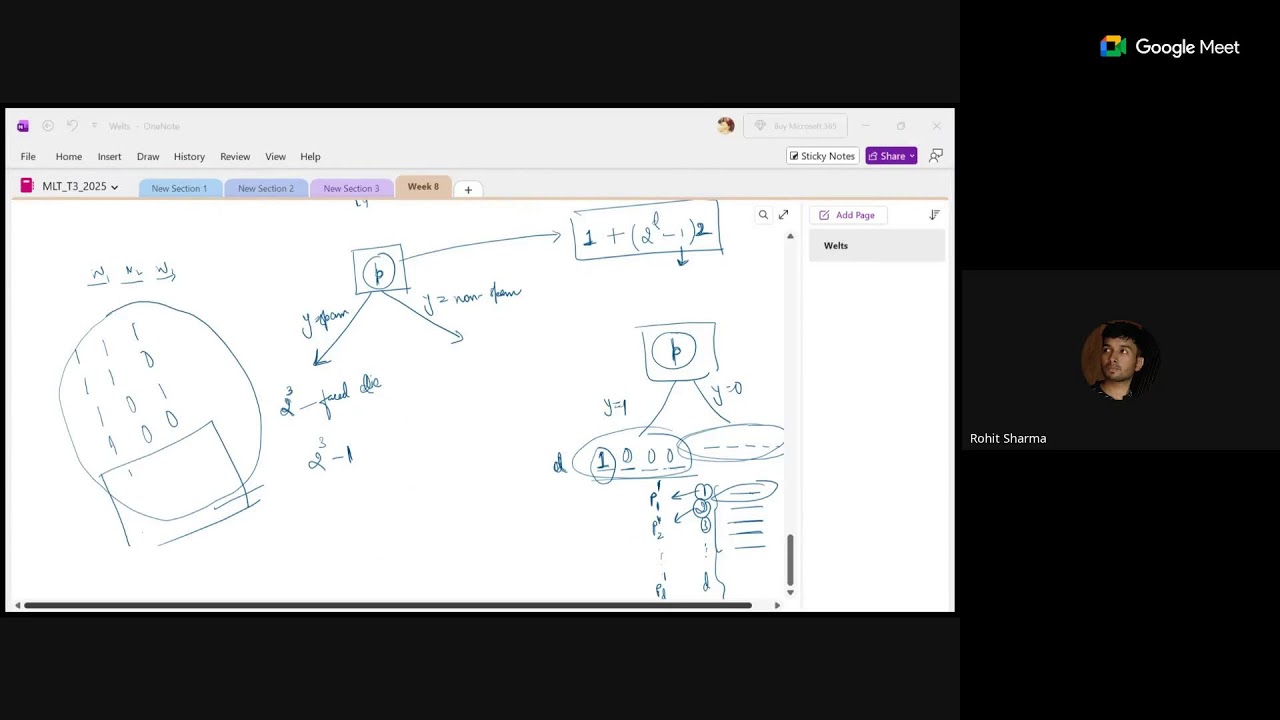
MLT - Week 8 SWU
Keywords
Summary
146 words
Critical Evaluation
Value of the Information & Strength of the Argument
The video provides a solid explanation of Naive Bayes classifiers, from the basic probabilistic formulation to the derivation of the linear decision boundary. The instructor’s step-by-step derivation is valuable for students seeking to understand the mathematical foundations. The argumentation is coherent, with clear connections between the assumptions (e.g., class-conditional independence) and the resulting model. However, the session occasionally lacks depth in explaining the intuition behind certain steps, and the instructor sometimes skips intermediate algebra, which might leave some students behind. The interactive Q&A helps clarify doubts, but the overall argumentation could be more structured.
Scientific Rigor, Source Quality, Title Accuracy
The video does not cite external sources, which is typical for a tutorial session. The instructor references course lectures and assumes students have access to them. The mathematical derivations appear correct, but the lack of citations reduces the scientific rigor. The title ‘MLT - Week 8 SWU’ is vague but accurately reflects the content as a weekly session. The session is informal, with occasional tangents, but the core content is accurate and well-explained.
182 words
Title / Content Match
The title is generic but accurate; it indicates a weekly session for a Machine Learning Techniques course.
Quality & Reliability
7/10
The content is a live tutorial session covering Naive Bayes classifiers, including mathematical derivations and problem-solving. The instructor demonstrates a solid understanding of the topic, but the session is informal and lacks structured references. The explanations are accurate but occasionally rushed, and the video quality is typical of a live class.
Key Moments
Markers derived by PSI from the transcript: the creator did not define chapters.
- Introduction and plan for the session.
- Derivation of decision function for Naive Bayes with binary features.
- Discussion on the linear decision boundary and its form.
- Introduction to Gaussian Naive Bayes for continuous features.
- Estimation of parameters: priors, means, and covariance matrix.
- Problem-solving: number of parameters for Naive Bayes with 5 classes and 3 binary features.
- Student questions and clarifications on the derivations.
Contribution & Novelties
The video provides a clear, step-by-step derivation of the Naive Bayes decision function, which is often glossed over in textbooks. It also bridges the gap between Bernoulli and Gaussian Naive Bayes, highlighting the impact of feature distribution assumptions on the decision boundary. The interactive problem-solving session reinforces the concepts.
Pour aller plus loin :
- Naive Bayes classifier — Wikipedia article providing an overview of the algorithm.
- Gaussian Naive Bayes — Scikit-learn documentation with implementation details.
- Bayes’ theorem — Wikipedia article on the underlying probability theorem.
85 words
Radar Profile
The radar profile shows balanced scores across all dimensions, indicating a well-rounded tutorial. The high scores in information quantity and quality reflect the comprehensive coverage of the topic, while the technical level is appropriate for an advanced undergraduate course. The reliability score is slightly lower due to the lack of citations.