MLT | Week-2 | Session-2
Keywords
Summary
215 words
Critical Evaluation
Value of the Information & Strength of the Argument
The session provides a clear conceptual explanation of why transformations are needed in PCA for nonlinear data, using a concrete example with a circle. The argumentation is logical and builds step by step, from identifying the problem to proposing a solution. However, the presentation is informal and lacks mathematical rigor, with some hand-waving and incomplete derivations. The interactive format helps address student doubts, but the discussion sometimes wanders. The value lies in its pedagogical approach, making abstract concepts accessible, though it may not satisfy viewers seeking a formal treatment.
Scientific Rigor, Source Quality, Title Accuracy
The session is a tutorial with no cited external sources; the instructor relies on his own explanations and examples. The mathematical content is generally correct, but the lack of references and the informal style reduce its scientific rigor. The title accurately reflects the content, as it is a weekly session of a machine learning course. No comments were provided for analysis.
165 words
Title / Content Match
The title accurately reflects the content: a weekly session of a machine learning course, focusing on kernel methods.
Quality & Reliability
6/10
The session is a live tutorial with interactive Q&A, but the audio is sometimes unclear and the instructor's explanations are informal. The mathematical content is correct but presented without rigorous formalism. No external sources are cited, and the video is not peer-reviewed.
Key Moments
Markers derived by PSI from the transcript: the creator did not define chapters.
- Introduction and technical setup; discussion about sharing notes and access to the live stream.
- Review of transformation concept; problem of PCA with nonlinear data (circle example).
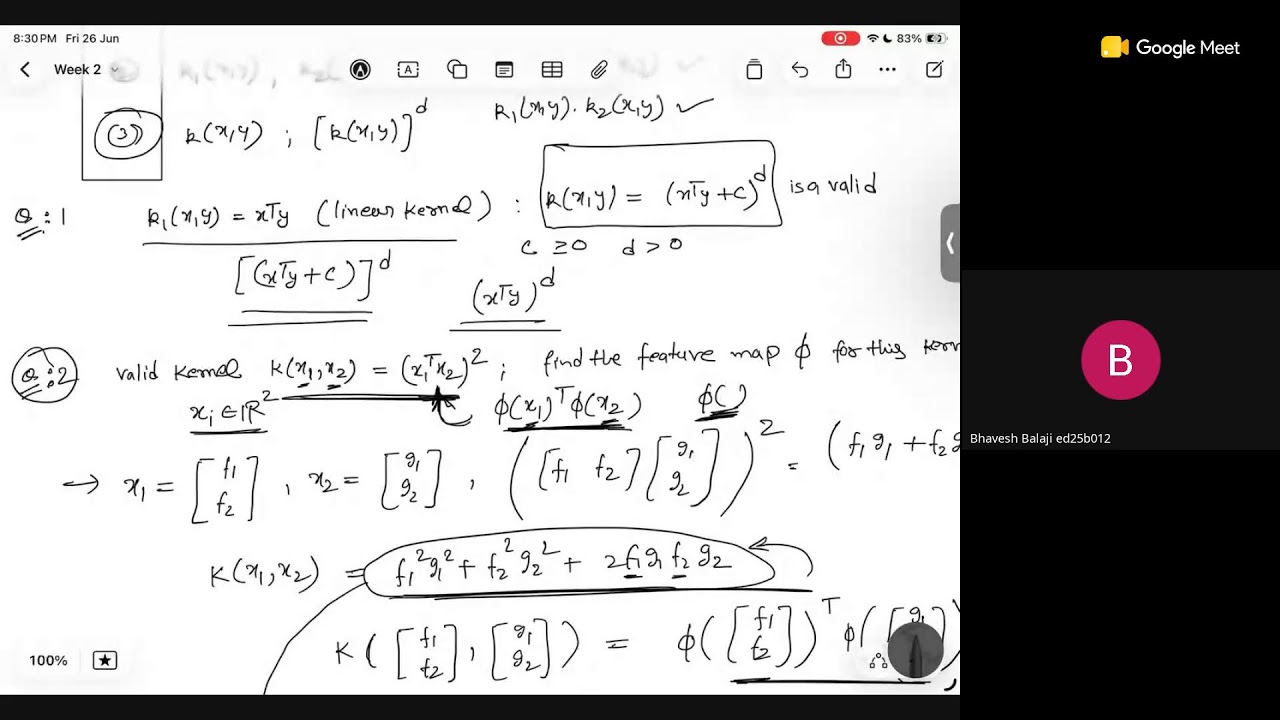
- Explanation of transformation to higher dimension to introduce linearity; example with R2 to R3.
- Introduction of polynomial transformation of degree 2; construction of feature vector.
- Discussion on number of features in polynomial transformation; combinatorial growth.
- Clarification of features vs. degree; general form of polynomial transformation.
Contribution & Novelties
The session offers a pedagogical walkthrough of the motivation behind kernel methods, using a simple circle example to illustrate how polynomial transformations can linearize data. It clarifies the distinction between features and degree, which is a common source of confusion. The interactive format allows for immediate clarification of doubts.
Pour aller plus loin :
- Kernel method (Wikipedia) — Provides an overview of kernel methods and their applications.
- Kernel PCA (Wikipedia) — Explains the kernelized version of PCA, directly relevant to the session’s topic.
- Polynomial kernel (Wikipedia) — Details the polynomial kernel, which is closely related to the polynomial transformation discussed.
100 words
Radar Profile
The radar profile shows moderate scores across all dimensions, with quantity of information slightly higher than quality and reliability. This reflects a session that covers a good amount of material but lacks depth and formal rigor.