MLT - Week 9 SWU
Keywords
Summary
196 words
Critical Evaluation
Value of the Information & Strength of the Argument
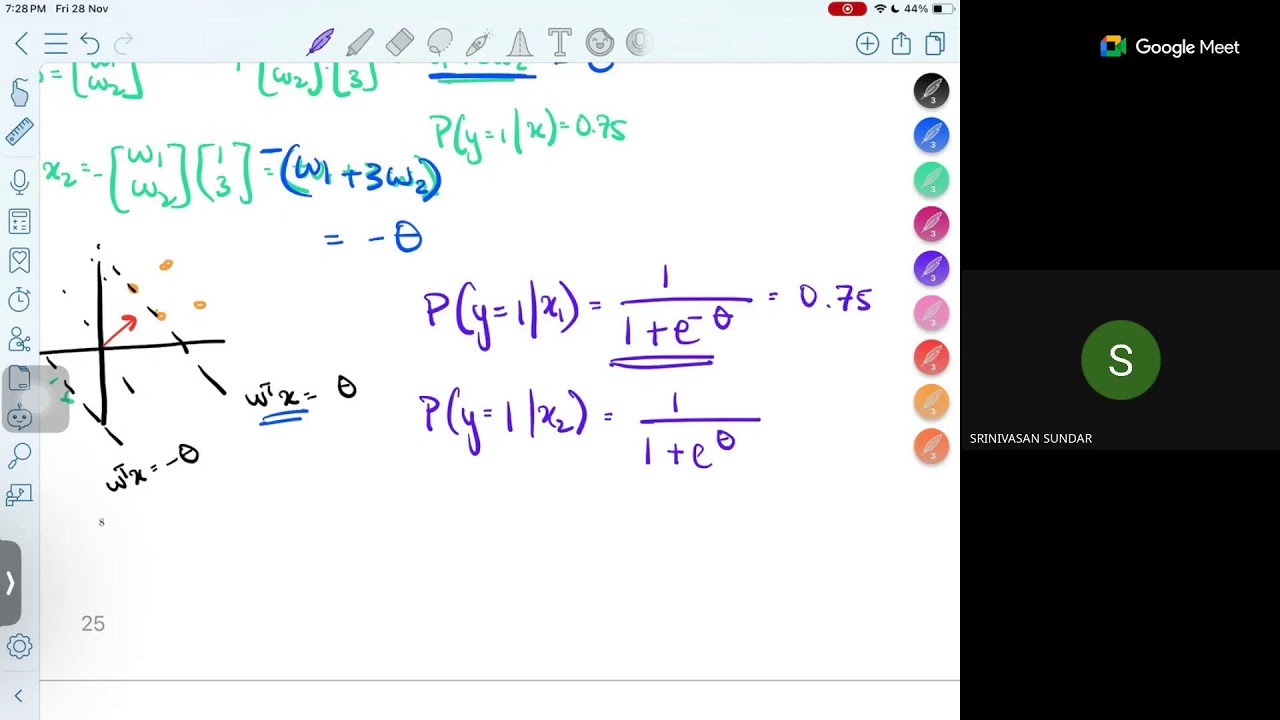
The video provides valuable clarifications on common misconceptions in perceptron and logistic regression. The instructor’s explanations are logically structured and mathematically grounded. For instance, he correctly explains that perceptron’s decision boundary always divides the space into two regions, and that the algorithm does not guarantee optimal weights. He also correctly derives the gradient of logistic regression loss and explains the trade-off between precision and recall in threshold selection. The argumentation is solid, with step-by-step calculations for the gradient ascent problem, demonstrating the difference between convergence and termination. However, the session is informal and may not cover all edge cases, but it effectively addresses the specific questions posed.
Scientific Rigor, Source Quality, Title Accuracy
The scientific rigor is adequate for a tutorial session. The instructor references standard machine learning concepts and formulas, such as the perceptron convergence bound and cross-entropy loss, without citing external sources. The title accurately reflects the content, as it is a week 9 session on machine learning techniques. The session does not include any external references or citations, which is typical for a classroom tutorial. The instructor’s explanations are consistent with established theory, but the lack of citations means the content relies on the instructor’s expertise. No comments were provided for analysis.
214 words
Title / Content Match
The title accurately reflects the content: a week 9 session on machine learning techniques, specifically covering perceptron and logistic regression.
Quality & Reliability
7/10
The session is an instructor-led tutorial focused on solving specific problems related to perceptron and logistic regression. The explanations are mathematically sound and align with standard machine learning theory. However, the content is not peer-reviewed and is presented in a conversational, classroom setting, which may introduce minor ambiguities.
Key Moments
Markers derived by PSI from the transcript: the creator did not define chapters.
- Introduction and start of the session.
- Discussion on perceptron decision boundary in R5.
- Solving the perceptron weight update problem.
- Multiple-choice questions on perceptron and logistic regression.
- Explanation of precision and recall in threshold selection.
- Gradient ascent problem for maximizing a function.
- Conclusion and wrap-up.
Contribution & Novelties
The video offers a practical, problem-solving approach to understanding perceptron and logistic regression, reinforcing theoretical concepts through worked examples. It clarifies subtle points such as the difference between convergence and termination in iterative algorithms, and the impact of threshold selection on precision and recall. The session is particularly useful for students preparing for exams or wanting to solidify their understanding.
Pour aller plus loin :
- Perceptron — Provides a comprehensive overview of the perceptron algorithm, including its convergence properties.
- Logistic regression — Explains the logistic regression model, loss function, and gradient descent.
- Cross-entropy — Details the cross-entropy loss used in logistic regression.
- Precision and recall — Discusses these metrics and their trade-offs, relevant to the threshold selection discussion.
118 words
Radar Profile
The radar profile shows a balanced performance across all dimensions, with slightly higher scores in information quality and technical level, indicating a solid educational content. The lower score in quantity of information reflects the focused scope of the session, while the overall reliability is good for a tutorial.