MLT | Week-7 & 8 | Revision Session
Keywords
Summary
129 words
Critical Evaluation
Value of the Information & Strength of the Argument
The session provides valuable practice for students, reinforcing key concepts through worked examples. The instructor explains the reasoning behind each step, such as why entropy measures impurity and how information gain guides split selection. The argumentation is generally sound, though some explanations are rushed or assume prior knowledge. The k-NN and naive Bayes problems are solved clearly, with derivations that are easy to follow. However, the session does not introduce new material or advanced insights, and the informal style may reduce its rigor.
Scientific Rigor, Source Quality, Title Accuracy
The content is scientifically accurate, but no external sources are cited. The instructor relies on standard textbook knowledge, which is appropriate for a revision session. The title accurately reflects the content, and the session stays on topic. The explanations are mostly clear, but there are occasional ambiguities, such as the interpretation of the k-NN training error statement. Overall, the scientific rigor is adequate for an educational context, but the lack of citations and informal delivery limit its depth.
176 words
Title / Content Match
The title accurately reflects the content: a revision session for weeks 7 and 8 of a machine learning course.
Quality & Reliability
7/10
The session is a live revision class covering core ML concepts (entropy, decision trees, k-NN, naive Bayes). The instructor provides worked examples and derivations, but the content is largely standard textbook material. No external sources are cited, and the session is informal with some ambiguities in explanations.
Key Moments
Markers derived by PSI from the transcript: the creator did not define chapters.
- Introduction and plan for the revision session.
- Solving entropy calculation for a 0.5/0.5 distribution.
- Discussion on entropy as a measure of impurity and its range.
- Solving a decision tree problem: choosing the best split using information gain.
- Explaining the concept of pure nodes and the number of leaf nodes needed for zero training error.
- Solving a k-NN problem: calculating distances and predictions for different k values.
- Discussion on k-NN properties: no explicit training phase and computational cost.
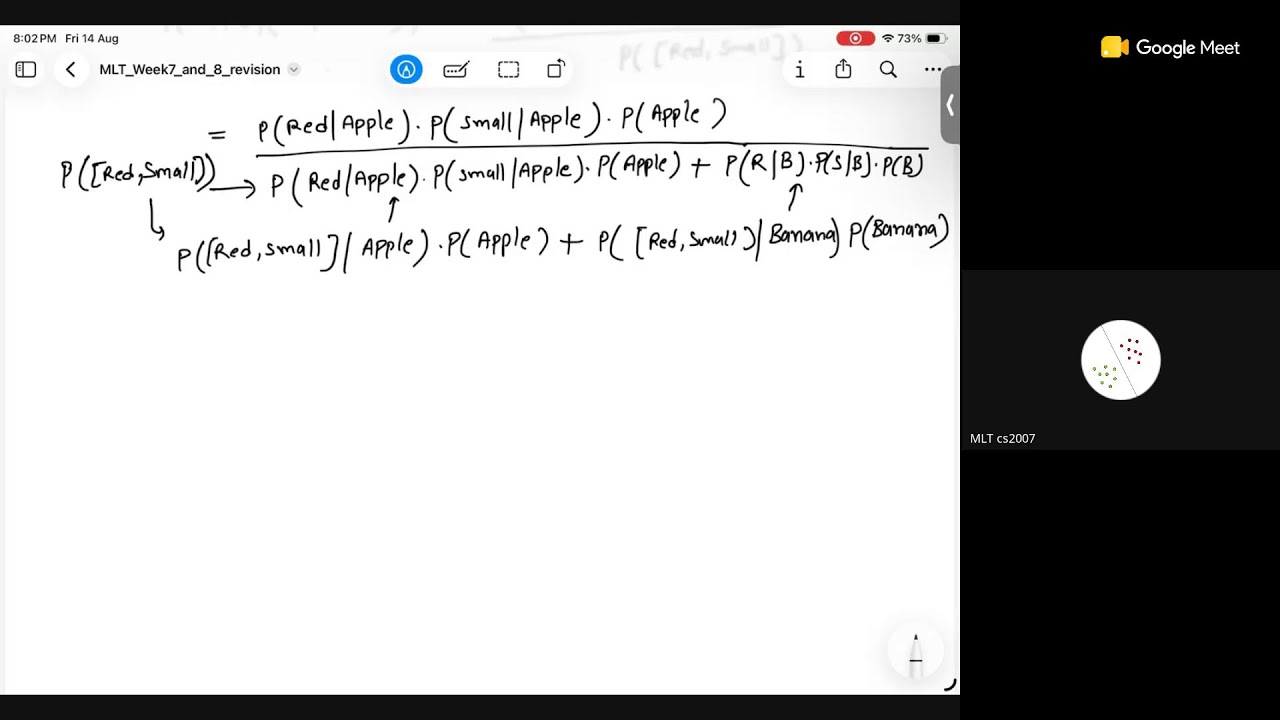
- Solving a naive Bayes problem: deriving the decision boundary for two Gaussian distributions.
- Conclusion and wrap-up of the session.
Contribution & Novelties
The session provides a practical revision of fundamental ML concepts through worked examples. It reinforces the intuition behind entropy, information gain, and decision boundaries. While not novel, it serves as a useful study aid for students.
Pour aller plus loin :
- Entropy (information theory) — Provides a formal definition and properties of entropy.
- Decision tree learning — Overview of decision tree algorithms and splitting criteria.
- k-nearest neighbors algorithm — Detailed explanation of the k-NN method.
- Naive Bayes classifier — Covers the probabilistic foundation and applications.
85 words
Radar Profile
The radar profile shows balanced scores across all dimensions, with slightly lower technical depth and source rigor. This indicates a solid but not exceptional educational resource, suitable for revision but not for advanced study.