MLT | Week-7 | Session-2
Keywords
Summary
210 words
Critical Evaluation
Value of the Information & Strength of the Argument
The value of the information is high for beginners in machine learning, as it provides a clear and intuitive introduction to decision trees. The instructor uses a step-by-step approach, building from basic definitions to the concept of node impurity, which is crucial for understanding how trees are constructed. The argumentation is solid, with concrete examples and visual aids (though not visible in the transcript) that help illustrate the concepts. The instructor also addresses common misconceptions, such as the impact of outliers and the importance of choosing good splits. However, the session lacks depth in advanced topics like pruning, handling continuous features, and impurity measures beyond the proportion of positives. The argumentation is coherent and logical, but it is more pedagogical than rigorous, with no formal proofs or references to literature.
Scientific Rigor, Source Quality, Title Accuracy
The scientific rigor is moderate. The content is accurate and aligns with standard machine learning textbooks, but the instructor does not cite any external sources or research papers. The quality of sources is therefore based on the instructor’s expertise and the course material. The title ‘MLT | Week-7 | Session-2’ is descriptive and matches the content, as it is a session in a machine learning techniques course. The adequacy between title and content is high, as the session focuses on decision trees, a core topic in machine learning. No comments were provided for analysis.
239 words
Title / Content Match
The title accurately reflects the content, as it is a session from a course on machine learning techniques, specifically covering decision trees.
Quality & Reliability
7/10
The content is a lecture on decision trees, covering fundamental concepts with clear explanations and examples. The instructor demonstrates a solid understanding of the material, but the session is interactive and includes some digressions. The information is accurate and aligns with standard machine learning pedagogy, though it lacks formal citations or references to external sources.
Key Moments
Markers derived by PSI from the transcript: the creator did not define chapters.
- Introduction to decision trees: definition, binary tree structure, questions of the form 'feature <= value', left branch = yes, right branch = no.
- Explanation of tree depth as a hyperparameter and the structure of internal nodes and leaves.
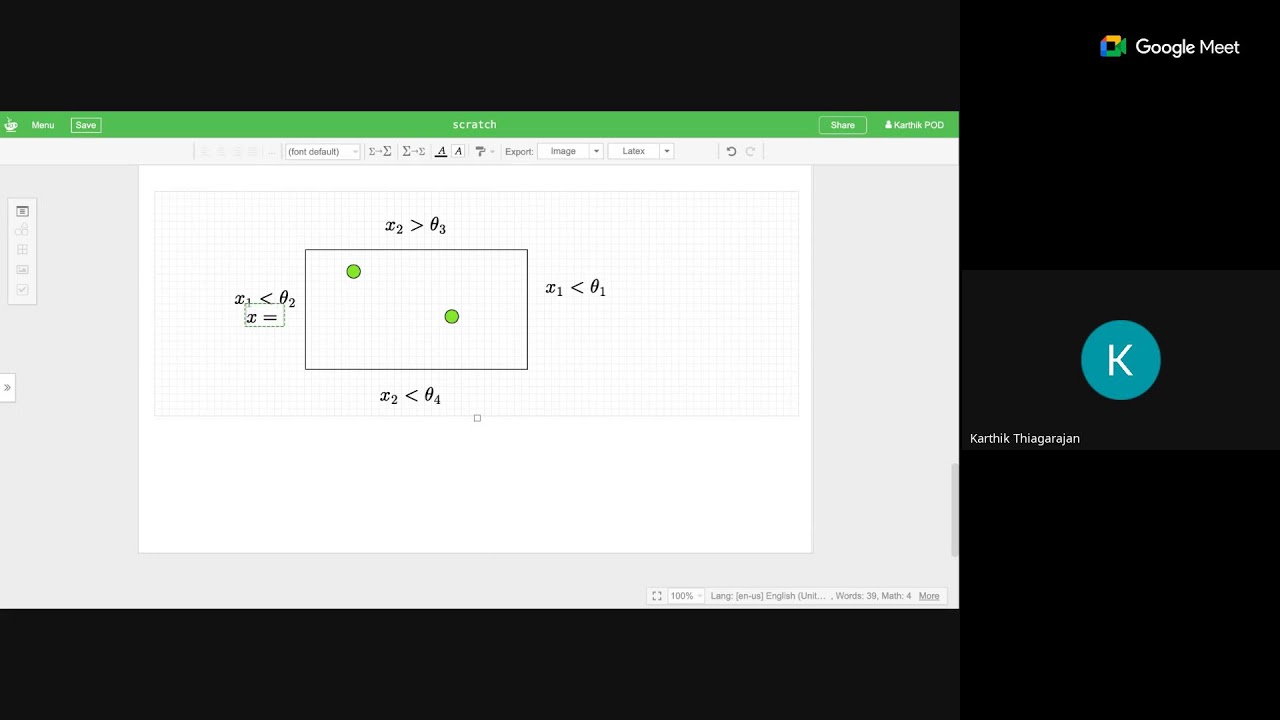
- Example of traversing a decision tree for prediction, with specific data points and their paths.
- Discussion on interpretability of decision trees and analogy to medical diagnosis.
- Introduction to node impurity: proportion of positive points in a node, and how it measures the quality of a split.
- Examples of computing impurity for different splits, and the concept of a 'stump' (single-question tree).
- Discussion on the No Free Lunch theorem and the sensitivity of models to outliers.
- Further examples of computing impurity and the idea that a good split results in pure nodes.
- Explanation of the impurity curve: low impurity at extremes, high impurity in the middle.
Contribution & Novelties
The session provides a clear and accessible introduction to decision trees, emphasizing the importance of node impurity in split selection. It is particularly valuable for beginners as it builds intuition through examples and interactive Q&A. The instructor’s approach of using a simple dataset to illustrate concepts is effective. However, the content is not novel; it covers standard material found in machine learning courses. The session does not introduce new algorithms or research findings.
Pour aller plus loin :
- Decision tree learning — Overview of decision tree algorithms and concepts.
- Gini impurity — A common impurity measure used in decision tree algorithms.
- No Free Lunch theorem — Theoretical result explaining why no single algorithm works for all problems.
117 words
Radar Profile
The radar profile shows balanced scores, with quality of information and fiabilite being relatively high, while quantity and technical level are moderate. This indicates a solid introductory lecture that is accurate but not exhaustive in depth or breadth.