MLT | Week-12 | Session-1
Keywords
Summary
163 words
Critical Evaluation
Value of the Information & Strength of the Argument
The session provides a clear and valuable explanation of why different classification algorithms exist, unifying them through the lens of loss function approximation. The argumentation is solid, with step-by-step derivations that connect mathematical formulations to algorithmic choices. The instructor effectively demonstrates how each loss function addresses the shortcomings of the 0-1 loss, and the comparison of their properties (e.g., penalizing correctly classified points) is insightful. The equivalence between perceptron and SGD on modified hinge loss is particularly illuminating, showing the practical implications of loss function selection.
Scientific Rigor, Source Quality, Title Accuracy
The scientific rigor is high, with precise mathematical derivations and correct references to standard machine learning concepts. The instructor does not cite external sources, but the content is based on well-established theory. The title accurately reflects the content, as it is a session from a machine learning course. The session is well-structured, and the instructor’s explanations are consistent with standard textbooks. No external sources are cited, but the internal consistency and clarity of the derivations support the reliability of the content.
182 words
Title / Content Match
The title accurately reflects the content: it is a session from a machine learning course, covering loss functions for classification in a structured manner.
Quality & Reliability
8/10
The session is a structured tutorial by an instructor, with rigorous mathematical derivations and clear explanations. The content aligns with established machine learning theory, and the instructor demonstrates deep understanding. Minor limitations include occasional informal language and lack of external citations, but the core material is accurate and well-presented.
Key Moments
Markers derived by PSI from the transcript: the creator did not define chapters.
- Introduction: Why are there many classification algorithms but only one regression algorithm?
- Definition of the 0-1 loss and its properties (non-differentiable, non-convex).
- Introduction of the variable u = w^T x y and its role in classification.
- Derivation of least squares loss as a convex surrogate.
- Derivation of hinge loss and its connection to SVM.
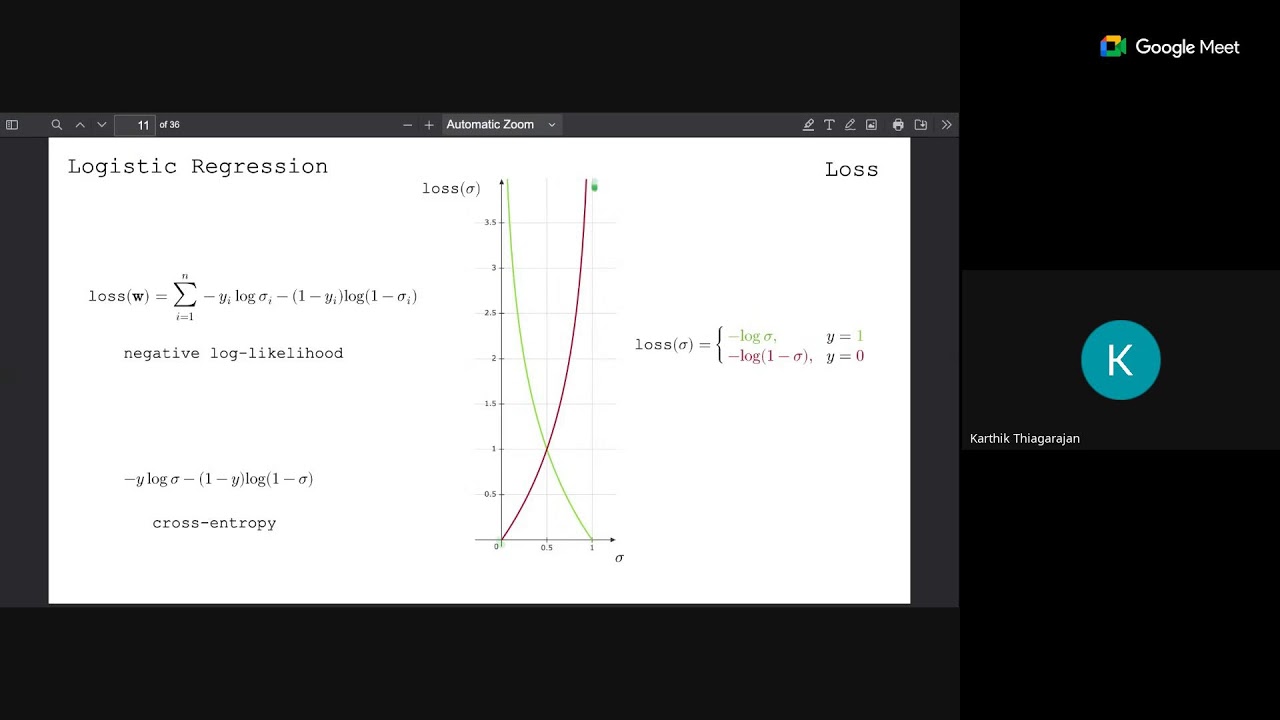
- Derivation of logistic loss from cross-entropy and its properties.
- Introduction of modified hinge loss and its equivalence to perceptron learning.
- Summary of loss functions and their trade-offs.
Contribution & Novelties
The session provides a clear and unified perspective on classification algorithms, showing that they can be derived from different convex surrogate loss functions approximating the 0-1 loss. This helps students understand the underlying principles and connections between algorithms. The explicit derivation of the perceptron update rule from SGD on modified hinge loss is particularly insightful.
Pour aller plus loin :
- Convex function — Background on convexity, essential for understanding surrogate losses.
- Support vector machine — Details on SVM and hinge loss.
- Logistic regression — Details on logistic loss and cross-entropy.
- Perceptron — Overview of the perceptron algorithm and its convergence properties.
101 words
Radar Profile
The radar profile shows high scores in information quantity, quality, technical level, and reliability, indicating a well-rounded and rigorous educational session. The balanced scores suggest that the content is both informative and technically sound, with no significant weaknesses.
💬 No comments were provided for analysis.