MLT | Week-1 | Session-2
Keywords
Summary
176 words
Critical Evaluation
Value of the Information & Strength of the Argument
The session provides a solid, interactive explanation of PCA, reinforcing theoretical concepts through discussion and examples. The instructor effectively connects the geometric intuition with the mathematical formulation, showing how error minimization is equivalent to variance maximization. The argumentation is coherent and builds step by step, addressing student questions to clarify misunderstandings. However, the session is more of a review and Q&A than a deep dive, and the lack of concrete examples or visualizations (beyond a simple diagram) limits its value for beginners. The instructor’s explanations are accurate, but the session would benefit from more structured presentation and additional illustrative examples.
Scientific Rigor, Source Quality, Title Accuracy
The scientific rigor is adequate for an introductory course: the mathematical derivations are standard and correct, and the instructor correctly explains the PCA algorithm. However, no external sources are cited, and the session relies solely on the instructor’s knowledge and course slides. The title accurately reflects the content, as it is a session of a course on machine learning techniques. The session is not a formal lecture but an interactive tutorial, which is appropriate for the context. The lack of citations is not a major issue for a tutorial, but it limits the ability to verify claims independently.
213 words
Title / Content Match
The title accurately reflects the content: a second session of the first week of a Machine Learning Techniques course, focusing on PCA.
Quality & Reliability
7/10
The session is an interactive tutorial on PCA, with the instructor explaining concepts and engaging students. The mathematical derivations are standard and correct, but the session lacks formal citations and the discussion is somewhat unstructured.
Key Moments
Markers derived by PSI from the transcript: the creator did not define chapters.
- Introduction and recap of PCA theory, discussion of dimensionality reduction.
- Explanation that principal components are combinations of features, and discussion of variance explained.
- Geometric interpretation of PCA: projection and residuals, Pythagoras theorem.
- Derivation of covariance matrix and its eigenvectors as principal components.
- Discussion on the number of principal components and the 95% variance threshold.
- Algorithm steps: centering data, computing covariance matrix, finding eigenvectors.
- Clarification on eigenvalues representing variance along principal components.
- Mention of programming assignments and TA session.
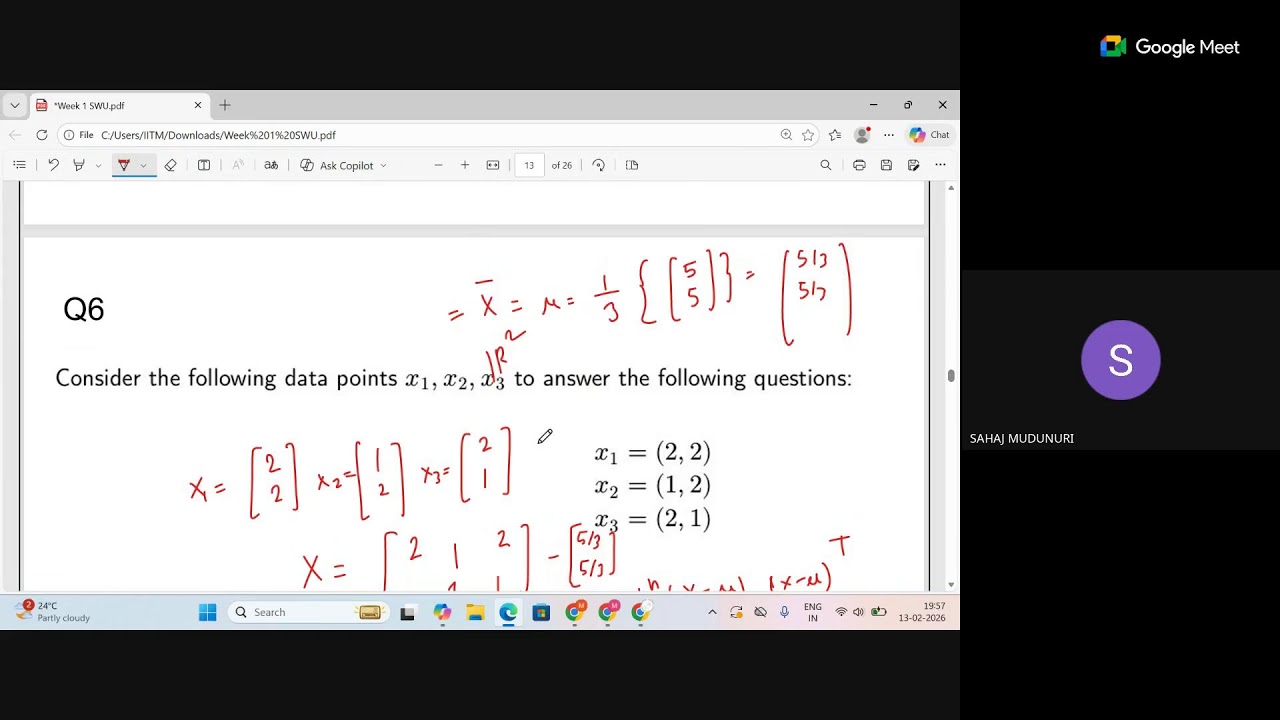
- Start of practice question on PCA.
Contribution & Novelties
The session provides an interactive review of PCA, reinforcing the theoretical foundations through Q&A. It clarifies common misconceptions, such as the relationship between error minimization and variance maximization, and the interpretation of eigenvalues. The instructor’s approach of connecting geometry to algebra is effective for understanding. However, the content is not novel; it is a standard tutorial on PCA.
Pour aller plus loin :
- Principal component analysis - Wikipedia — Comprehensive overview of PCA, including mathematical details and applications.
- A Tutorial on Principal Component Analysis — A well-known tutorial paper by Jonathon Shlens, providing a thorough derivation and intuition.
- Eigenvalues and eigenvectors - Wikipedia — Background on eigenvalues and eigenvectors, essential for understanding PCA.
113 words
Radar Profile
The radar profile shows balanced scores across all dimensions, with slightly lower technical depth and information quantity. This indicates a solid but not exceptional tutorial, suitable for beginners but not for advanced learners.