MLT | Week-2 | Session-1
Keywords
Summary
165 words
Critical Evaluation
Value of the Information & Strength of the Argument
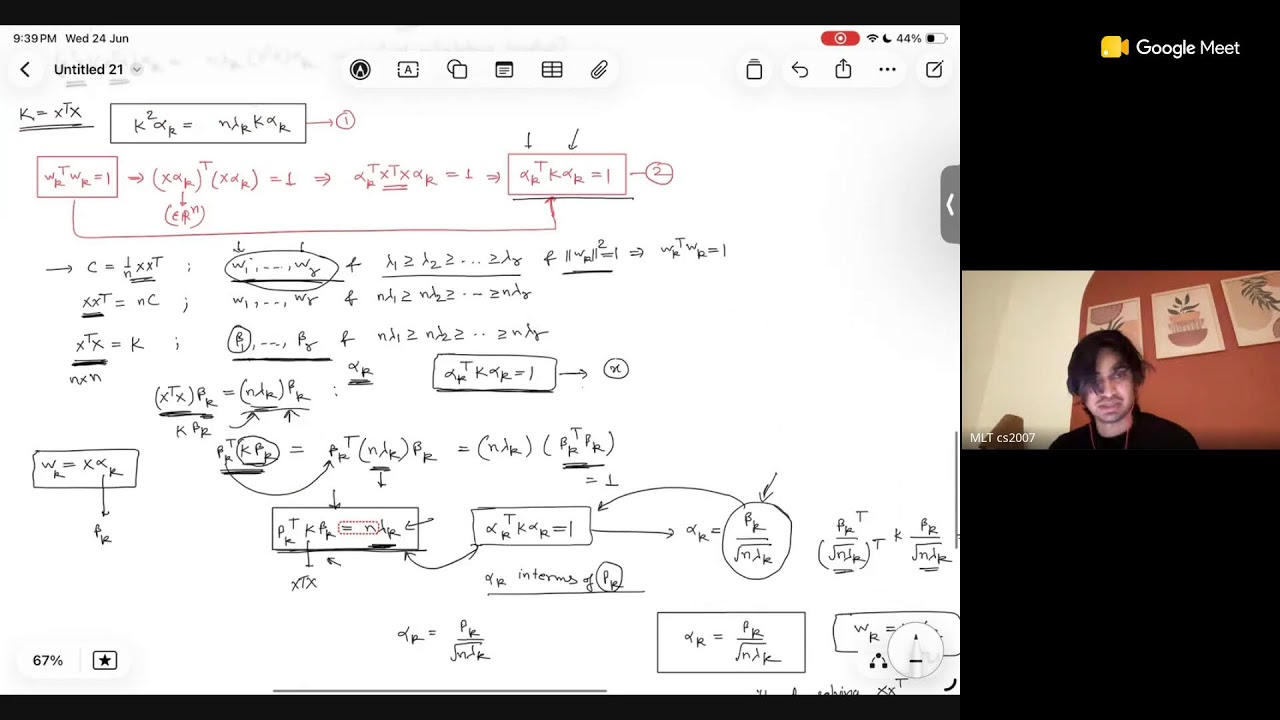
The session provides valuable pedagogical content, clearly explaining the mathematical foundations of PCA and the motivation for considering the Gram matrix to reduce computational cost. The argumentation is solid, building step-by-step from the eigenvalue equation of X^T X to the derivation of eigenvectors for XX^T. The instructor emphasizes understanding over rote memorization, encouraging students to derive equations themselves. The interactive format allows for immediate clarification of doubts, enhancing the learning experience. However, the session is not a formal lecture but a live Q&A, so the structure is somewhat informal, with some digressions on assignment grading. The mathematical derivations are accurate and well-explained, making the content valuable for students learning PCA.
Scientific Rigor, Source Quality, Title Accuracy
The session demonstrates scientific rigor in its mathematical explanations, with careful attention to the properties of matrices and eigenvalues. The instructor references the book ‘Mathematics for Machine Learning’ for further study, but no specific sources are cited in the video. The title accurately reflects the content, as it is a week 2 session of a machine learning techniques course. The session is a tutorial, not a research presentation, so the lack of formal citations is appropriate. The instructor’s explanations are consistent with standard PCA theory, and the approach to reducing computational complexity via the Gram matrix is a well-known technique. No comments were provided for analysis.
231 words
Title / Content Match
The title accurately reflects the content: a week 2 session of a machine learning techniques course, focusing on PCA and its computational challenges.
Quality & Reliability
7/10
The session is a live tutorial by an instructor, providing a review of PCA and introducing the computational complexity issue. The mathematical explanations are clear and pedagogically sound, but the content is not peer-reviewed and relies on the instructor's expertise. The session is interactive, addressing student questions, which adds value but also introduces some digressions.
Key Moments
Markers derived by PSI from the transcript: the creator did not define chapters.
- Introduction and student questions about linear algebra and assignments.
- Discussion on assignment grading and how to submit answers.
- Review of PCA steps and assumptions from week 1.
- Introduction of two issues with PCA: computational complexity and linear subspace assumption.
- Explaining the computational cost of eigenvalue decomposition of covariance matrix.
- Exploring the relationship between XX^T and X^T X.
- Deriving eigenvectors of XX^T from eigenvectors of X^T X.
- Discussion on the benefits of using the smaller Gram matrix when N << D.
- Further mathematical details and student questions.
- Wrap-up and summary of key points.
Cited Sources
- Mathematics for Machine Learning — Recommended by the instructor for revising linear algebra concepts.
Concurring Sources
- Mathematics for Machine Learning — Recommended by the instructor for further study on linear algebra.
Contribution & Novelties
The session provides a clear pedagogical explanation of a key technique to reduce the computational burden of PCA when the feature dimension is large. It bridges the gap between theoretical PCA and practical implementation by showing how to compute eigenvectors of the covariance matrix via the Gram matrix. The interactive format allows for immediate clarification of doubts, which is valuable for learners.
Pour aller plus loin :
- Principal component analysis — Overview of PCA and its applications.
- Eigenvalues and eigenvectors — Mathematical background on eigenvalues and eigenvectors.
- Covariance matrix — Definition and properties of covariance matrices.
- Singular value decomposition — Related matrix factorization technique often used in PCA.
108 words
Radar Profile
The radar profile shows balanced scores across all dimensions, with slightly higher scores in information quantity and technical level, reflecting the session's focus on detailed mathematical explanations. The fiabilite_globale is moderate, as the content is based on instructor expertise rather than peer-reviewed sources.