NRF-SAIAB Student Symposium: Session 2
Keywords
Summary
193 words
Critical Evaluation
Value of the Information & Strength of the Argument
The presentations provide valuable insights into the ecological and physiological factors affecting biological control agents. Frank’s study is particularly novel as it is the first to characterize the gut microbiome of Megamelus scutellaris and link heavy metal pollution to dysbiosis. The argumentation is solid, with clear hypotheses and data-driven conclusions. Liam’s work addresses a critical gap in understanding hybridization between biocontrol agents, which could have significant implications for their efficacy. Rion’s experimental design is straightforward and effectively demonstrates the negative impacts of plastic leachates on agent survival. The final talk, while more qualitative, adds a social dimension to the issue. Overall, the arguments are well-supported by the presented data, though some conclusions are preliminary and require further validation.
Scientific Rigor, Source Quality, Title Accuracy
The scientific rigor is generally high, with speakers referencing their own research and established methods. However, specific sources are not cited in the video, and the description provides no links. The title accurately reflects the content, and the presentations are well-structured. The lack of explicit citations limits the ability to verify claims, but the research appears to be conducted within established frameworks. The adequacy between title and content is excellent, as the session focuses on aquatic biodiversity research.
211 words
Title / Content Match
The title accurately reflects the content: a session of a student symposium with multiple presentations on aquatic biodiversity research.
Quality & Reliability
7/10
The video presents original research findings from ongoing studies, with clear methodology and data. However, it is a symposium session, so details are limited and some results are preliminary. The speakers are researchers from recognized institutions, and the content is scientifically grounded.
Key Moments
Markers derived by PSI from the transcript: the creator did not define chapters.
- Introduction by chairperson Muso, welcoming attendees and introducing the first speaker.
- Frank begins his presentation on acid mine drainage and its effects on the gut microbiome of a biocontrol agent.
- Frank explains the background of water hyacinth as an invasive species and the study sites in South Africa.
- Frank discusses the methodology for analyzing gut microbiome and presents initial findings on heavy metal concentrations.
- Frank presents results on alpha and beta diversity, highlighting dysbiosis in polluted sites.
- Frank concludes with implications for biological control and takes questions from the audience.
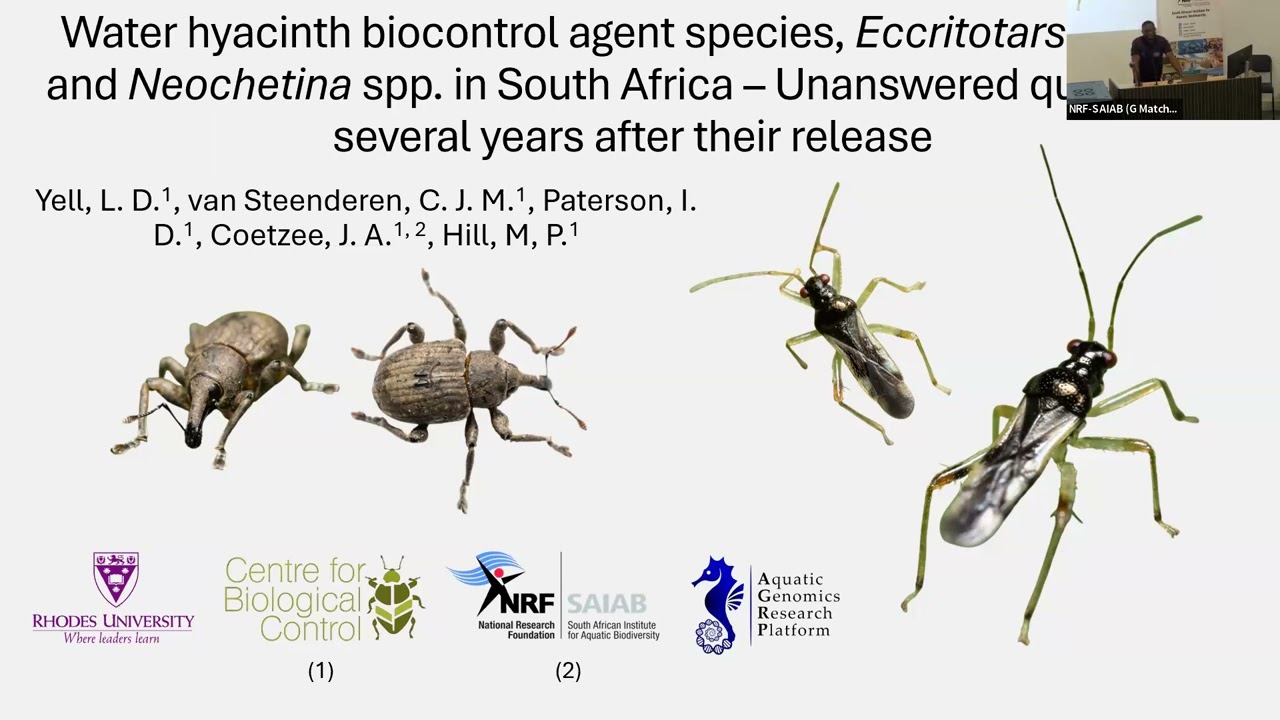
- Liam begins his talk on hybridization between two biocontrol weevils, Neochetina eichhorniae and N. bruchi.
- Liam presents nationwide survey results, showing a high proportion of potential hybrids and no detection of the Peruvian mirid.
- Rion presents his study on the effects of plastic leachates on survival of biocontrol agents.
- Rion discusses results showing significant declines in survival for both agents, with Megamelus more sensitive.
- Hloniphani presents her research on community perceptions of invasive aquatic plants and management.
Contribution & Novelties
This session provides novel insights into the interactions between environmental stressors and biological control agents. Frank’s study is the first to characterize the gut microbiome of Megamelus scutellaris and link heavy metal pollution to dysbiosis, offering a potential explanation for failed establishment at polluted sites. Liam’s work reveals a high prevalence of hybridization between two biocontrol weevils, which could impact their efficacy and host specificity. Rion’s research highlights the previously unknown effects of plastic leachates on biocontrol agent survival, adding a new dimension to the challenges of managing invasive plants in polluted waters. The session also underscores the importance of considering social perceptions in management strategies.
Pour aller plus loin :
- Water hyacinth (Eichhornia crassipes) — Background on the invasive plant species discussed.
- Biological pest control — Overview of biological control methods and their applications.
- Gut microbiota — General information on gut microbiomes and their roles in organisms.
- Acid mine drainage — Explanation of the environmental issue studied by Frank.
- Microsatellite — Genetic markers used in hybridization detection.
168 words
Radar Profile
The radar profile shows high scores in quality of information and technical level, reflecting the scientific depth of the presentations. The quantity of information is moderate, as the session is limited to four talks. The overall reliability is good, but the lack of cited sources and preliminary nature of some results prevent a perfect score.