SAIAB Seminar Series 2026: Jessica Allen
Keywords
Summary
185 words
Critical Evaluation
Value of the Information & Strength of the Argument
The presentation provides valuable insights into the current state of GGI research, highlighting gaps and challenges. The speaker’s argumentation is logical and well-structured, moving from problem to proposed solutions. She supports her points with examples and preliminary data, though she acknowledges the ongoing nature of her work. The discussion of public perceptions adds a social dimension often missing in ecological studies. The use of the elephant analogy effectively illustrates the need for synthesis. Overall, the value lies in its comprehensive overview and the integration of ecological and social perspectives.
Scientific Rigor, Source Quality, Title Accuracy
The presentation demonstrates scientific rigor through transparent methodology, including a systematic review protocol with expert input and a questionnaire adapted from Australian studies. The speaker acknowledges limitations, such as potential bias in public surveys. The title accurately reflects the content, as it is a seminar presentation by Jessica Allen. No external sources are cited in the video, but the description mentions the University of Plymouth and NRF-SAIAB, which are credible institutions.
175 words
Title / Content Match
The title accurately reflects the content: a seminar presentation by Jessica Allen.
Quality & Reliability
7/10
The presentation is based on ongoing PhD research, with methods described transparently (systematic review protocol, questionnaires, field experiment). However, results are preliminary and not yet peer-reviewed, and the speaker is a PhD student presenting her own work.
Key Moments
Markers derived by PSI from the transcript: the creator did not define chapters.
- Introduction to ocean sprawl and its impacts
- Examples of greening of grey infrastructure (vertipools, habitat panels)
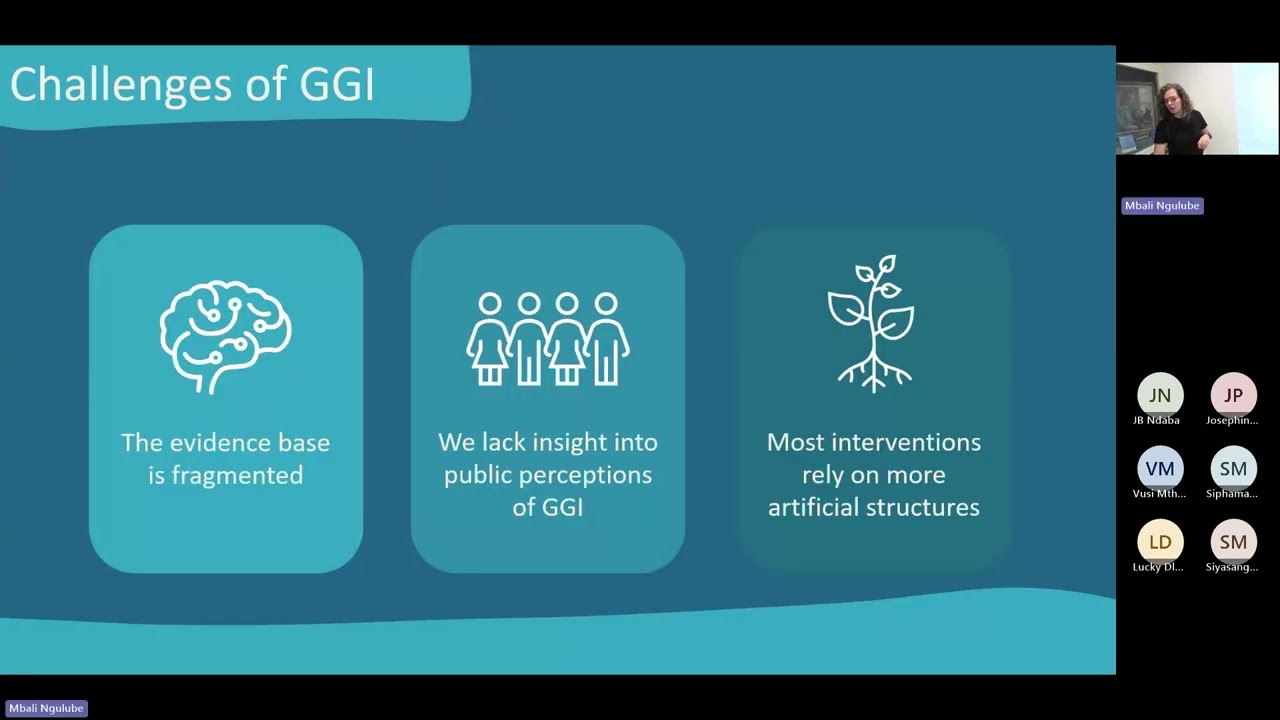
- Key challenges: fragmented evidence base
- Systematic review and meta-analysis protocol
- Public perceptions study in Plymouth
- Nature-based solutions using Amzy and mussels
- Preliminary results from field experiment
Cited Sources
- University of Plymouth — Institution where Jessica Allen is based
- NRF-SAIAB — Host institution for the seminar
Concurring Sources
- Living Seawalls — Example of GGI implementation in Australia
Contribution & Novelties
The presentation offers a comprehensive overview of the current state of greening of grey infrastructure, highlighting the need for a systematic synthesis of evidence and the integration of public perceptions. The speaker’s ongoing research, including a systematic review and a field experiment using traditional Amzy fibers, contributes novel approaches to the field.
Pour aller plus loin :
- Ecological Engineering — Relevant to the concept of designing with nature.
- Marine ecosystem services — Context for the benefits of biodiversity.
- Nature-based solutions — Framework for the approach discussed.
86 words
Radar Profile
The radar profile shows balanced scores across information quantity, quality, technical level, and reliability, with a slight emphasis on information quality and technical level, reflecting the seminar's academic nature.