SAIAB Seminar Series 2026: Professor Pete McIntyre
Keywords
Summary
88 words
Critical Evaluation
Value of the Information & Strength of the Argument
The presentation provides valuable insights into the impacts of environmental changes on lake fisheries, supported by extensive field and lab data. The argumentation is solid, with clear logical progression from problem identification to potential solutions. The speaker effectively combines multiple lines of evidence, including sensor technologies and genomics, to strengthen his points.
61 words
Title / Content Match
The title accurately reflects the content, which is a seminar presentation by Professor Pete McIntyre on fisheries research.
Quality & Reliability
8/10
The speaker is a professor at Cornell University with over 150 peer-reviewed papers and 26,000 citations. The presentation is based on extensive field research and published studies, though it is a seminar talk rather than a peer-reviewed publication.
Key Moments
Markers derived by PSI from the transcript: the creator did not define chapters.
- Introduction of Professor Pete McIntyre and his research background.
- Overview of the three vignettes: brook trout, invasive bass, and aquaculture.
- Discussion of lake warming and deoxygenation trends.
- Explanation of browning and its effects on lake stratification and oxygen.
- Habitat compression for brook trout due to browning.
- Lab experiments on brook trout thermal and oxygen tolerances.
- Field tracking of brook trout with acoustic tags.
- Invasive smallmouth bass removal program in Adirondack lakes.
- Evolutionary adaptations of bass to high mortality.
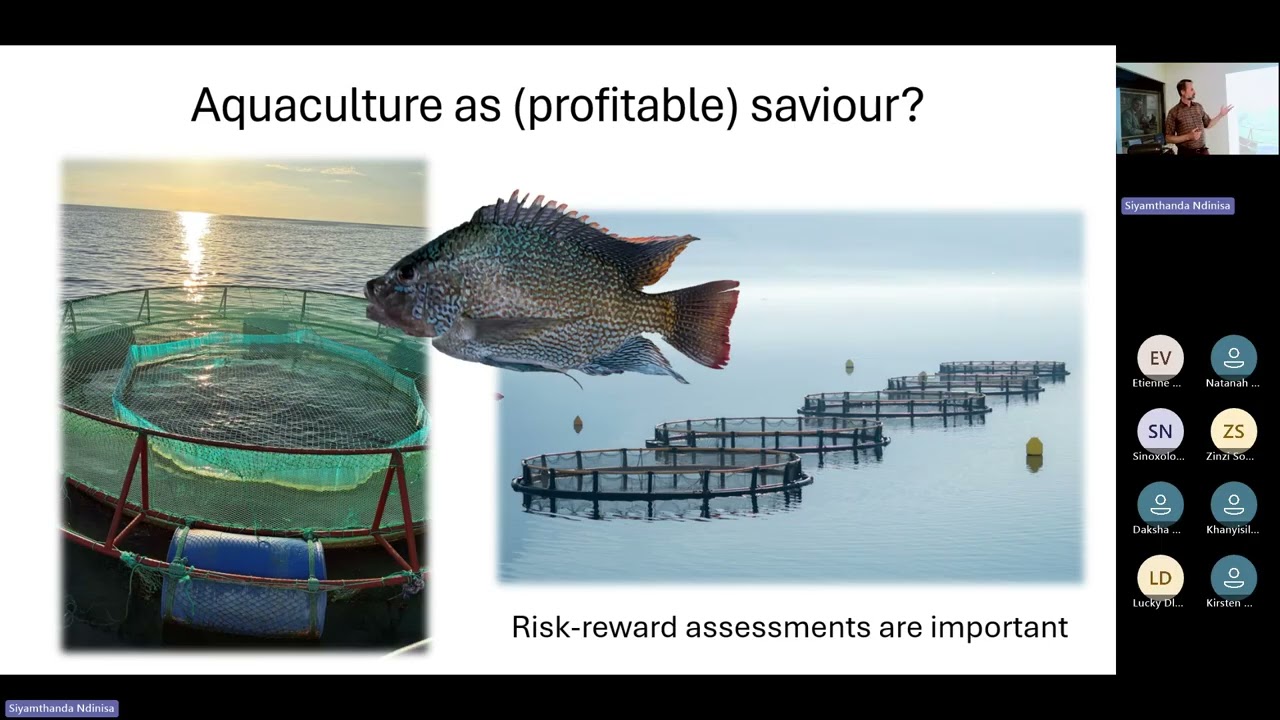
- Aquaculture expansion in Lake Tanganyika and eDNA use.
Cited Sources
- Arlinghaus et al. synthesis on recreational fisheries — Referenced in the talk as a graphic on recreational fisheries.
- Jane et al. on lake browning — Work led by Steve Jane on browning and deoxygenation.
Concurring Sources
- Jane et al. 2021 on lake browning — Referenced as key work on browning.
Contribution & Novelties
The talk provides a comprehensive overview of ongoing research on lake fisheries, integrating physiological, ecological, and genomic approaches. It highlights novel findings on habitat compression due to browning and the evolutionary challenges of invasive species control. The use of eDNA for aquaculture siting is a forward-looking application.
Pour aller plus loin :
- Lake browning and dissolved organic carbon — Relevant to the browning phenomenon discussed.
- Smallmouth bass invasive species — Background on the invasive species.
- Environmental DNA (eDNA) — Technique used for aquaculture siting.
84 words
Radar Profile
The radar profile shows high scores in information quantity, quality, and reliability, with a slightly lower technical level, indicating a well-supported but accessible presentation.