SAIAB Seminar Series 2026: Dr Danai Kontou, James Hodson & Emma Baker
Keywords
Summary
190 words
Critical Evaluation
Value of the Information & Strength of the Argument
The value of the information is high, as it presents novel, field-collected data on an invasive species in a protected area, which is crucial for conservation planning. The argumentation is solid, with clear methodology and logical interpretation of results. The speakers acknowledge limitations, such as detection uncertainty and the preliminary nature of some findings, which strengthens their credibility. They also integrate multiple lines of evidence, including morphology, catch rates, and environmental factors, to support their conclusions about spread and impact.
Scientific Rigor, Source Quality, Title Accuracy
The scientific rigor is good: the research is based on systematic surveys, standardized methods, and statistical analyses. However, the video does not cite specific external sources, and the findings are not yet published in peer-reviewed journals, so the quality of sources is moderate. The title accurately reflects the content, as it is a seminar series with three presentations. The adequacy between title and content is high, with no misleading elements.
165 words
Title / Content Match
The title accurately reflects the content: a seminar series with three speakers presenting on redclaw crayfish invasion in Kruger National Park.
Quality & Reliability
8/10
The seminar presents original research data from field surveys, with clear methodology and peer-reviewed context. The speakers are experts in invasion ecology, and the content is consistent with scientific standards. However, some claims are preliminary and based on limited data, and no external sources are cited in the video.
Key Moments
Markers derived by PSI from the transcript: the creator did not define chapters.
- Introduction by host, Luba, and overview of the seminar structure.
- Dr Danai Kontou begins her talk on redclaw crayfish biology and invasion history.
- Kontou presents survey methods and catch per unit effort data.
- Kontou discusses spread rates and population increases between 2024 and 2025.
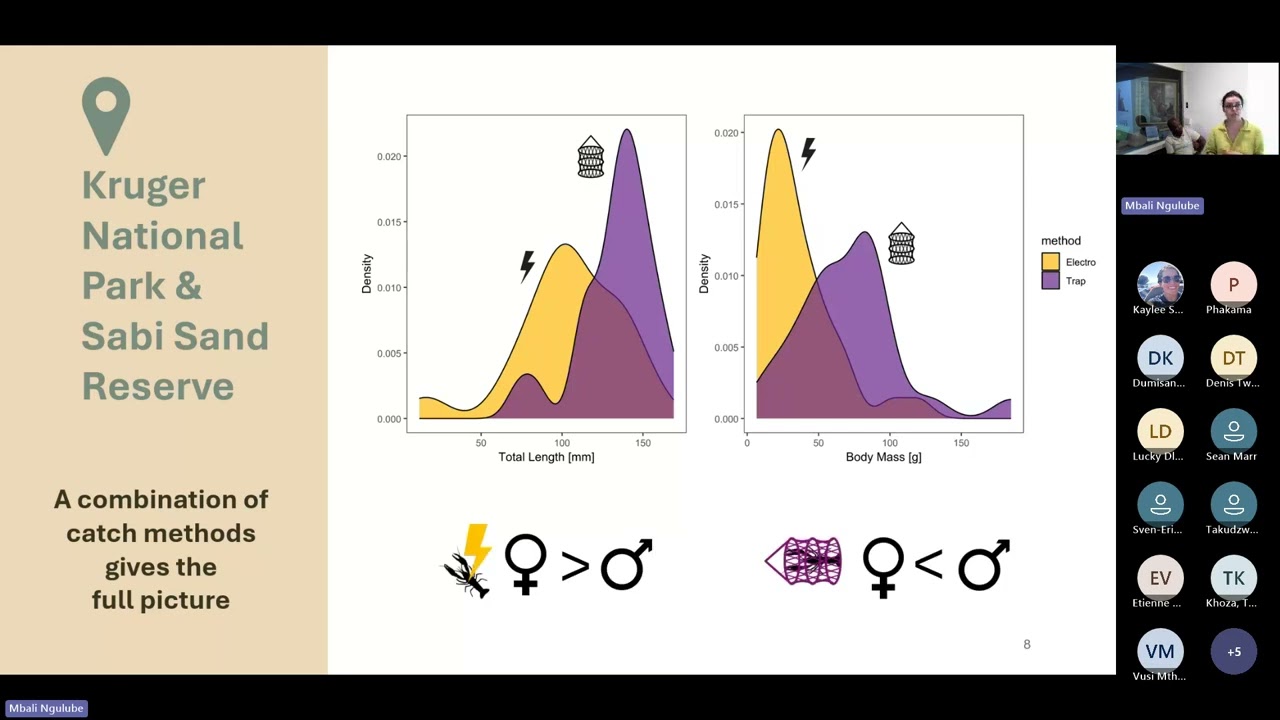
- Kontou highlights biases in trapping methods and the need for combined methods.
- James Hodson presents on the impacts of crayfish on fish communities.
- Emma Baker discusses macroinvertebrate monitoring and ecosystem-level impacts.
- Discussion and Q&A session on management strategies and challenges.
Contribution & Novelties
This seminar provides original data on the spread and impact of redclaw crayfish in Kruger National Park, a region where such information was previously lacking. The combination of population dynamics, morphological analysis, and community-level impacts offers a comprehensive view of the invasion. The finding that trapping methods bias towards larger males is particularly novel and has practical implications for management.
Pour aller plus loin :
- Redclaw crayfish (Cherax quadricarinatus) - Wikipedia — Provides background on the species’ biology and invasive status.
- Invasive species management - IUCN — Offers guidelines and strategies for managing invasive species.
- Environmental DNA (eDNA) for monitoring aquatic invasions - Nature — Discusses the potential and limitations of eDNA for detecting invasive species.
116 words
Radar Profile
The radar profile shows high scores in information quantity, quality, and reliability, with a slightly lower technical level, indicating a seminar that is rich in data and scientifically sound but accessible to a broader audience.