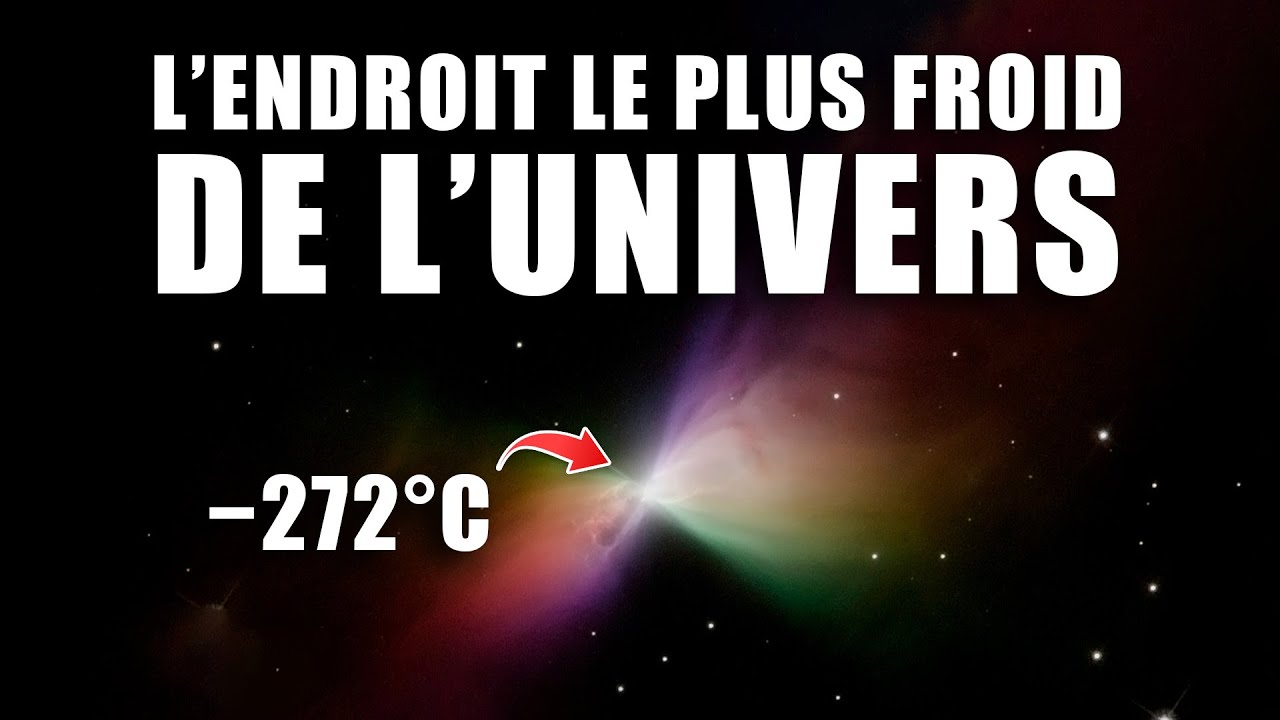
L'endroit le plus froid de tout l'univers - Documentaire 2025
Keywords
Summary
142 words
Critical Evaluation
Value of the Information & Strength of the Argument
The video provides valuable information about a unique astronomical object, explaining the physics behind its extreme cold in an accessible way. The argumentation is solid, building from basic concepts of temperature to the specific mechanisms of the Boomerang Nebula. The use of analogies, such as comparing the nebula to a refrigerator, helps convey the scientific principles effectively. The explanation of the common envelope binary phase is particularly insightful, as it is a complex and rarely discussed topic. The video also acknowledges the limitations of current knowledge, such as the uncertainty about the nebula’s future evolution, which adds to its credibility.
Scientific Rigor, Source Quality, Title Accuracy
The video demonstrates scientific rigor by referencing reputable sources, including ESA/Hubble and NASA. The information presented aligns with current astrophysical understanding. The title accurately reflects the content, as the video indeed focuses on the coldest place in the universe. The documentary is well-structured, with a clear narrative that guides the viewer through the topic. The use of visuals and music enhances the presentation without compromising scientific accuracy.
182 words
Title / Content Match
The title accurately reflects the content, focusing on the coldest known place in the universe.
Quality & Reliability
8/10
The video presents a well-structured explanation of the Boomerang Nebula, relying on established astrophysical concepts and referencing credible sources such as ESA/Hubble and NASA. The scientific content is accurate, though some simplifications are made for a general audience.
Key Moments
Markers derived by PSI from the transcript: the creator did not define chapters.
- Introduction to the Boomerang Nebula and its extreme cold.
- Explanation of temperature and absolute zero.
- Discovery of the Boomerang Nebula's temperature in 1995.
- Comparison with a refrigerator to explain the cooling mechanism.
- Introduction of the common envelope binary system.
- Discussion of the possible future of the Boomerang Nebula.
- Comparison with laboratory experiments and conclusion.
Cited Sources
- Boomerang Nebula - ESA/Hubble — Image of the Boomerang Nebula captured by the Hubble Space Telescope.
- NASA Presentation on Merger-Driven Transients — Scientific presentation discussing merger-driven transients, relevant to the common envelope binary evolution.
Concurring Sources
- Boomerang Nebula - ESA/Hubble — The image and description from ESA/Hubble confirm the nebula's appearance and location.
External References
Contribution & Novelties
The video offers a fresh perspective on a relatively obscure astronomical object, making it accessible to a broad audience. It explains the concept of a common envelope binary in a clear and engaging manner, which is rarely covered in popular science media. The documentary also highlights the Boomerang Nebula as a natural laboratory for studying extreme cooling processes.
Pour aller plus loin :
- Boomerang Nebula - Wikipedia — Provides a comprehensive overview of the nebula’s properties and discovery.
- Common envelope - Wikipedia — Explains the astrophysical process of common envelope evolution.
- Cosmic microwave background - Wikipedia — Background on the radiation that sets the temperature floor in space.
108 words
Radar Profile
The radar profile shows high scores in information quantity and quality, with a moderate technical level. This indicates a well-balanced documentary that is both informative and accessible, with a strong emphasis on reliable scientific content.
💬 Très positif. Sur les 30 commentaires analysés, les spectateurs expriment un enthousiasme marqué pour le nouveau format documentaire, saluant la qualité de la réalisation, le sound design et la clarté des explications.