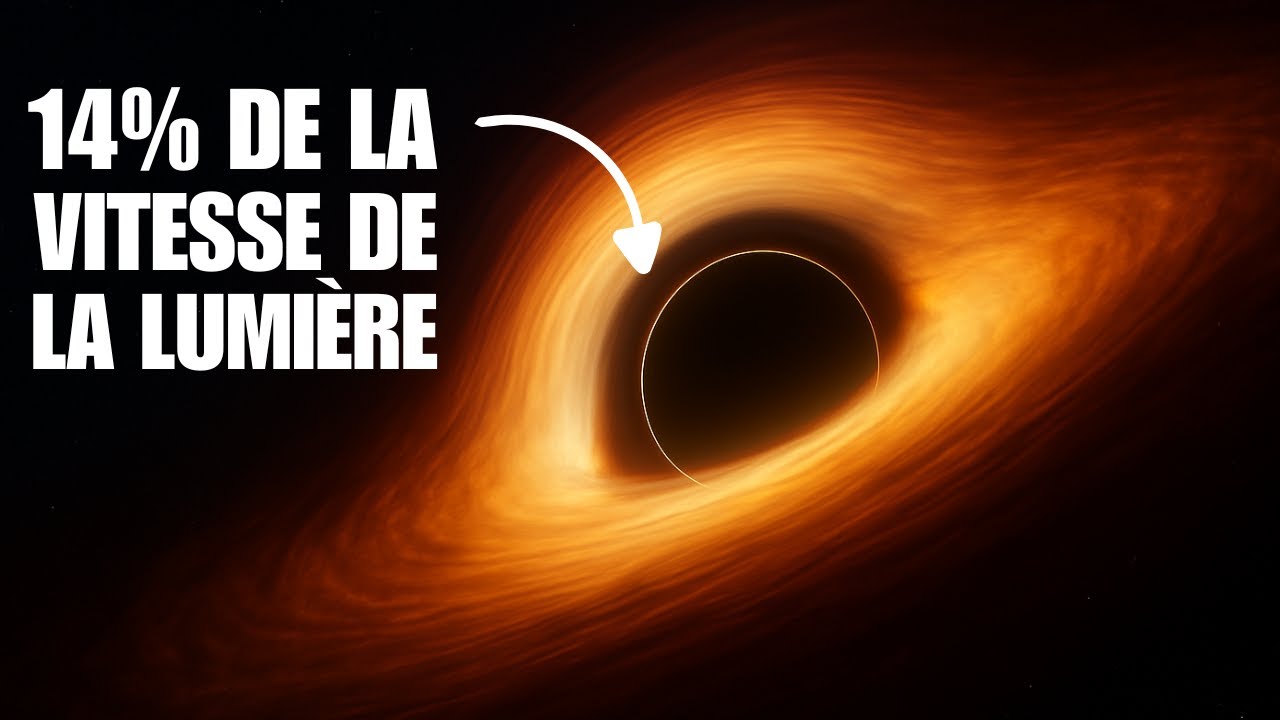
Le TROU NOIR de M87 tourne à une VITESSE TERRIFIANTE !
Keywords
Summary
204 words
Critical Evaluation
Value of the Information & Strength of the Argument
The video provides valuable and up-to-date information on several space topics, with a clear focus on recent scientific results and industry developments. The discussion of M87* is well-structured, explaining the significance of the measurements and their implications for our understanding of black holes. The segment on Alpha Impulsion offers a clear explanation of the autophage engine concept and its potential advantages, while also acknowledging the technical challenges. The argumentation is generally solid, with claims supported by references to sources such as the arXiv paper and SpaceNews. However, some technical details are simplified for a general audience, and the video does not delve deeply into the methodologies behind the measurements. The presentation is engaging and accessible, making complex topics understandable without oversimplifying the core science.
Scientific Rigor, Source Quality, Title Accuracy
The video demonstrates a good level of scientific rigor by citing relevant sources, including the arXiv preprint for the M87* study, a SpaceNews article on NASA budget impacts, and a European Spaceflight article on the Mission Possible recovery vessel. The sources are credible and directly related to the topics discussed. The title accurately reflects the main content, focusing on the black hole’s rotation, which is a central theme. The video also includes a brief sponsorship segment, which is clearly indicated. Overall, the sourcing is transparent and appropriate for a science communication format.
231 words
Title / Content Match
The title accurately reflects the main topic, though it emphasizes the black hole's spin, which is a key finding but not the only subject covered.
Quality & Reliability
8/10
The video presents recent scientific results on M87* with a link to the arXiv paper, and discusses European space news with sources from SpaceNews and European Spaceflight. The information is generally accurate and well-contextualized, though the presentation is popularized and some details are simplified.
Key Moments
Markers derived by PSI from the transcript: the creator did not define chapters.
- Introduction to the episode's topics: M87* black hole, Alpha Impulsion autophage rocket, and NASA budget impacts.
- Discussion of Sagittarius A* and the extreme speeds of stars around it.
- Introduction to M87* and its characteristics, including mass and distance.
- Explanation of the Event Horizon Telescope image and the measurement of the accretion disk's rotation speed.
- Details on the calculated speeds: 14% and 23% of light speed, and implications for the black hole's spin.
- Discussion of the black hole's low accretion rate and its significance.
- Introduction to Alpha Impulsion and the autophage rocket engine concept.
- Description of the successful test of the autophage engine, highlighting the use of hydraulic cylinders and structural integrity.
- Overview of Alpha Impulsion's future plans, including the Opal engine and the Grena launch vehicle.
- Discussion of the Mission Possible capsule launch and the potential impact of NASA budget cuts on European missions.
Cited Sources
- M87* paper on arXiv — Source for the measurements of M87*'s accretion disk speed and spin.
- The Exploration Company launches Mission Possible recovery vessel — Source for the Mission Possible capsule launch and recovery plans.
- ESA studying impacts of proposed NASA budget cuts — Source for the potential effects of NASA budget cuts on European space missions.
Concurring Sources
- M87* paper on arXiv — Directly supports the claims about M87*'s rotation speed.
- ESA studying impacts of proposed NASA budget cuts — Supports the discussion on the impact of NASA budget cuts on European missions.
External References
Contribution & Novelties
The video provides a concise and accessible summary of recent developments in astrophysics and space industry, particularly the new measurements of M87*’s rotation speed and the progress of autophage rocket technology. It highlights the significance of these findings for our understanding of extreme gravity and the future of space exploration. The discussion of the potential impact of NASA budget cuts on European missions adds a timely geopolitical dimension.
Pour aller plus loin :
- Event Horizon Telescope — Official site of the collaboration that imaged M87* and Sgr A*.
- Autophage rocket engine — Wikipedia article on the concept of self-eating rockets.
- LISA mission — NASA page on the Laser Interferometer Space Antenna, a gravitational wave observatory mentioned in the video.
119 words
Radar Profile
The radar profile shows high scores in information quantity and quality, with a moderate technical level. This indicates a well-informed and reliable video that is accessible to a general audience, though it does not delve into highly technical details. The overall balance suggests a strong science communication piece.
💬 Très positif. Sur les 30 commentaires analysés, les spectateurs expriment une grande appréciation pour la vidéo, saluant la qualité de la vulgarisation et l'intérêt des sujets abordés, avec des remerciements adressés à Maxime et Hugo.