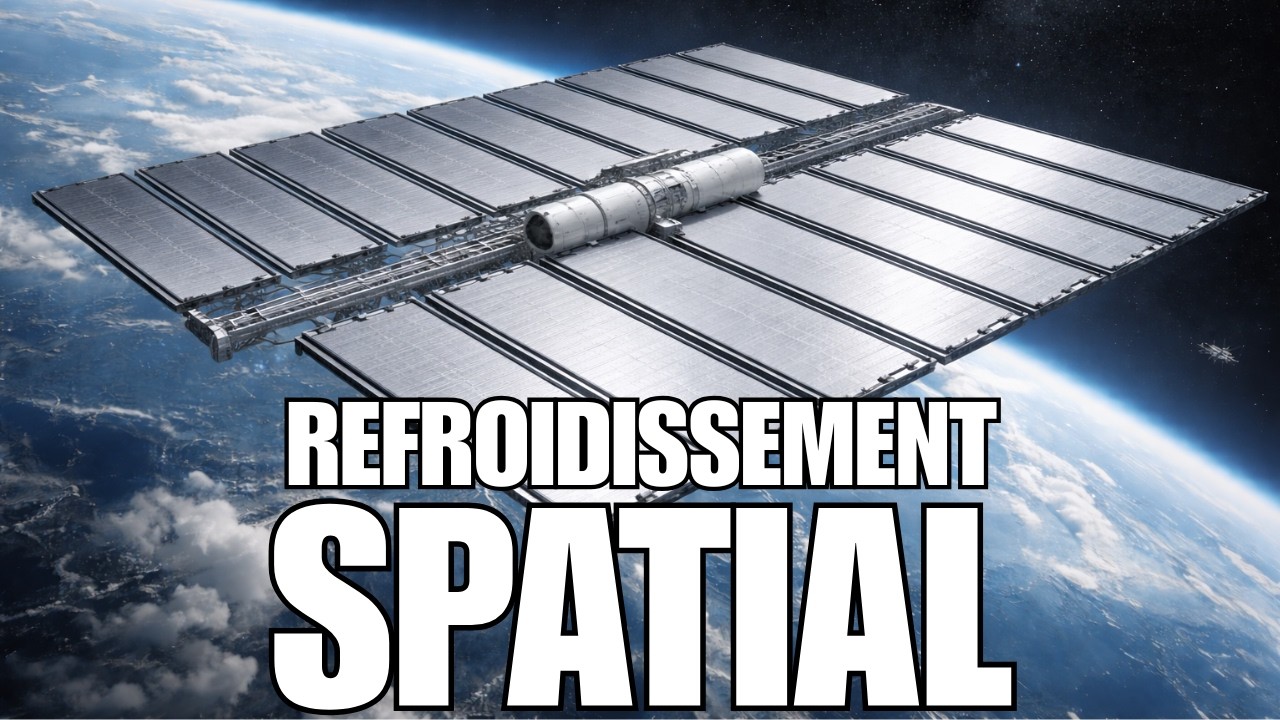
Le problème THERMIQUE qui freine les ambitions spatiales de l'Humanité !
Keywords
Summary
153 words
Critical Evaluation
Value of the Information & Strength of the Argument
The video provides valuable insights into a less-publicized but crucial aspect of space engineering. It effectively explains the physical principles and their practical implications, making a strong case for why thermal management is a key challenge. The argumentation is logical and well-structured, progressing from basic physics to specific applications and potential solutions. The use of concrete examples, such as the ISS and SpaceX’s AI Mini, helps ground the discussion. However, the video could have delved deeper into the quantitative aspects and trade-offs of different cooling technologies.
Scientific Rigor, Source Quality, Title Accuracy
The video demonstrates scientific rigor by referencing authoritative sources like NASA and ESA, and it correctly identifies the fundamental physical constraints. The title accurately reflects the content, and the video stays on-topic throughout. The sources cited are relevant and credible, though the video does not provide a comprehensive review of all ongoing research. The adéquation between title and content is excellent, with no misleading elements.
166 words
Title / Content Match
The title accurately reflects the content, which focuses on the thermal challenges limiting space ambitions and the innovative solutions being developed.
Quality & Reliability
8/10
The video provides a clear and accurate explanation of the fundamental physics of heat transfer in space, supported by references to NASA and ESA sources. It correctly identifies the challenges and discusses current and emerging solutions, though it remains at a general level without deep technical detail.
Key Moments
Markers derived by PSI from the transcript: the creator did not define chapters.
- Introduction to the thermal challenge in space
- Explanation of the three heat transfer modes and why radiation is key in space
- Discussion on the ISS radiators and their operation
- Challenges for nuclear reactors and data centers in orbit
- Innovations in materials and two-phase loops
- Deployable radiator architectures and future spacecraft design
Cited Sources
- NASA SmallSat Thermal Control — Referenced as a source for thermal control technologies in small satellites.
- ESA Materials News - Haddad — Referenced as a source for materials research relevant to thermal control.
- European Commission Research Document — Referenced as a source for European research on thermal management.
Concurring Sources
- NASA SmallSat Thermal Control — Supports the discussion on thermal control technologies and their evolution.
External References
Contribution & Novelties
The video brings attention to a critical yet often overlooked aspect of space engineering, synthesizing current challenges and emerging solutions in thermal management. It effectively bridges the gap between fundamental physics and practical engineering, making the topic accessible to a broader audience.
Pour aller plus loin :
- Thermal control of spacecraft — Provides a comprehensive overview of thermal control methods and challenges.
- Heat pipe — A key technology for efficient heat transport in space, related to two-phase loops.
- Radiator (heat transfer) — Explains the principles of radiative heat transfer, relevant to spacecraft radiators.
93 words
Radar Profile
The radar profile shows high scores in information quantity and quality, with a moderate technical level. This indicates a well-researched and informative video that is accessible to a general audience while still providing substantial depth. The lower technical score suggests that while the content is accurate, it does not delve into highly specialized details.
💬 Positif. Sur les 30 commentaires analysés, les spectateurs expriment majoritairement leur appréciation pour la clarté et la pédagogie de la vidéo, tout en soulevant des questions techniques et des préoccupations sur les risques spatiaux comme le syndrome de Kessler.