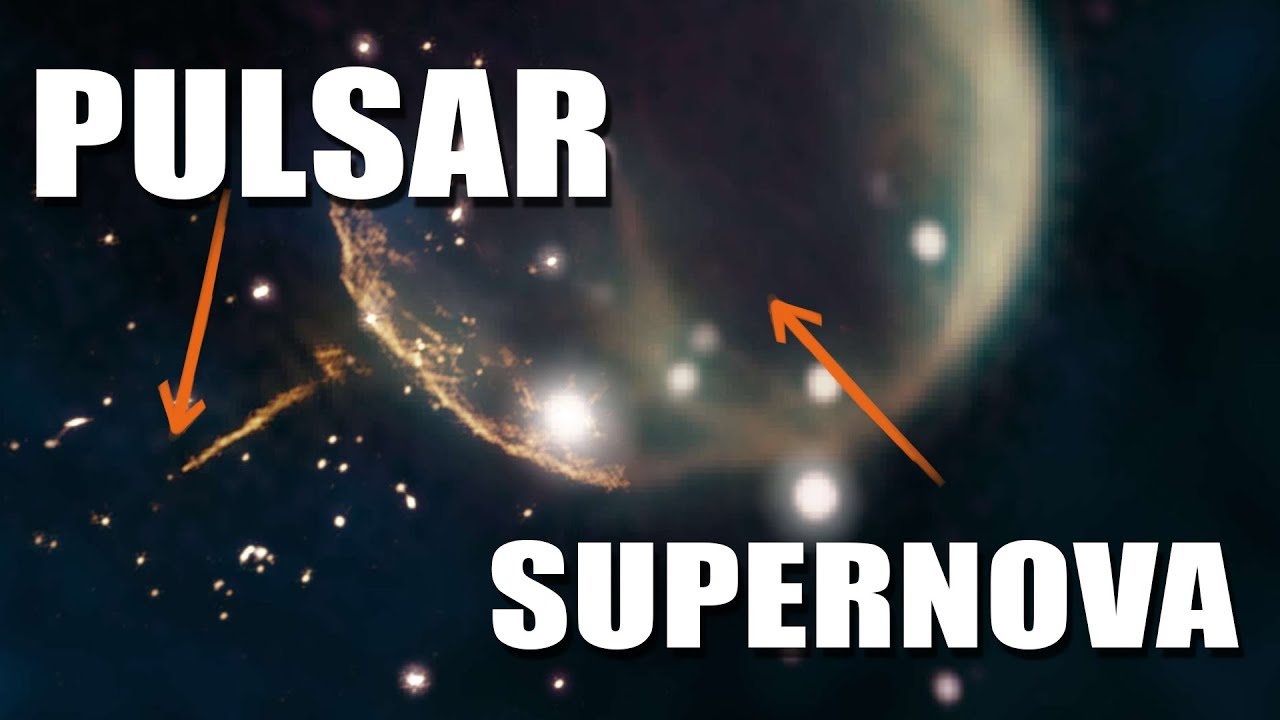
Un Pulsar catapulté par une SuperNova ! DNDE #100
Keywords
Summary
178 words
Critical Evaluation
Value of the Information & Strength of the Argument
The video provides valuable information by synthesizing recent space news with clear scientific explanations. The argumentation is solid, particularly in the pulsar segment, where the physics of supernovae and pulsars is accurately described, and the significance of the pulsar’s speed is contextualized. The discussion on NASA’s 2024 Moon goal is balanced, acknowledging both the political motivations and the technical challenges. The Franco-Chinese cooperation is presented factually, with implications for international space politics. The video maintains a neutral tone and supports claims with references to official sources.
Scientific Rigor, Source Quality, Title Accuracy
The video demonstrates strong scientific rigor by citing reputable sources such as NASA, NRAO, SpaceNews, and CNES. The sources are directly relevant to the topics discussed, and the video encourages viewers to consult them for more details. The title accurately reflects the content, focusing on the pulsar story, which is the most detailed segment. The video’s structure is clear, and the information is presented in an engaging yet accurate manner.
171 words
Title / Content Match
The title accurately reflects the main topic of the video, which focuses on a pulsar ejected by a supernova, and the episode number is correctly indicated.
Quality & Reliability
8/10
The video presents a well-structured summary of recent space news, citing official sources (NASA, NRAO, CNES, SpaceNews) and providing accurate scientific explanations of the pulsar phenomenon. The information is reliable and up-to-date as of the publication date, with clear references for further reading.
Key Moments
Markers derived by PSI from the transcript: the creator did not define chapters.
- Introduction and celebration of the 100th episode, with a special making-of announced for Thursday.
- Explanation of supernovae and pulsars, leading to the discovery of pulsar J0002+6216.
- Details on the pulsar's extreme speed and the mystery of its ejection mechanism.
- Discussion on Mike Pence's announcement to return to the Moon by 2024 and its feasibility.
- Analysis of the strategic implications and potential budget increases for NASA.
- Coverage of the Franco-Chinese space cooperation, including Chang'e 6 and Earth observation missions.
- Mention of the failed OneSpace launch and the state of China's private space sector.
Cited Sources
- Cannonball Pulsar — Source for the discovery and speed of pulsar J0002+6216.
- NASA's Fermi Satellite Clocks 'Cannonball' Pulsar Speeding Through Space — NASA article about the pulsar's speed and the Fermi telescope data.
- Pence calls for human return to the Moon by 2024 — SpaceNews article on Mike Pence's announcement.
- Military space gets big boost in Pentagon's $750 billion budget — Source for the increase in military space budget.
- State visit of France President Xi Jinping: France set to fly to the Moon with China — CNES press release about the Franco-Chinese space agreement.
- Maiden launch of OneSpace OS-M rocket fails — Article about the failed OneSpace launch.
Concurring Sources
- Cannonball Pulsar — Confirms the pulsar's speed and discovery details.
- NASA's Fermi Satellite Clocks 'Cannonball' Pulsar Speeding Through Space — Confirms the pulsar's speed and the Fermi data.
External References
Contribution & Novelties
The video provides a concise and accessible summary of recent space news, with a particular focus on the intriguing pulsar J0002+6216, which was recently discovered and is notable for its extreme velocity. It also highlights the geopolitical dimensions of space exploration, such as the US-China rivalry and international cooperation. The video adds value by explaining complex astrophysical concepts in an understandable way, making it a good resource for science communication.
Pour aller plus loin :
- Pulsar — Overview of pulsars, their properties, and discovery.
- Supernova — Explanation of supernova types and mechanisms.
- Chang’e 6 — Information about the Chinese lunar sample-return mission.
- Artemis program — NASA’s current lunar exploration program, which evolved from the 2024 goal.
116 words
Radar Profile
The radar profile shows high scores in information quantity, quality, and reliability, with a slightly lower technical level, indicating that the video is well-researched and informative but accessible to a general audience. The balance between these dimensions suggests a solid science communication piece.
💬 Très positif. Sur les 30 commentaires analysés, les spectateurs expriment majoritairement leur enthousiasme pour le 100ème épisode, félicitent les créateurs pour leur travail de qualité et manifestent leur attachement à la chaîne.