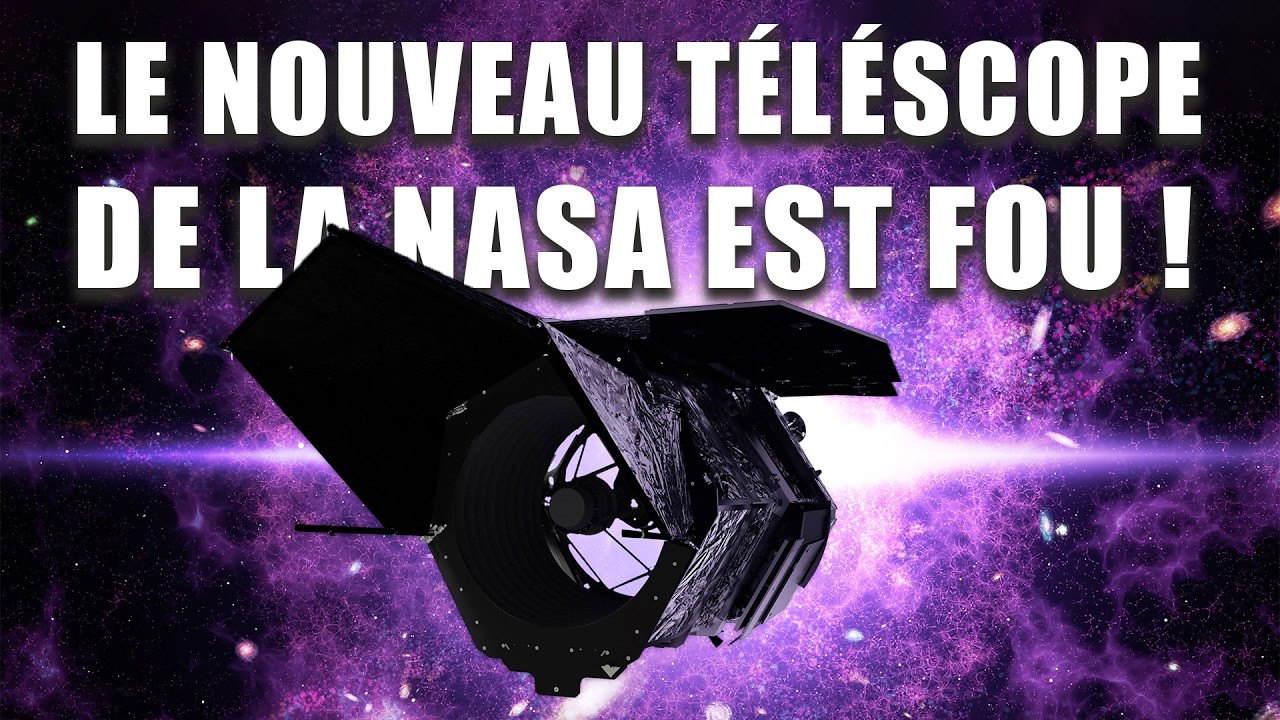
La NASA présente son nouveau TÉLÉSCOPE qui va RÉVOLUTIONNER L'ASTRONOMIE !
Keywords
Summary
181 words
Critical Evaluation
Value of the Information & Strength of the Argument
The video provides substantial information about the Nancy Grace Roman telescope, covering its history, technical specifications, scientific objectives, and expected discoveries. The argumentation is solid, explaining complex concepts like weak lensing, coronagraphy, and microlensing in an accessible manner. The host also contextualizes the mission within the broader landscape of astronomical surveys, emphasizing complementarity with Euclid and Vera Rubin. The presentation is engaging and logically structured, building from the telescope’s origin to its potential impact on cosmology and exoplanet research.
Scientific Rigor, Source Quality, Title Accuracy
The video cites official sources from NASA and ESA, which are listed in the description. The information appears accurate and up-to-date, with appropriate caveats about uncertainties (e.g., primordial black holes). The title is somewhat sensationalist but the content is scientifically sound. The host clearly distinguishes between confirmed facts and speculative hypotheses, enhancing the video’s credibility. The adéquation between title and content is good, as the video does discuss a revolutionary telescope, though the title’s hyperbole is not fully matched by the measured tone of the presentation.
180 words
Title / Content Match
The title is somewhat sensationalist ('REVOLUTIONNER L'ASTRONOMIE') but the content does discuss a major upcoming telescope, so it is broadly appropriate.
Quality & Reliability
8/10
The video is well-structured, based on official NASA and ESA sources, and presents technical details accurately. The host clearly distinguishes facts from hypotheses and mentions the mission's history, including budget and schedule changes. The content is reliable for a general audience, though some simplifications are made.
Key Moments
Markers derived by PSI from the transcript: the creator did not define chapters.
- Introduction: presentation of the Nancy Grace Roman telescope and its upcoming launch.
- Origin story: donation of two spy telescope mirrors by the NRO to NASA.
- Adaptation of the WFIRST mission and addition of a coronagraph.
- Mission architecture: 2.4m mirror, infrared observations, L2 orbit.
- Primary science: dark energy survey using weak lensing and BAO.
- Exoplanet direct imaging with coronagraph and technology demonstration.
- Microlensing survey for exoplanets and primordial black holes.
- Data challenges and AI; complementarity with Euclid and Vera Rubin.
Cited Sources
- Roman Space Telescope - NASA Science — Official NASA mission page for the Nancy Grace Roman Space Telescope.
- Observatory Microlensing and Binary Self-Lensing with Roman and with Rubin — NASA page detailing microlensing science with Roman and Rubin.
- Roman factsheet - ESA — ESA factsheet on the Roman mission.
Concurring Sources
- Roman Space Telescope - NASA Science — NASA's official page confirms the mission's objectives and status.
- Roman factsheet - ESA — ESA provides complementary information on the mission.
External References
Contribution & Novelties
The video provides a comprehensive overview of the Nancy Grace Roman telescope, highlighting its unique capabilities and scientific goals. It explains how the telescope’s wide field of view and infrared sensitivity will enable groundbreaking surveys of dark energy and exoplanets. The discussion of microlensing for detecting free-floating planets and primordial black holes is particularly insightful, as it showcases the telescope’s potential to address fundamental questions in cosmology. The video also emphasizes the synergy with other observatories like Euclid and Vera Rubin, illustrating a new era of coordinated astronomical surveys.
Pour aller plus loin :
- Nancy Grace Roman Space Telescope - Wikipedia — Provides detailed technical and historical background.
- Weak gravitational lensing - Wikipedia — Explains the technique used to study dark matter and dark energy.
- Gravitational microlensing - Wikipedia — Overview of the method used to detect exoplanets and other objects.
- Habitable Worlds Observatory - Wikipedia — Future NASA mission that Roman’s coronagraph will help enable.
156 words
Radar Profile
The radar profile shows high scores across all dimensions, indicating a well-rounded and reliable video. The strongest aspects are the quantity and quality of information, with a slightly lower but still solid technical level. The overall reliability is high, reflecting the use of official sources and accurate presentation.
💬 Très positif : Sur les 30 commentaires analysés, l'enthousiasme domine, avec des remerciements pour la qualité de la vidéo et l'excitation pour les futures découvertes. Aucun commentaire négatif ou critique n'a été relevé.