Act like you mean it
Keywords
Summary
136 words
Critical Evaluation
Value of the Information & Strength of the Argument
The video offers valuable insights into the neuroscience of emotions and acting, presenting scientific findings in an accessible manner. The argumentation is balanced, with both speakers providing compelling points. Grunwald’s explanations of amygdala activity and dopamine’s role are well-founded, while Rey’s emphasis on theatrical techniques and the history of acting theory provides a complementary perspective. The live demonstrations and film clips effectively illustrate the concepts discussed. However, the format is more of a public engagement event than a rigorous scientific presentation, and some claims could benefit from more detailed citations.
Scientific Rigor, Source Quality, Title Accuracy
The scientific content is generally rigorous, drawing on established neuroscience research, but specific sources are not cited within the video. The speakers are credible experts, and the information aligns with current understanding. The title accurately reflects the content, focusing on the authenticity of actors’ emotions. The video does not provide a detailed reference list, but the discussion is informed by the speakers’ expertise. The adequacy between title and content is strong, as the performance directly addresses the question of whether actors ‘mean it’.
188 words
Title / Content Match
The title 'Act like you mean it' aptly captures the central question of whether actors genuinely feel emotions or merely simulate them, which is the core of the lecture performance.
Quality & Reliability
7/10
The video presents a debate between a neuroscientist and a theater scholar, combining scientific findings with artistic perspectives. The scientific content is based on established neuroscience (e.g., amygdala responses to eye contact, reward system), but the format is a lecture performance, not a peer-reviewed study. The sources are not explicitly cited in the video, but the speakers are experts in their fields.
Key Moments
Markers derived by PSI from the transcript: the creator did not define chapters.
- Introduction by the moderator, setting up the debate between neuroscience and theater.
- Thomas Grunwald explains the role of the hippocampus and amygdala in memory and emotions.
- Anton Rey discusses the history of acting theory, referencing Diderot and Stanislavski.
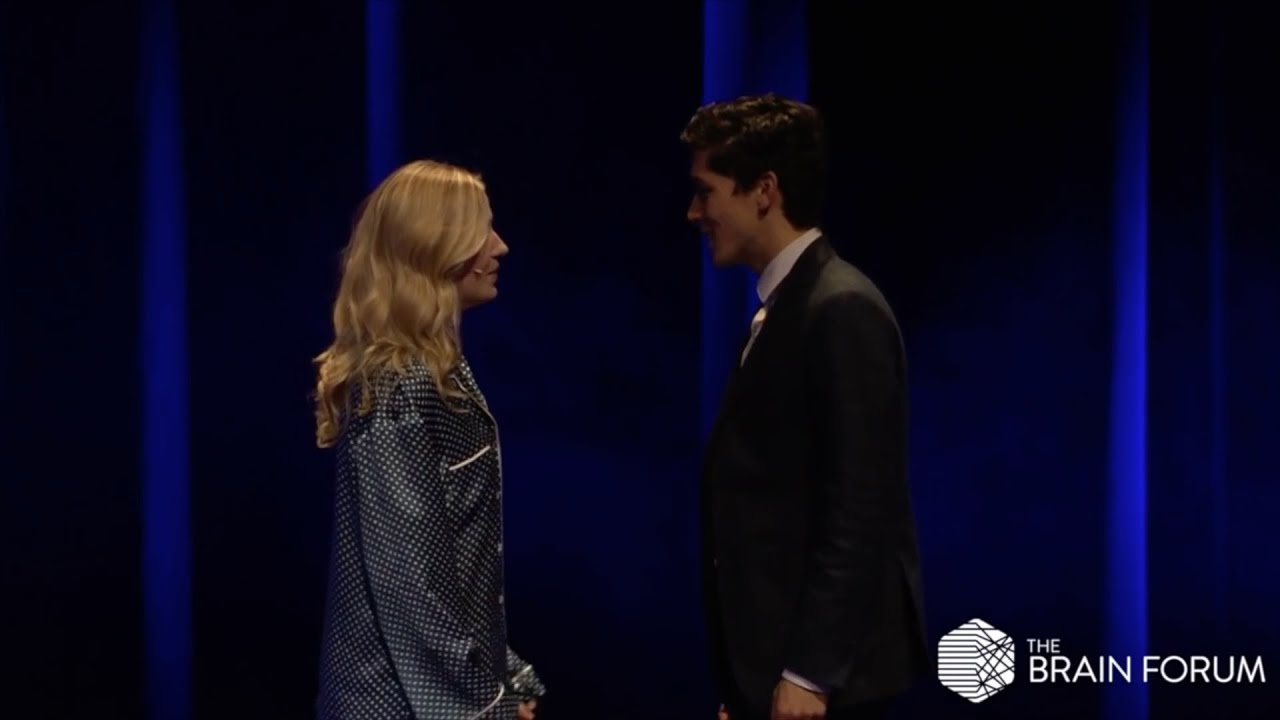
- Live rehearsal of the balcony scene with actors Annina Euling and Jan Beller.
- Grunwald presents data on amygdala responses to eye contact, showing gender differences.
- Discussion of the reward system and dopamine's role in romantic attraction and risk-taking.
- Conclusion and final thoughts on the intersection of art and science.
Cited Sources
- The Brain Forum — Official website of the event, mentioned in the video description.
Concurring Sources
- The Brain Forum — The event's website provides context for the lecture performance.
Contribution & Novelties
The video provides a unique interdisciplinary perspective on the neuroscience of acting, combining live performance with scientific analysis. It offers a novel approach to popularizing neuroscience by using Shakespeare’s Romeo and Juliet as a case study. The discussion of amygdala responses to eye contact and the role of dopamine in romantic attraction is presented in an engaging manner. The video also highlights the ‘Romeo and Juliet effect’ (adversity heightens passion) as a real phenomenon.
Pour aller plus loin :
- Amygdala — Key brain region involved in emotional processing, central to the discussion.
- Dopamine — Neurotransmitter associated with reward and motivation, discussed in the context of romantic attraction.
- Method acting — Acting technique that emphasizes emotional authenticity, relevant to the debate on actors’ emotions.
123 words
Radar Profile
The radar profile shows a balanced performance across all dimensions, with slightly higher scores in quality of information and reliability, reflecting the expert speakers and scientific basis. The lower score in technical level indicates that the content is accessible to a general audience, while still providing depth.
💬 Sur les 0 commentaires analysés, aucune tendance n'est disponible.