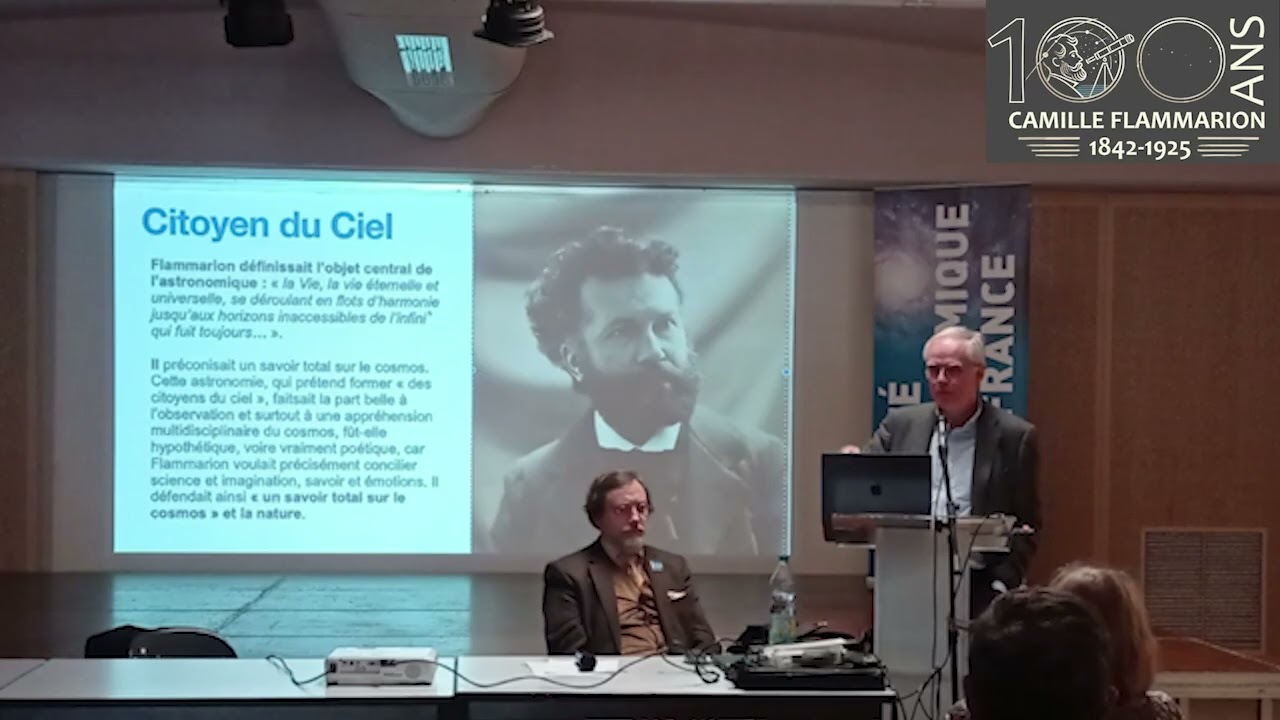
Symposium Camille FLAMMARION (audio uniquement)
Keywords
Summary
136 words
Critical Evaluation
Value of the Information & Strength of the Argument
The value of the information lies in its historical and scientific perspective on Camille Flammarion’s contributions. The argumentation is solid, grounded in the speakers’ expertise and the context of the centenary. The presentations provide insights into Flammarion’s pioneering work in planetology and science popularization, supported by references to his books and the evolution of astronomical knowledge. The discussion on lunar craters illustrates the scientific method and the correction of earlier misconceptions. The argumentation is coherent and well-structured, though it is more commemorative than deeply analytical.
Scientific Rigor, Source Quality, Title Accuracy
The scientific rigor is evident in the speakers’ expertise and the institutional backing of the Société Astronomique de France. However, specific sources are not explicitly cited within the video, limiting verifiability. The title accurately reflects the content, as the symposium is entirely dedicated to Flammarion. The event is part of the official centenary celebrations, adding to its credibility. The lack of explicit citations is a minor weakness, but the overall reliability is high due to the organizers’ reputation.
178 words
Title / Content Match
The title accurately reflects the content: a symposium dedicated to Camille Flammarion, with multiple presentations on his life, work, and influence.
Quality & Reliability
7/10
The symposium is organized by the Société Astronomique de France, a reputable astronomical society. Speakers include experts in astronomy and related fields. The content is historical and commemorative, with scientific discussions on planetology and Flammarion's legacy. Sources are not explicitly cited in the video, but the event is part of the official centenary celebrations, and the society's credibility supports reliability.
Key Moments
Markers derived by PSI from the transcript: the creator did not define chapters.
- Opening remarks by the mayor of Val-de-Meuse, welcoming attendees and introducing the symposium's purpose.
- Patrick Baradeau, Secretary General of the SAF, discusses Flammarion's role in the history of the Société Astronomique de France.
- Gilles Davidowicz presents on the stakes of planetology, highlighting Flammarion's comparative approach and his belief in extraterrestrial life.
- Discussion on lunar craters and the evolution of understanding from volcanic to impact origins.
- Jean Guérard presents the Flammarion collection at the Camille Flammarion Observatory.
- Jonathan Ginet discusses Flammarion and the general activity of Albert Spin, a historical connection.
- Presentation on Flammarion and the advances in optics, the golden age of great refractors.
- Round table discussion and closing remarks, with plans for night sky observation.
Cited Sources
- Camille Flammarion official website — Mentioned in the video description as a resource for more information about the centenary and the symposium.
- Symposium Flammarion page — Provided in the description as the specific page for the symposium details.
Concurring Sources
- Camille Flammarion official website — The official website provides detailed information about Flammarion's life and the centenary events, aligning with the symposium's content.
Contribution & Novelties
The symposium provides a comprehensive overview of Camille Flammarion’s multifaceted legacy, emphasizing his role as a pioneer in planetology and science popularization. It highlights his holistic view connecting astronomy with ecology and human destiny, which remains relevant today. The event also showcases the ongoing efforts of the Société Astronomique de France to preserve and promote his work.
Pour aller plus loin :
- Camille Flammarion — Overview of his life and contributions.
- Planetary geology — Context for comparative planetology.
- Impact crater — Explanation of impact craters, relevant to the discussion on lunar craters.
92 words
Radar Profile
The radar profile shows high scores in quantity of information and reliability, reflecting the symposium's comprehensive coverage and credible organizers. The technical level is moderate, suitable for a general audience, while the quality of information is strong due to expert speakers. The overall balance indicates a valuable educational resource.