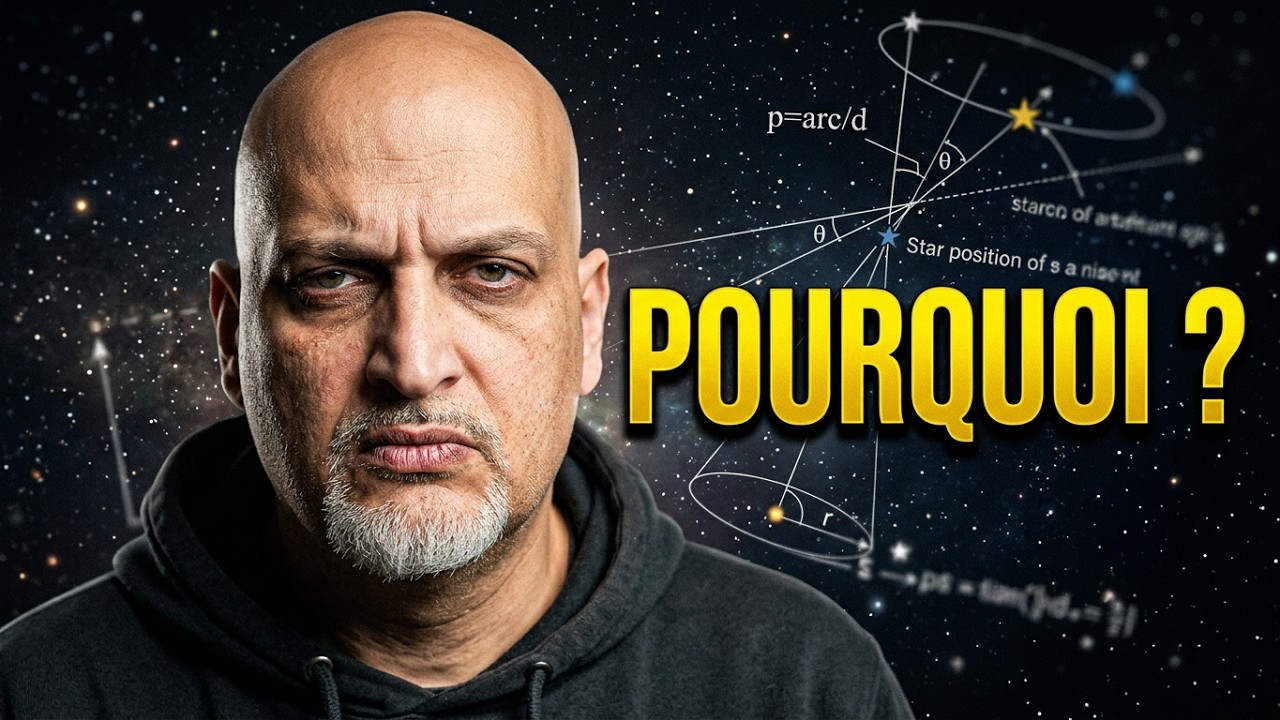
Le parsec : mais pourquoi on s'inflige ce machin ?
The parsec: but why do we put ourselves through this thing?
Keywords
Summary
164 words
Critical Evaluation
Value of the Information & Strength of the Argument
The video provides a clear and engaging explanation of the parsec, its derivation, and its practical (lack of) use. The argumentation is solid, using historical context and mathematical derivation to support the claim that the parsec is an arbitrary and somewhat unnecessary unit. The presenter’s humorous tone helps make complex concepts accessible, and the use of visual demonstrations (e.g., parallax with two cameras) effectively illustrates the principles. The value lies in its ability to educate while entertaining, making a potentially dry topic interesting.
Scientific Rigor, Source Quality, Title Accuracy
The scientific content is rigorous, with accurate definitions and derivations. The presenter cites relevant sources in the video description, including an article on the parsec from the Paris Observatory and a Slate article on new SI prefixes. The title accurately reflects the content, which is a critical look at the parsec. The video is well-structured with chapters, and the presenter’s credentials as a science communicator add to its reliability. The inclusion of a sponsor segment is clearly marked and does not detract from the scientific content.
184 words
Title / Content Match
The title accurately reflects the content, which humorously critiques the parsec unit while explaining its definition and utility.
Quality & Reliability
8/10
The video is scientifically accurate in its definitions and derivations, with clear explanations of the parsec and related units. The presenter uses humor and personal opinions, but the core scientific content is reliable and well-presented.
Chapters
Cited Sources
- Displate (sponsor) — Sponsor segment at the beginning of the video.
- Article on new SI prefixes (Slate) — Referenced in the discussion of large units like quettameter.
- Parsec article from Paris Observatory — Referenced as a source for the parsec definition.
- Related video: Hubble deep field — Mentioned in the context of arcseconds and parallax.
- Related video: conference at ENS Lyon — Mentioned in the introduction.
Concurring Sources
- Parsec (Wikipedia) — Confirms the definition and derivation of the parsec.
- Parallax (Wikipedia) — Explains the parallax method used to measure stellar distances.
External References
Contribution & Novelties
The video offers a fresh, humorous take on a standard astronomical unit, making it memorable and engaging. It clarifies common misconceptions and provides a solid mathematical derivation. The comparison with larger SI units is a nice addition.
Pour aller plus loin :
- Parsec (Wikipedia) — Provides a comprehensive overview of the parsec, its definition, and usage.
- Parallax (Wikipedia) — Explains the parallax effect, which is central to the parsec definition.
- Astronomical unit (Wikipedia) — Details the AU, its history, and current definition.
- Light-year (Wikipedia) — Discusses the light-year as an alternative unit of distance.
- Metric prefix (Wikipedia) — Lists the SI prefixes, including the new ones like quetta and ronna.
110 words
Radar Profile
The radar profile shows high scores in information quality and reliability, with moderate scores in quantity and technical level. This indicates a well-produced educational video that is both accurate and engaging, though not extremely dense in information.
💬 Très positif. Sur les 30 commentaires analysés, les spectateurs expriment un fort enthousiasme pour la vidéo, saluant l'humour, la clarté des explications et la qualité de la vulgarisation, avec de nombreuses références aux blagues récurrentes de la chaîne.