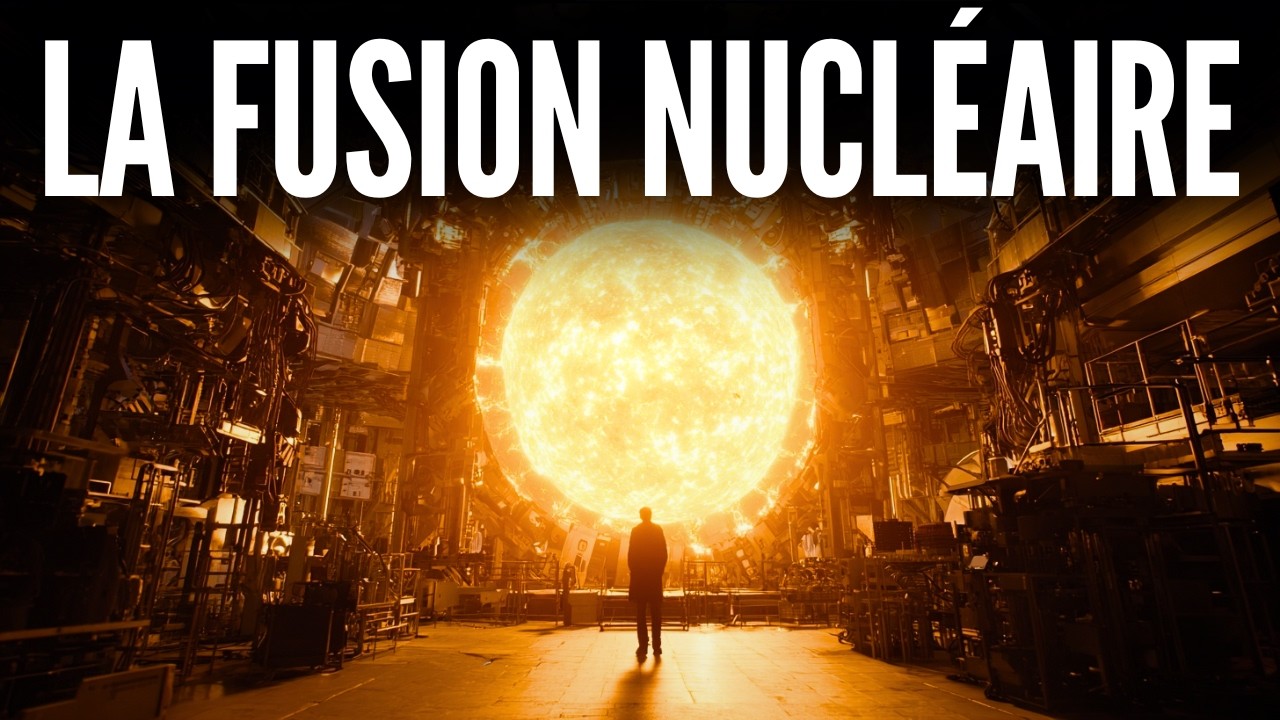
La PREUVE que l'Humanité peut Atteindre l'Énergie ILLIMITÉE
Keywords
Summary
128 words
Critical Evaluation
The video is a high-quality science communication piece that effectively explains the principles and challenges of nuclear fusion. The argumentation is solid, building from the energy crisis to the physics of fusion, and then to the engineering efforts. The scientific content is largely accurate, with a few minor errors (e.g., the product of D-T fusion is helium-4, not hydrogen; the temperature for superconductors is -269°C, not -169°C). The video cites credible sources, including a scientific article from IOP, and references a book and an interview, which enhances its reliability. The visuals and animations are excellent and aid understanding. The title is somewhat sensationalist but the content is grounded. The video does not oversimplify the challenges, presenting a balanced view of the progress and obstacles. It also correctly notes that fusion is not a ‘renewable’ energy in the strict sense, but a dense primary source. Overall, it is a valuable resource for anyone interested in the topic, suitable for both general audiences and those with some scientific background. The inclusion of a commercial partnership is transparent, and the AI-generated images are disclosed. The video’s strength lies in its clarity and engaging storytelling, making complex physics accessible without compromising accuracy.
198 words
Title / Content Match
The title is somewhat sensationalist ('La PREUVE') but the content does address the feasibility of achieving unlimited energy through fusion, so it is largely adequate.
Quality & Reliability
8/10
The video provides a clear and accurate overview of nuclear fusion, with correct explanations of key concepts (E=mc2, plasma, magnetic confinement). It cites credible sources and includes a scientific article reference. Minor inaccuracies (e.g., product of D-T fusion is helium-4, not hydrogen) are present but do not undermine the overall reliability.
Chapters
- Le mur de l’énergie
- Créer un soleil sur Terre
- Âge sombre et naissance des étoiles
- Gravité compression et début de la fusion
- E=mc2 : la masse devient énergie
- Fusion sur Terre entre bombe H et science
- Un plasma plus chaud que le Soleil
- Confinement magnétique et inertiel
- Tokamak le donut de plasma
- ITER et la coopération mondiale
- Lasers géants NIF et ignition
- Le vrai défi bilan énergétique et course finale
Cited Sources
- EUROfusion contributions to ITER nuclear operation — Referenced as a scientific article read during research, providing technical details on ITER operations.
- La fusion nucléaire (book) — Recommended as a book for further reading on nuclear fusion.
- Interview with Françoise Combes — Recommended as an interview with a scientist on the Big Bang and the Universe.
- Christophe Pauly's website — Personal website of the creator, providing additional content and contact information.
Concurring Sources
- EUROfusion contributions to ITER nuclear operation — Scientific article supporting the technical details of ITER operations.
Contribution & Novelties
The video provides a comprehensive and accessible synthesis of the current state of nuclear fusion research, highlighting both magnetic and inertial confinement approaches. It effectively communicates the scientific principles and the engineering challenges, making it a valuable educational resource. The inclusion of historical context and the human stories of scientists like Sakharov adds depth.
Pour aller plus loin :
- ITER official website — The international fusion project, providing up-to-date information on progress and challenges.
- National Ignition Facility (NIF) — The laser-based inertial confinement facility, where recent breakthroughs in ignition were achieved.
- Wendelstein 7-X — The world’s largest stellarator, a key alternative to tokamaks.
- Nuclear fusion on Wikipedia — A broad overview of fusion physics and technology.
116 words
Radar Profile
The radar profile shows high scores in information quantity, quality, and reliability, with a slightly lower technical level, indicating a well-balanced video that is both informative and accessible. The strong performance across all dimensions suggests a high-quality educational resource.
💬 Très positif. Sur les 30 commentaires analysés, les spectateurs expriment une admiration unanime pour la clarté, la précision et la qualité de la vulgarisation, avec quelques remarques constructives sur de légères erreurs factuelles.