Synthetic Biology 2026 | Keynote by Luis Serrano, Centre for Genomic Regulation (CRG), Spain
Keywords
Summary
198 words
Critical Evaluation
Value of the Information & Strength of the Argument
The talk provides substantial value by showcasing a comprehensive approach to synthetic biology, from basic research to translational applications. The argumentation is solid, grounded in the speaker’s extensive experience and the detailed description of experimental methods and results. Serrano effectively demonstrates the potential of Mycoplasma pneumoniae as a chassis for therapeutic protein secretion, supported by data on promoter engineering, protein secretion, and in vivo efficacy. The logical progression from understanding the organism to engineering it for therapy is compelling. However, the talk is an overview and lacks detailed statistical analysis or direct comparisons with alternative approaches, which would strengthen the scientific argument.
Scientific Rigor, Source Quality, Title Accuracy
The scientific rigor is high, as the speaker is a leading expert and the work is based on years of research at prestigious institutions. The talk references several publications and tools, such as the whole-cell model by Jonathan Karr and Markus Covert, and the protein design software FoldX. However, specific citations are not provided in the talk, and the description only includes general conference information. The title accurately reflects the content, which is a keynote on synthetic biology with a focus on therapeutic bacteria for lung diseases. The talk is well-structured and the claims are plausible, but the lack of detailed references limits the ability to verify all statements independently.
227 words
Title / Content Match
The title accurately reflects the content, which is a keynote on synthetic biology with a focus on therapeutic bacteria for lung diseases.
Quality & Reliability
8/10
High credibility due to the speaker's established expertise and institutional affiliation, but limited by the absence of detailed methodological data and peer-reviewed references in the talk.
Key Moments
Markers derived by PSI from the transcript: the creator did not define chapters.
- Introduction to the concept of using a living system as a 'living pill' for therapy, inspired by a science fiction movie.
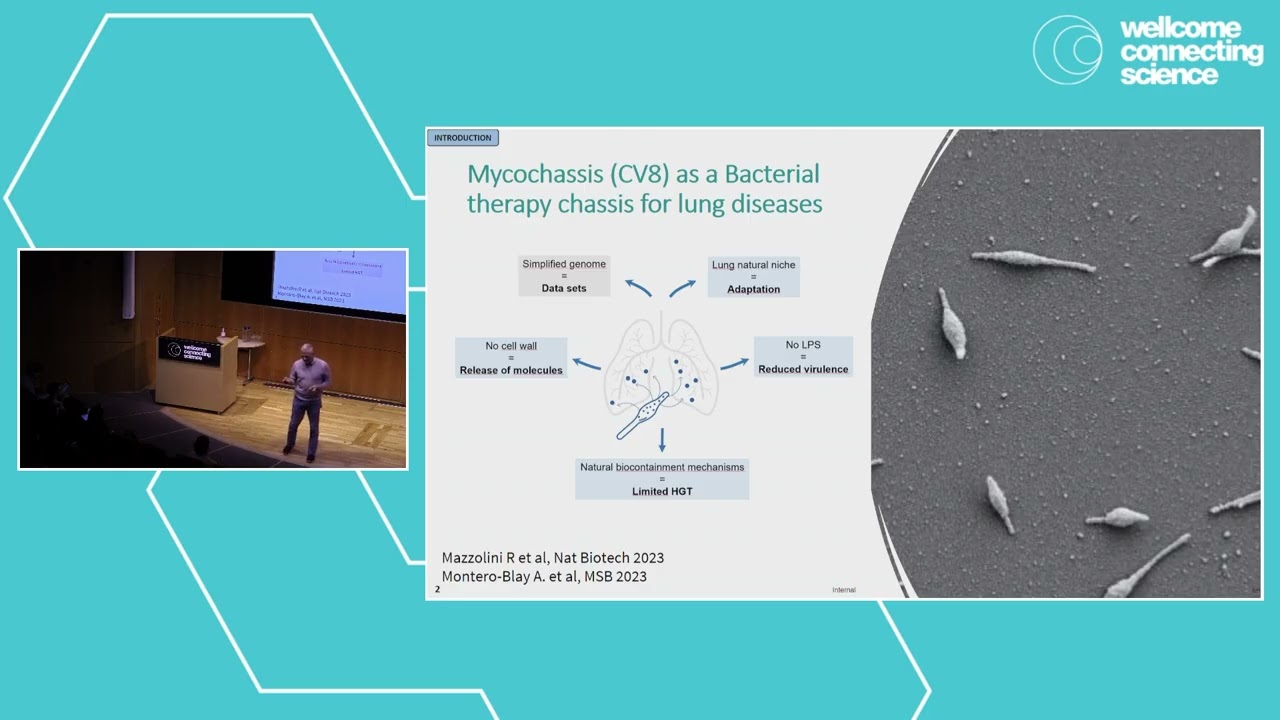
- Choice of Mycoplasma pneumoniae as a chassis due to its small genome and unique properties such as lack of cell wall and natural biocontainment.
- Overview of the extensive systems biology data collected on Mycoplasma pneumoniae, including transcriptomics, proteomics, and metabolomics.
- Development of genetic engineering tools for precise genome editing and high-throughput promoter characterization using Dam methylase.
- Creation of a defined medium (BB13) without animal components and engineering of a non-pathogenic strain (CVH) by removing pathogenic determinants.
- Importance of protein design to enhance the potency of secreted biologics, using FoldX and AI tools.
- Application to ventilator-associated pneumonia: engineering bacteria to dissolve biofilms and kill Pseudomonas aeruginosa, with efficacy in mouse and pig models.
- Shift to treating idiopathic pulmonary fibrosis and lung cancer, highlighting the potential of the platform for other diseases.
Cited Sources
- Whole-cell model of Mycoplasma genitalium — Mentioned as a collaboration for whole-cell modeling.
- FoldX protein design software — Developed by the speaker's lab and used for protein design.
Concurring Sources
- Whole-cell model of Mycoplasma genitalium — Supports the systems biology approach mentioned.
Contribution & Novelties
The talk presents an original approach to synthetic biology by using Mycoplasma pneumoniae as a chassis for therapeutic protein secretion, combining systems biology understanding with protein engineering. The development of a defined medium and non-pathogenic strain, along with high-throughput promoter characterization, are notable contributions. The integration of protein design tools to enhance therapeutic efficacy is a novel aspect.
Pour aller plus loin :
- Synthetic biology — Overview of the field.
- Mycoplasma pneumoniae — Information on the organism used.
- Protein engineering — Techniques for modifying proteins.
85 words
Radar Profile
The radar profile shows high scores across all dimensions, indicating a well-rounded and reliable presentation. The talk is rich in information, technically detailed, and credible, with a strong scientific foundation.