Mitochondrial Medicine - Therapeutic Development | Keynote speaker: Mike Murphy
Keywords
Summary
160 words
Critical Evaluation
Value of the Information & Strength of the Argument
The lecture provides valuable insights into the molecular mechanisms of ischemia-reperfusion injury, presenting a clear and well-supported hypothesis. The argumentation is solid, built on a series of experiments that progressively validate each step of the proposed pathway. The use of multiple techniques (mass spectrometry, in vivo sensors, genetic models) strengthens the evidence. The speaker also addresses potential counterarguments and acknowledges limitations, such as the difficulty of measuring ROS in vivo. Overall, the value is high for researchers in the field, offering a comprehensive overview of the current state of research and future directions.
Scientific Rigor, Source Quality, Title Accuracy
The scientific rigor is high, with detailed methodology and references to published work. The speaker cites specific studies and collaborations, indicating a strong foundation in the literature. The title accurately reflects the content, which focuses on mitochondrial medicine and therapeutic development. The lecture is well-structured, moving from basic science to potential clinical applications. However, as a single lecture, it does not provide a comprehensive review of all perspectives in the field, and some claims may be debated. The adequacy between title and content is excellent, with no misleading elements.
197 words
Title / Content Match
The title accurately reflects the content, focusing on mitochondrial medicine and therapeutic development.
Quality & Reliability
8/10
The lecture presents original research from a leading expert, with detailed mechanistic explanations and references to published studies. The methodology is rigorous, but the content is a single perspective and not peer-reviewed in this format.
Key Moments
Markers derived by PSI from the transcript: the creator did not define chapters.
- Introduction to ischemia-reperfusion injury and its clinical relevance.
- Explanation of the mouse model for studying reperfusion injury.
- Discovery of succinate accumulation during ischemia using mass spectrometry imaging.
- Hypothesis that succinate oxidation drives ROS production via reverse electron transport.
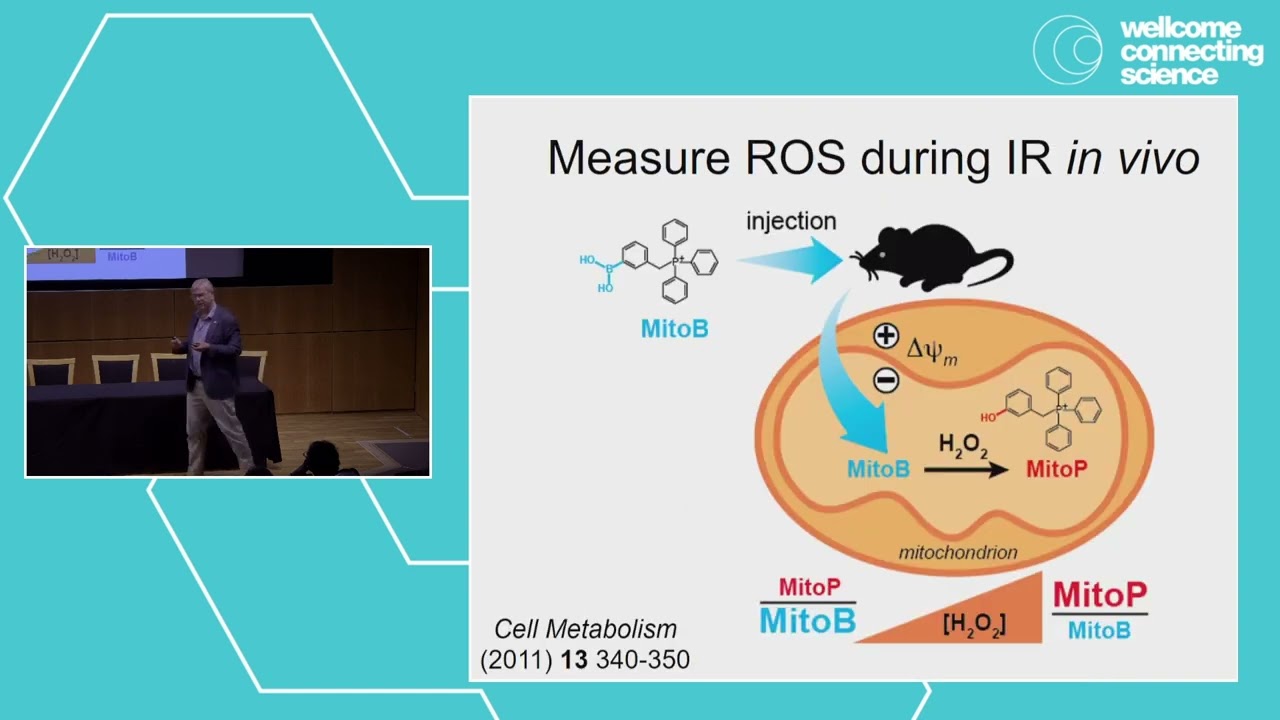
- Development of MitoB as a mitochondrial-targeted ROS sensor.
- Experiments with dimethyl malonate to inhibit succinate metabolism and reduce ROS.
- Use of ND6 mutant mice to confirm the role of reverse electron transport.
- Measurement of mitochondrial membrane potential in isolated hearts using spectroscopy.
- Demonstration that membrane potential rapidly repolarizes upon reperfusion, consistent with the model.
- Implications for therapeutic timing and development of ester prodrugs.
Cited Sources
- Ischaemic accumulation of succinate controls reperfusion injury through mitochondrial ROS — Key paper by Chouchani et al. (2014) demonstrating succinate accumulation and its role in reperfusion injury.
- A mitochondrial-targeted mass spectrometry probe for detecting hydrogen peroxide in vivo — Protocol for MitoB, a mitochondrial-targeted probe for measuring ROS in vivo.
- The role of reverse electron transport in mitochondrial ROS production — Review discussing the mechanism of reverse electron transport at complex I.
Concurring Sources
- Ischaemic accumulation of succinate controls reperfusion injury through mitochondrial ROS — Original research supporting the succinate-driven ROS mechanism.
- Mitochondrial ROS production and its role in cell death — Review confirming the role of mitochondrial ROS in reperfusion injury.
Dissenting Sources
- Alternative sources of ROS in reperfusion injury — Some studies suggest that other sources, such as xanthine oxidase or NADPH oxidase, may also contribute to ROS production during reperfusion, challenging the exclusive role of mitochondria.
Contribution & Novelties
This lecture provides a comprehensive overview of the speaker’s research program, which has significantly advanced the understanding of ischemia-reperfusion injury. The key novelty is the identification of succinate as a critical metabolite that accumulates during ischemia and drives ROS production upon reperfusion via reverse electron transport. This mechanistic insight has direct therapeutic implications, suggesting that targeting succinate metabolism could be a viable strategy to reduce reperfusion injury. The lecture also highlights the importance of timing in therapy, as the ROS burst occurs within the first minutes of reperfusion.
Pour aller plus loin :
- Ischemia-reperfusion injury — Overview of the clinical condition.
- Mitochondrial reactive oxygen species — Background on ROS and their role in cellular signaling.
- Reverse electron transport — Explanation of the mechanism at complex I.
- Succinate dehydrogenase — Enzyme involved in succinate oxidation.
134 words
Radar Profile
The radar profile shows high scores in information quantity and technical level, reflecting the detailed and specialized content. The quality and reliability scores are also high, indicating a well-supported and credible presentation. The overall balance suggests a strong scientific lecture with minor limitations in accessibility for a general audience.
💬 No comments were provided for analysis.