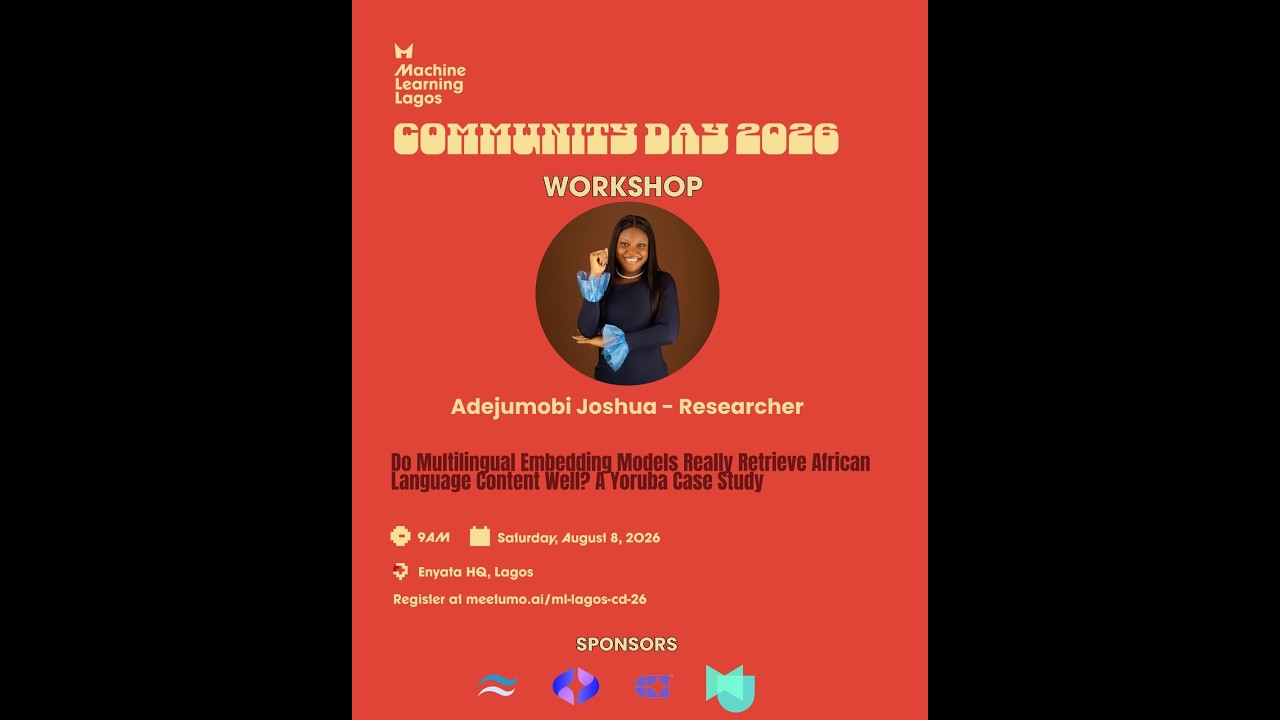
Do Multilingual Embedding Models Really Retrieve African Language Content Well? A Yoruba Case Study
Keywords
Summary
176 words
Critical Evaluation
Value of the Information & Strength of the Argument
The video provides a practical, hands-on approach to evaluating embedding models, which is valuable for practitioners working on information retrieval in low-resource languages. The argumentation is clear and logical, building from basic concepts to specific metrics and results. The presenter effectively explains the importance of NDCG and Recall and demonstrates their application on a real benchmark. The comparison of multiple models offers useful insights, though the analysis could be deepened with more discussion of why certain models perform better.
88 words
Title / Content Match
The title accurately reflects the content, which focuses on evaluating multilingual embedding models for Yoruba retrieval.
Quality & Reliability
7/10
The video is a technical tutorial demonstrating evaluation of embedding models on a benchmark. It provides clear explanations of concepts and metrics, and uses a real dataset (MIRACL). However, it lacks formal citations and the results are presented without rigorous statistical analysis.
Key Moments
Markers derived by PSI from the transcript: the creator did not define chapters.
- Introduction and overview of the session
- Explanation of embedding models vs generative models
- Introduction to MIRACL benchmark and Yoruba subset
- Explanation of NDCG and Recall metrics
- Worked example of cosine similarity and metric calculation
- Loading and encoding queries and passages for each model
- Running evaluation and waiting for results
- Discussion of contrastive fine-tuning for low-resource languages
- Presentation of results and comparison of models
- Conclusion and next steps
Cited Sources
- MIRACL benchmark — The benchmark used for evaluation, containing Yoruba subset.
- BGE-M3 model — One of the embedding models evaluated.
- Multilingual E5 model — One of the embedding models evaluated.
- LABSE model — One of the embedding models evaluated.
Concurring Sources
- MIRACL benchmark — The benchmark used in the video, consistent with its description.
Contribution & Novelties
The video provides a practical tutorial on evaluating multilingual embedding models for a low-resource language (Yoruba), which is a valuable contribution for researchers and practitioners. It demonstrates a reproducible workflow using MIRACL and open-source models. The comparison of base and fine-tuned models offers insights into the benefits of fine-tuning for specific languages.
Pour aller plus loin :
- MIRACL: A Multilingual Retrieval Dataset — The original paper describing the benchmark.
- Sentence-BERT: Sentence Embeddings using Siamese BERT-Networks — Foundational work on sentence embeddings.
- Contrastive Learning — A technique used for fine-tuning embedding models.
91 words
Radar Profile
The radar profile shows balanced scores across all dimensions, indicating a well-rounded tutorial with solid information quality and technical depth, though not exceptional in any single area.