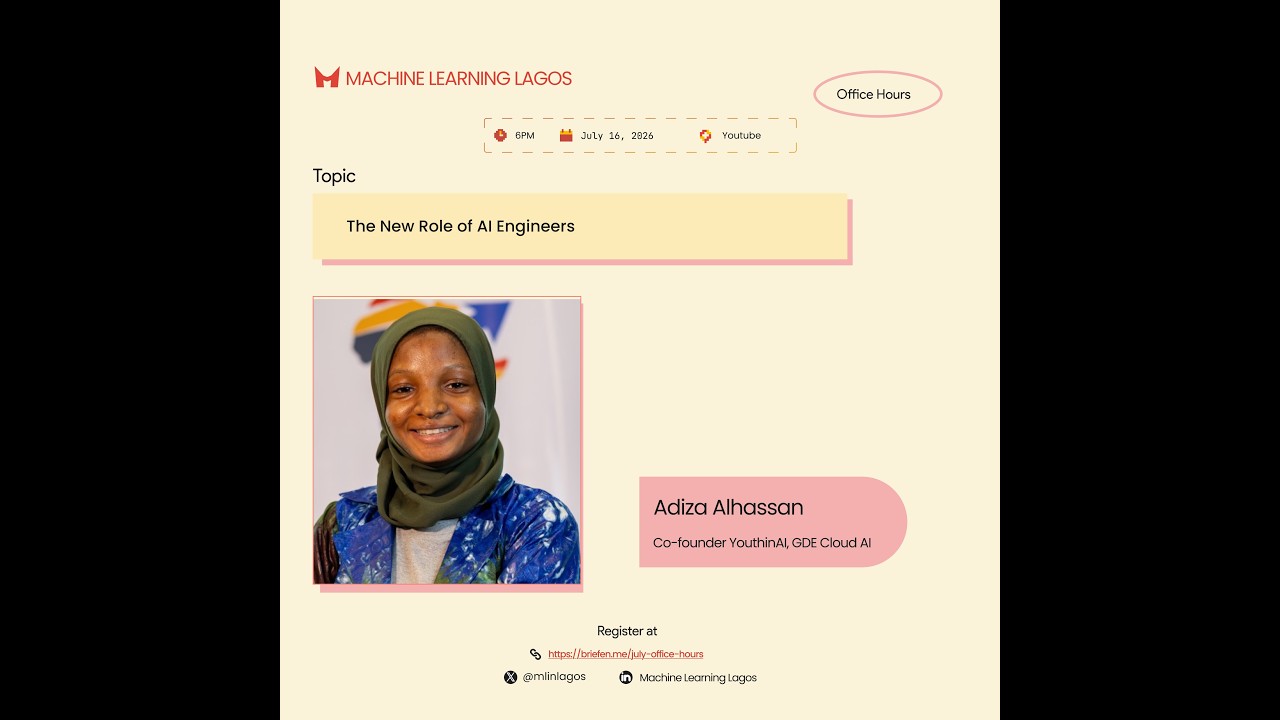
The New Role of AI Engineers
Keywords
Summary
163 words
Critical Evaluation
Value of the Information & Strength of the Argument
The talk provides a valuable, practical perspective on the AI engineering profession, distinguishing it from ML engineering and emphasizing the applied nature of the role. The speaker’s argument is coherent, supported by personal experience and industry observations. She effectively uses analogies and examples, such as a RAG project for organizational documents, to illustrate concepts. However, the argumentation lacks rigorous evidence; statistics are presented without sources, and some claims are oversimplified. The emphasis on the 80/20 rule and the importance of software engineering skills is well-articulated, but the discussion could benefit from more concrete case studies or data.
Scientific Rigor, Source Quality, Title Accuracy
The talk does not cite specific sources or references, relying instead on general industry knowledge and personal experience. The title accurately reflects the content, which focuses on the evolving role of AI engineers. The presentation is informal, with some technical inaccuracies and unclear slides, but the core message is clear. The lack of citations reduces the scientific rigor, but the practical insights are valuable for those entering the field.
181 words
Title / Content Match
The title accurately reflects the content, which focuses on the evolving role of AI engineers and the skills required.
Quality & Reliability
6/10
The talk provides a clear, practical overview of the AI engineer role, but lacks citations to specific sources and relies on personal experience and general industry observations. The statistics cited (e.g., 2% ML engineers) are not sourced, and the presentation is informal with some technical inaccuracies.
Key Moments
Markers derived by PSI from the transcript: the creator did not define chapters.
- Introduction and speaker background
- Definition of AI engineering as applied engineering
- Job market statistics for AI and ML engineers
- Differences between ML engineer and AI engineer
- 80/20 rule: software engineering vs AI layer
- Key pillars: RAG, prompt engineering, agents, LLMOps
- Mindset shift: embracing the loop and non-deterministic systems
- Challenges: picking metrics, context engineering, guardrails
- Advice: build production portfolio, be the AI person, use AI tools
- Full-stack AI developer architecture and Q&A
Contribution & Novelties
The talk provides a clear, practical framework for understanding the AI engineer role, emphasizing the applied nature and the importance of software engineering skills. It offers actionable advice for career development. The distinction between ML and AI engineers is well-articulated, and the 80/20 rule is a useful heuristic.
Pour aller plus loin :
- Retrieval-Augmented Generation (RAG) — Overview of RAG, a key technique mentioned.
- Prompt engineering — Introduction to prompt engineering, a core skill for AI engineers.
- MLOps — Practices for deploying and maintaining ML models in production.
- LangChain — A framework for building applications with LLMs, mentioned in the talk.
- Google Kubernetes Engine (GKE) — Managed Kubernetes service recommended for AI applications.
113 words
Radar Profile
The radar profile shows moderate scores across all dimensions, indicating a balanced but not deeply rigorous presentation. The talk is informative and practical, but lacks strong scientific backing and technical depth.
💬 No comments were provided for analysis.