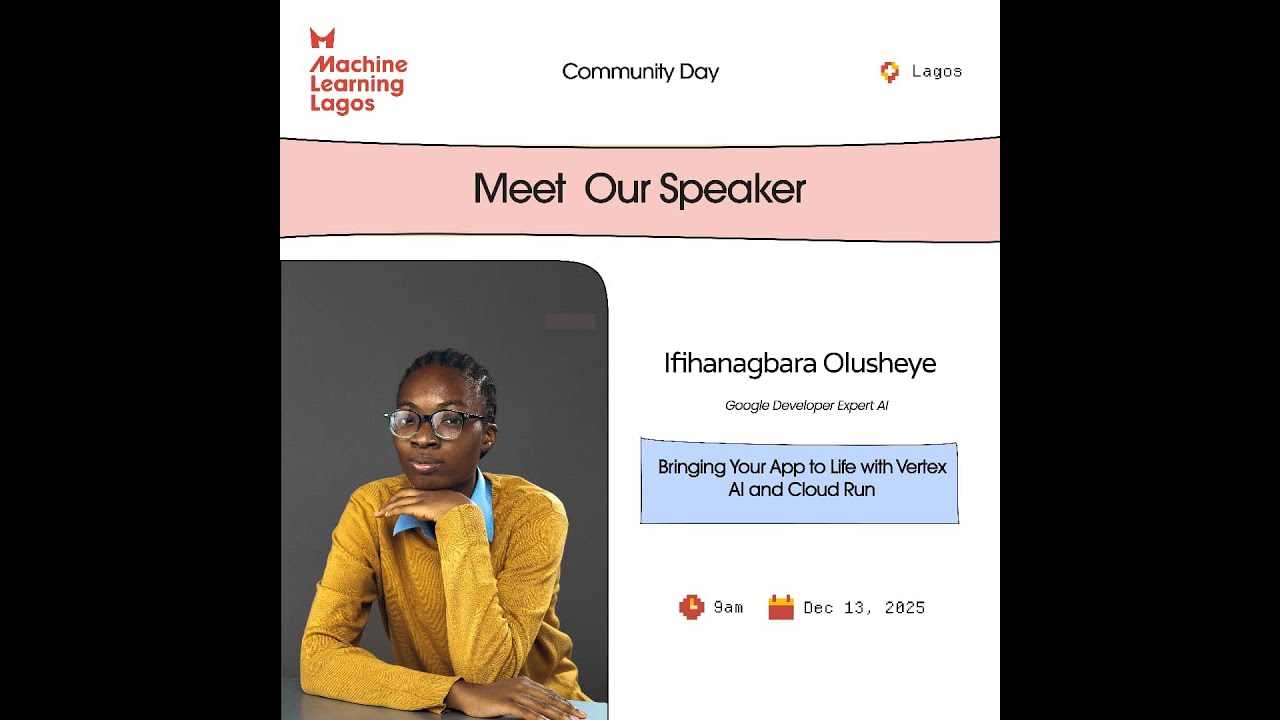
Bringing Your App to Life with Vertex AI and Cloud Run
Keywords
Summary
156 words
Critical Evaluation
Value of the Information & Strength of the Argument
The tutorial provides a practical, step-by-step approach to integrating Vertex AI and deploying on Cloud Run, which is valuable for developers looking to implement AI in their applications. The argumentation is based on the presenter’s personal experience and the perceived ease of using Google Cloud services. However, the value is diminished by the lack of clear explanations and the incomplete nature of the presentation. The speaker often jumps between steps without fully explaining the underlying concepts, and the transcription reveals many moments of confusion and unresolved issues. The argumentation is not strongly supported by evidence or detailed reasoning, and the tutorial would benefit from a more structured and comprehensive approach.
Scientific Rigor, Source Quality, Title Accuracy
The tutorial does not cite any external sources or references. The content is based on the presenter’s own experience and the official Google Cloud documentation, which is not explicitly mentioned. The title accurately reflects the content, but the execution lacks scientific rigor due to the fragmented and unclear presentation. The tutorial would be more credible if it provided references to official documentation and offered clearer explanations of the steps involved.
195 words
Title / Content Match
The title accurately reflects the content, which focuses on integrating Vertex AI and deploying on Cloud Run.
Quality & Reliability
5/10
The tutorial is a practical walkthrough, but the transcription is highly fragmented and incomplete, with many unclear steps and missing details. The speaker's explanations are often confusing, and the code snippets are not fully shown. The video lacks clear structure and fails to provide a comprehensive understanding of the integration.
Key Moments
Markers derived by PSI from the transcript: the creator did not define chapters.
Contribution & Novelties
The tutorial offers a practical demonstration of integrating Vertex AI with a Flask app and deploying on Cloud Run, which is a common use case for developers. However, the presentation is not original and follows standard Google Cloud documentation. The main value lies in the step-by-step guidance, but it is poorly executed due to the fragmented transcription.
Pour aller plus loin :
- Vertex AI documentation — Official documentation for Vertex AI.
- Cloud Run documentation — Official documentation for Cloud Run.
- Flask documentation — Official Flask documentation.
86 words
Radar Profile
The radar profile shows moderate scores across all dimensions, indicating a tutorial that provides some useful information but lacks depth and clarity. The scores are balanced, with no particular strength or weakness standing out.