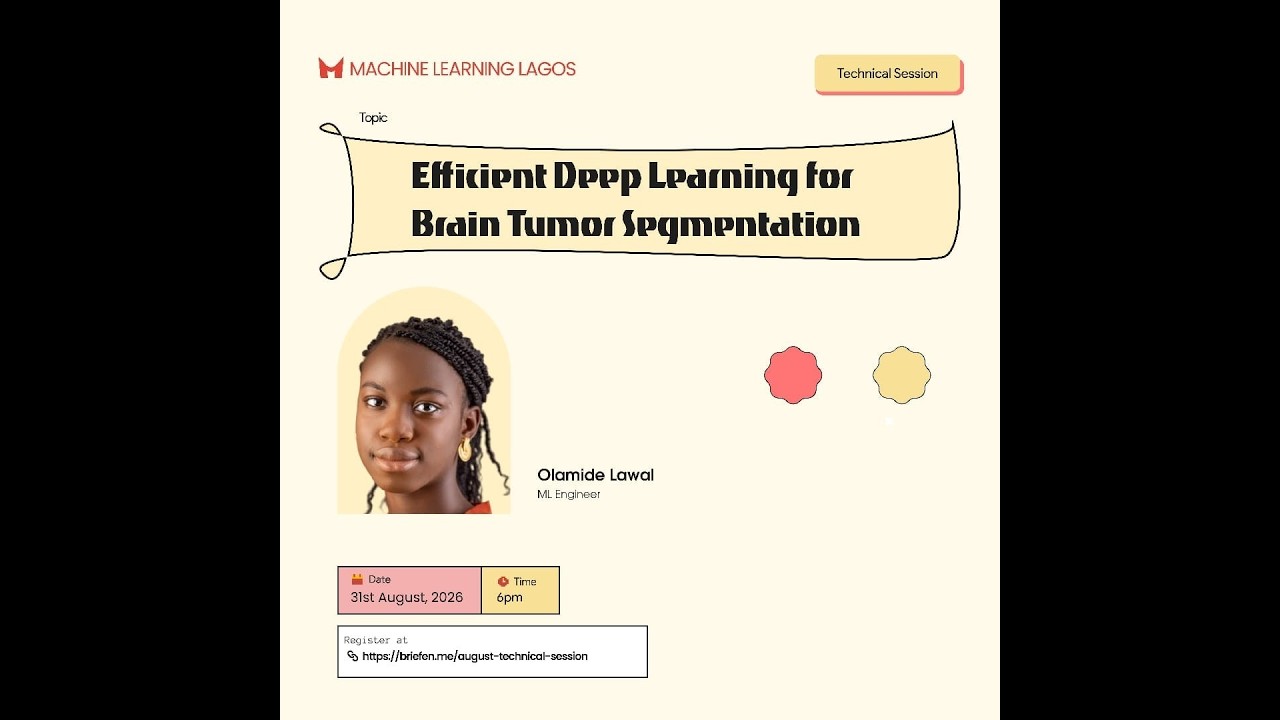
Efficient Deep Learning for Brain Tumor Segmentation
Keywords
Summary
185 words
Critical Evaluation
Value of the Information & Strength of the Argument
The talk provides a clear and accessible introduction to the challenges of brain tumor segmentation and the importance of computational efficiency in deep learning models. The speaker effectively explains the U-Net architecture and the trade-offs between spatial context and computational cost. The argumentation is logical, moving from problem definition to baseline, then to efficiency strategies and evaluation metrics. However, the talk lacks concrete examples, quantitative results, or a detailed comparison of different efficiency techniques. The discussion remains at a conceptual level, which limits its value for practitioners seeking actionable insights. The emphasis on activation memory and the distinction between parameters, FLOPs, and memory is valuable, but the talk does not delve into specific methods like pruning, quantization, or knowledge distillation, which are central to efficient deep learning.
Scientific Rigor, Source Quality, Title Accuracy
The talk is presented by an expert in the field, which lends credibility. However, the presentation lacks explicit citations to research papers or datasets, aside from mentioning the BraTS Africa dataset. The speaker does not provide references for the claims made about U-Net or efficiency techniques. The title accurately reflects the content, but the talk’s scope is broad and introductory, which may not satisfy viewers seeking in-depth technical details. The lack of verifiable sources and the absence of specific experimental data reduce the scientific rigor of the presentation. The talk is more of an expert opinion and overview than a rigorous scientific review.
245 words
Title / Content Match
The title accurately reflects the content: the talk focuses on efficient deep learning methods for brain tumor segmentation, covering the problem, baseline, efficiency strategies, and trade-offs.
Quality & Reliability
6/10
The talk is an expert presentation on efficient deep learning for brain tumor segmentation, but it lacks concrete technical depth, quantitative results, and verifiable citations. The speaker's expertise is evident, but the content is largely conceptual and introductory, with no specific experiments or data presented.
Key Moments
Markers derived by PSI from the transcript: the creator did not define chapters.
- Introduction and welcome, speaker introduction.
- Definition of brain tumor segmentation and its challenges.
- Explanation of MRI modalities (T1, T1c, T2, FLAIR) and their roles.
- Why 3D processing is used and its computational cost.
- Introduction to U-Net architecture: encoder, bottleneck, decoder.
- Sources of computational cost: parameters, FLOPs, memory, activation memory.
- Discussion on making models lightweight and the meaning of 'lightweight'.
- Trade-offs between accuracy and efficiency.
- Evaluation metrics beyond accuracy: Dice, IoU, Hausdorff distance, model size, inference time, memory.
- Open questions and potential applications to other medical imaging tasks.
Cited Sources
- BraTS Africa dataset — Mentioned as the dataset used for brain tumor segmentation, with 146 cases of brain MRI scans.
Concurring Sources
- U-Net: Convolutional Networks for Biomedical Image Segmentation — The baseline architecture discussed in the talk is U-Net, and this paper is the primary reference for it.
Contribution & Novelties
The talk provides a clear conceptual framework for understanding the computational costs in deep learning-based brain tumor segmentation, particularly highlighting the often-overlooked activation memory. It emphasizes the importance of evaluating models not only on accuracy but also on efficiency metrics, which is crucial for deployment in resource-constrained settings. The discussion on the trade-offs between accuracy and efficiency is valuable for practitioners.
Pour aller plus loin :
- U-Net: Convolutional Networks for Biomedical Image Segmentation — The original U-Net paper, foundational for understanding the architecture.
- BraTS Challenge — The Brain Tumor Segmentation Challenge, providing benchmarks and datasets.
- Efficient Deep Learning: A Survey — A survey on techniques for efficient deep learning, including pruning, quantization, and knowledge distillation.
- Hausdorff distance — A metric used to evaluate segmentation quality, mentioned in the talk.
129 words
Radar Profile
The radar profile shows moderate scores across all dimensions, with slightly higher quality and reliability scores compared to quantity and technical depth. This indicates a balanced but not deeply technical presentation, suitable for an introductory audience but lacking in-depth quantitative analysis.
💬 No comments were provided for analysis.