Columbia GSAPP LiPS: Miriam Greenberg
Keywords
Summary
168 words
Critical Evaluation
Value of the Information & Strength of the Argument
The lecture provides valuable insights into the understudied connection between housing affordability and wildfire risk. Greenberg’s argument is well-structured, moving from personal experience and prior research to empirical findings and theoretical frameworks. She effectively uses data from surveys and maps to support her claims, and she acknowledges the limitations of her research, such as the difficulty of tracking displacement. The argument is persuasive, though it relies heavily on her own research and may not fully represent the broader literature. The call for interdisciplinary collaboration is compelling and timely.
Scientific Rigor, Source Quality, Title Accuracy
Greenberg demonstrates scientific rigor by grounding her work in established theories (e.g., crisis-driven urbanization) and citing specific studies and reports (e.g., National Low Income Housing Coalition’s Out of Reach). She transparently discusses her methods, including community-engaged research, and acknowledges the siloed nature of academic fields. The title accurately reflects the content, as it is a lecture in the LiPS series at Columbia GSAPP. The presentation is well-organized and the sources are credible, though the lecture format limits the depth of source verification.
185 words
Title / Content Match
The title accurately reflects the content: a lecture by Miriam Greenberg at Columbia GSAPP, part of the LiPS series.
Quality & Reliability
8/10
The lecture is based on the speaker's extensive research and publications, including peer-reviewed articles and reports. The arguments are well-supported by data from surveys and maps, and the speaker acknowledges limitations and the need for interdisciplinary approaches. However, the presentation is a lecture, not a peer-reviewed study, and some claims rely on the speaker's own research without external verification.
Key Moments
Markers derived by PSI from the transcript: the creator did not define chapters.
- Introduction by moderator Andrea, welcoming Miriam Greenberg.
- Greenberg begins her talk, outlining her background and research trajectory.
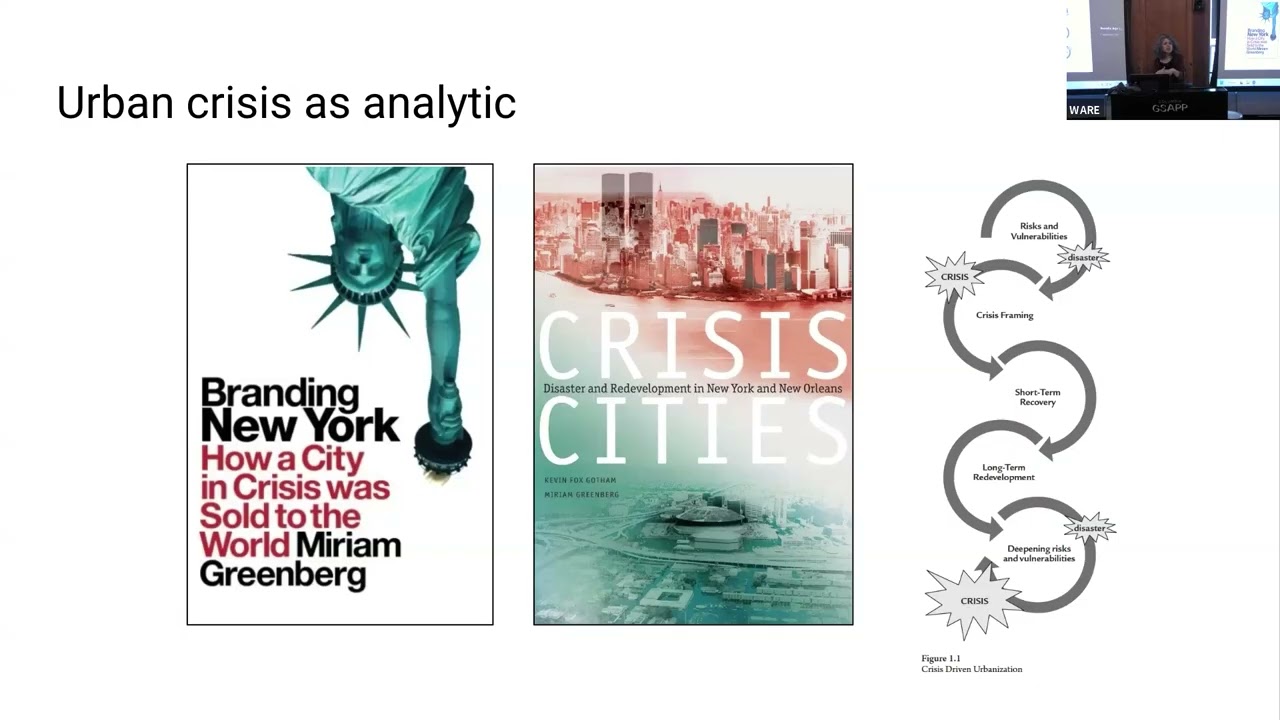
- Discussion of her previous work on urban crises in New York and New Orleans.
- Introduction of the housing crisis in California and the concept of exurbanization.
- Presentation of the 'No Place Like Home' report and findings on forced moves.
- Discussion of the 2020 CZU Lightning Complex fire and its connection to housing.
- Introduction of the wildland-urban interface (WUI) concept and its growth.
- Call for interdisciplinary research and policy integration.
- Q&A session begins.
Cited Sources
- Branding New York: How City in Crisis Was Sold to the World — Greenberg's earlier book on urban crisis and branding.
- Crisis Cities: Disaster and Redevelopment in New York and New Orleans — Comparative study of urban crises.
- The City Is the Factory: Solidarities and Spatial Tactics in the New Urban Age — Edited volume on urban solidarity.
- Seeking Shelter: How Housing and Urban Exclusion Shape Exurban Disaster — Article in a special issue on disaster.
- Out of Reach — Report by the National Low Income Housing Coalition used for housing wage data.
Concurring Sources
- Silvis Lab - Wildland-Urban Interface — Research on WUI growth and mapping.
- National Low Income Housing Coalition - Out of Reach — Data on housing affordability used in the lecture.
Dissenting Sources
- Some fire ecologists argue that climate change is the primary driver of megafires, not WUI growth. — Greenberg emphasizes housing as a key factor, but some research prioritizes climate change.
Contribution & Novelties
Greenberg’s lecture offers a novel synthesis of housing crisis and wildfire risk, highlighting the dialectical relationship between urban displacement and environmental disaster. She introduces the concept of the wildland-urban interface (WUI) to urban studies audiences, bridging a gap between disciplines. Her community-engaged research method provides a model for participatory scholarship. The lecture underscores the need for integrated policy responses to the polycrisis of housing, climate, and inequality.
Pour aller plus loin :
- Wildland-urban interface — Provides background on the WUI concept and its relevance.
- Housing crisis in California — Context on the housing affordability crisis.
- CZU Lightning Complex fire — Details on the specific fire event discussed.
- Community-based participatory research — Methodological approach used in the research.
117 words
Radar Profile
The radar profile shows high scores in quantity and quality of information, reflecting the depth and reliability of the content. The technical level is moderate, indicating accessibility to a general academic audience. The overall reliability is strong, supported by the speaker's expertise and use of data.
💬 No comments were provided for analysis.