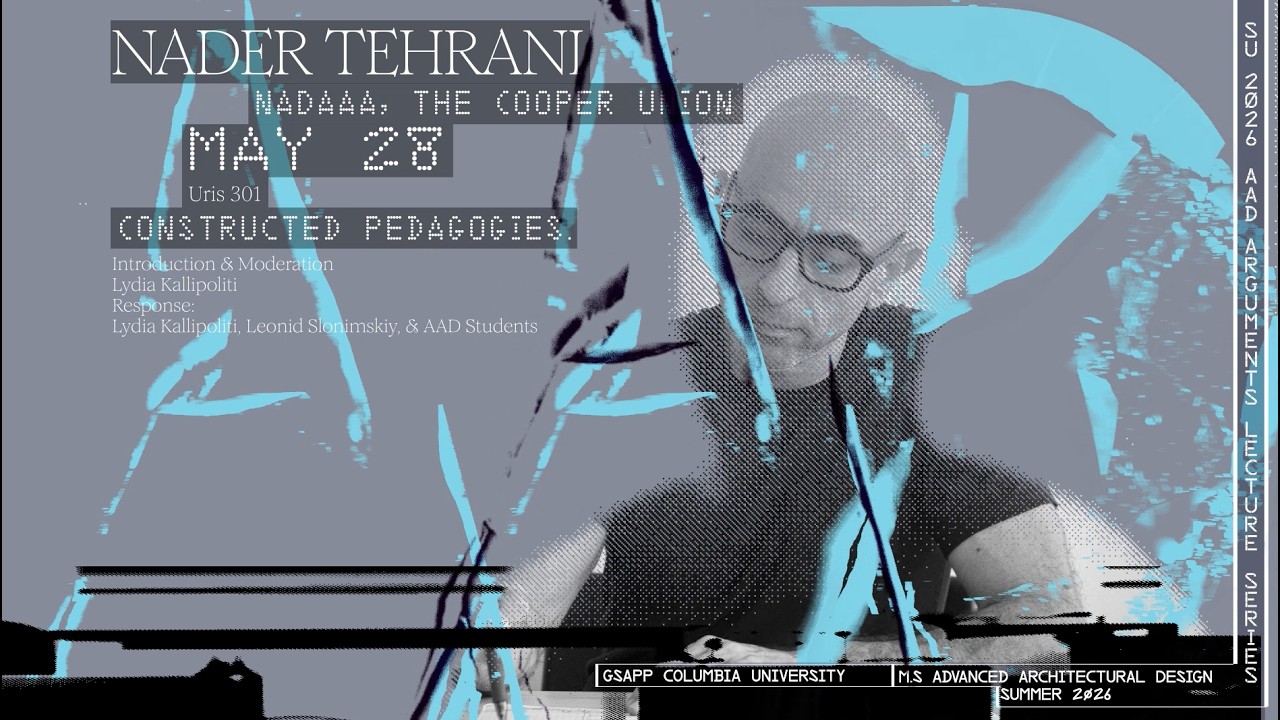
Nadar Tehrani AAD Arguments
Keywords
Summary
111 words
Critical Evaluation
Value of the Information & Strength of the Argument
The lecture provides valuable insights into the intersection of architecture and pedagogy, grounded in Tehrani’s extensive experience. He argues convincingly that architectural design can influence educational practices and intellectual exchange. His argumentation is well-structured, using historical precedents and his own projects to illustrate his points. He emphasizes the importance of materiality and tectonic details as vehicles for thought, and the need for architecture to engage with social and political contexts. The lecture is rich in examples and references, making it a compelling case for the agency of architecture.
Scientific Rigor, Source Quality, Title Accuracy
Tehrani’s credentials are impeccable, and he references several architectural precedents and thinkers. However, the lecture is primarily based on personal experience and professional projects, which may limit its generalizability. The title ‘Nadar Tehrani AAD Arguments’ is vague and does not convey the specific focus on pedagogy. The lecture is well-argued but lacks formal citations or references to external sources, relying instead on anecdotal evidence and personal authority.
170 words
Title / Content Match
The title is generic and does not reflect the specific content of the lecture, which focuses on architecture and pedagogy.
Quality & Reliability
8/10
Lecture by a renowned architect with extensive academic and professional credentials. The content is based on personal experience and professional projects, providing a unique perspective. However, it is not a peer-reviewed scientific study, and some claims are subjective.
Key Moments
Markers derived by PSI from the transcript: the creator did not define chapters.
- Introduction by Lydia Kallipoliti, highlighting Tehrani's achievements and the significance of his work.
- Tehrani begins his lecture, discussing the accidental nature of designing schools of architecture.
- Tehrani discusses the importance of the bar at the AA as a space for debate and discourse.
- Tehrani talks about the impact of online education and the debate between campus and virtual learning.
- Tehrani presents his projects for Georgia Tech, Melbourne, and Nebraska, emphasizing material agency.
- Tehrani discusses the civic role of architecture and the importance of unscripted events.
- Q&A session begins, with responses from students and faculty.
Cited Sources
- NADAAA — Tehrani's practice, whose projects are discussed in the lecture.
- Cooper Union — Tehrani was Dean of the Irwin S. Chanin School of Architecture.
- MIT Department of Architecture — Tehrani was Head of the Department from 2010-2014.
Concurring Sources
- NADAAA — The practice's projects are discussed in the lecture.
Contribution & Novelties
The lecture offers a unique perspective on the relationship between architecture and pedagogy, based on Tehrani’s extensive experience in designing schools of architecture. It emphasizes the importance of material agency and tectonic details as generative forces in design, and argues that buildings can shape intellectual discourse. The lecture also addresses contemporary challenges such as online education and the need for spaces that allow for dissent and unscripted events.
Pour aller plus loin :
- Architecture and Pedagogy — Overview of the intersection.
- Tectonics in Architecture — Concept of tectonic expression.
- Panopticon — Foucault’s concept of surveillance and visibility, referenced by Tehrani.
100 words
Radar Profile
The radar profile shows high scores in quantity and quality of information, reflecting the depth and richness of the lecture. The technical level is also high, indicating a sophisticated audience. The reliability is strong due to the speaker's credentials, though the subjective nature of the content slightly lowers it.
💬 No comments were provided for analysis.