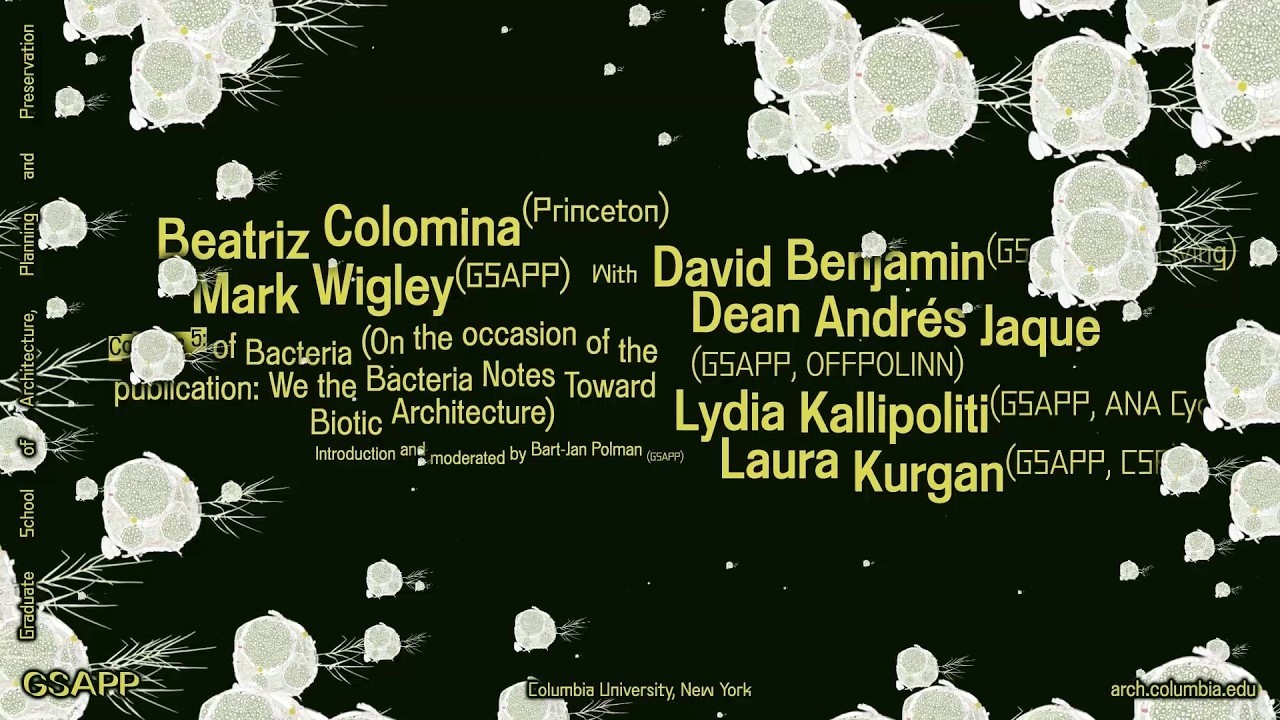
Columbia GSAPP: Coalition 4 - Coalition of Bacteria
Keywords
Summary
184 words
Critical Evaluation
Value of the Information & Strength of the Argument
The value of the information lies in its interdisciplinary synthesis, bringing together architectural history, microbiology, and design practice. The argumentation is compelling, as Colomina and Wigley present a well-researched historical narrative that connects the rise of modern architecture to the fear of bacteria, and then propose a radical rethinking of architecture’s role. The panelists’ responses add practical and speculative dimensions, grounding the theoretical claims in concrete projects and ideas. However, the discussion is more provocative than rigorously scientific, with some claims (e.g., the timeline of microbiome-related deaths) presented without detailed evidence. The strength of the argumentation is in its ability to challenge conventional thinking and open up new avenues for design.
Scientific Rigor, Source Quality, Title Accuracy
The discussion is rigorous in its use of historical and scientific references, citing figures like Louis Pasteur, Robert Koch, and Le Corbusier, and referencing the microbiome research. The sources are credible, though the presentation is conversational and not a formal academic lecture. The title accurately reflects the content, which is a coalition of experts discussing the role of bacteria in architecture. The event is well-structured, with clear presentations and a moderated discussion. The participants are all established experts in their fields, lending authority to the conversation.
212 words
Title / Content Match
The title accurately reflects the content, which is a coalition of experts discussing the role of bacteria in architecture.
Quality & Reliability
8/10
The discussion features leading academics and practitioners in architecture, providing a high-level, interdisciplinary perspective on the role of bacteria in architecture. The arguments are grounded in historical and scientific references, though they are presented in a conversational and speculative manner rather than as rigorous empirical research.
Key Moments
Markers derived by PSI from the transcript: the creator did not define chapters.
- Introduction by Bart-Jan Polman, setting the context for the coalition series and introducing the speakers.
- Beatriz Colomina and Mark Wigley begin their presentation, introducing the book 'We the Bacteria' and the concept of biotic architecture.
- Discussion of the human body as a 'bag of bacteria', with statistics on the number of microbes in the body.
- Historical overview of the relationship between architecture and bacteria, from the 19th-century sanitary reforms to modernism.
- Presentation of the exhibition 'We the Bacteria' at the Milan Triennale, and the contributions of the panelists.
- David Benjamin presents his work on living materials and the potential for architecture to incorporate biological systems.
- Lydia Kallipoliti discusses her research on closed-world architecture and the idea of metabolic cycles.
- Andrés Jaque presents his office's work on political ecology and the entanglement of bodies and environments.
- Laura Kurgan discusses her work on mapping and data visualization, and its relevance to understanding microbial environments.
- Open discussion and Q&A session, with panelists responding to questions from the audience.
Cited Sources
- We the Bacteria: Notes Toward Biotic Architecture — The book by Beatriz Colomina and Mark Wigley, which is the central topic of the discussion.
- Milan Triennale Exhibition — The exhibition 'We the Bacteria' at the Milan Triennale, which the book accompanies.
- Sick Architecture — Edited volume by Beatriz Colomina, mentioned in the introduction.
Concurring Sources
- The Human Microbiome Project — Supports the claim that the human body hosts trillions of microbes, as discussed in the video.
- Sick Building Syndrome — Related to the discussion of modern architecture's potential negative health effects.
Dissenting Sources
- Critiques of microbiome research — Some scientists caution against overstating the causal links between microbiome diversity and specific diseases, which the video presents as established.
Contribution & Novelties
The video offers a novel perspective by framing architecture’s relationship with bacteria as a central design concern, challenging the anthropocentric tradition. It synthesizes historical research with contemporary microbiome science to propose a new ‘biotic architecture’ that could have significant implications for health and sustainability. The panelists’ diverse responses enrich the discussion, providing concrete examples of how such ideas might be implemented.
Pour aller plus loin :
- Microbiome — Overview of the microbial communities that inhabit the human body and their role in health.
- Human microbiome project — Research initiative to characterize the human microbiome.
- Probiotic — Concept of beneficial bacteria, relevant to the idea of ‘probiotic architecture’.
107 words
Radar Profile
The radar profile shows high scores in quantity and quality of information, reflecting the depth and expertise of the panel. The technical level is moderately high, suitable for an informed audience. Overall reliability is strong, though the speculative nature of some claims prevents a perfect score.
💬 Sur les 0 commentaires analysés, aucune tendance n'est disponible.