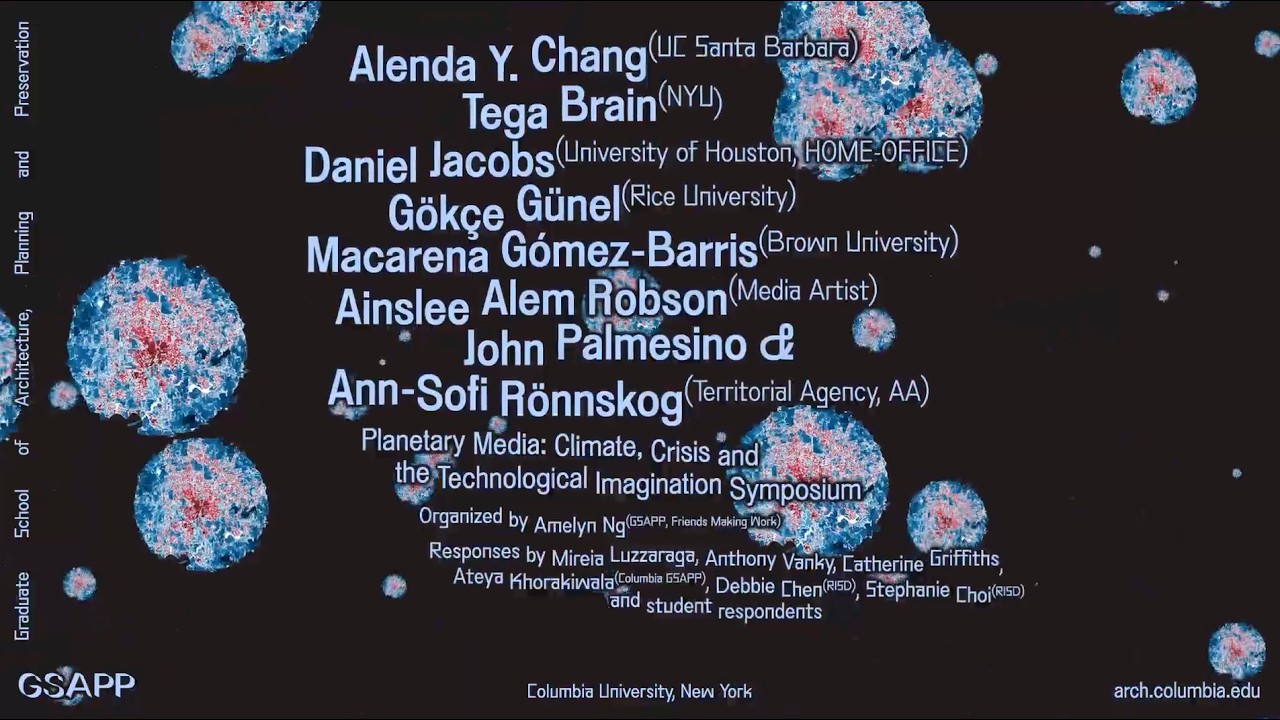
Planetary Media Symposium - Morning Session
Keywords
Summary
150 words
Critical Evaluation
Value of the Information & Strength of the Argument
The value of the information is high, as the speakers bring diverse academic perspectives (media studies, environmental engineering, architecture, anthropology) to bear on the topic of planetary media. The arguments are well-structured and grounded in theoretical frameworks and case studies. For instance, Alenda Chang’s critique of god games and her proposal of ‘partial earth’ mentality is nuanced and supported by references to specific games and scholarly work. The session encourages critical thinking about the relationship between media, technology, and the environment, and the Q&A adds depth to the discussion.
Scientific Rigor, Source Quality, Title Accuracy
The scientific rigor is strong, with speakers citing their own published works and established scholars (e.g., Haraway, Wilson, Jackson). The sources are credible and relevant. The title accurately reflects the content, as the session focuses on media infrastructures within the broader context of planetary media. The symposium format includes structured responses and audience engagement, enhancing the reliability of the discussion. No comments were provided for analysis.
170 words
Title / Content Match
The title accurately reflects the content: a morning session of a symposium on planetary media, focusing on media infrastructures.
Quality & Reliability
8/10
The session features established academics (Alenda Chang, Tega Brain, Daniel Jacobs, Gökçe Günel) presenting research in their fields, with structured responses and Q&A. The content is scholarly and well-argued, though the recording is a symposium session rather than a peer-reviewed publication.
Key Moments
Markers derived by PSI from the transcript: the creator did not define chapters.
- Introduction and framing of the symposium theme
- Host's opening remarks on planetary media
- Alenda Chang's talk begins: critique of god games and half-earth proposals
- Tega Brain's presentation on ecology, data, and automation
- Daniel Jacobs on architecture as environmental media
- Gökçe Günel on energy infrastructure and south-south relations
- Responses and Q&A session
Cited Sources
- Playing Nature: Ecology, and Video Games — Mentioned by Alenda Chang as her 2019 book
- Half-Earth: Our Planet's Fight for Life — Referenced by Alenda Chang as E.O. Wilson's book
- Code as Creative Medium — Mentioned as Tega Brain's book
- Spaceship in the Desert: Energy, Climate Change, and Urban Design in Abu Dhabi — Referenced as Gökçe Günel's book
- Floating Power: Energy Infrastructure and South-South Relations — Mentioned as Gökçe Günel's recent book
Concurring Sources
- Playing Nature: Ecology, and Video Games — Alenda Chang's book aligns with her talk's themes
- Half-Earth: Our Planet's Fight for Life — E.O. Wilson's book is central to the critique
Dissenting Sources
- Half-Earth Project — Chang critiques the project's approach as potentially tone-deaf to social justice issues
Contribution & Novelties
The session offers a novel interdisciplinary perspective on planetary media, challenging conventional notions of global imagery and technological solutionism. Alenda Chang’s concept of ‘partial earth’ mentality provides a fresh framework for thinking about environmental media and games. The symposium fosters critical dialogue on how media infrastructures shape our understanding of the planet.
Pour aller plus loin :
- Donna Haraway’s situated knowledges — Key theoretical basis for partial perspective.
- Gaia games and ecological game studies — Relevant to the critique of god games.
- E.O. Wilson’s Half-Earth Project — Directly related to the half-earth proposal discussed.
94 words
Radar Profile
The radar profile shows high scores in information quantity, quality, and reliability, with a slightly lower technical level, reflecting the interdisciplinary and accessible nature of the symposium. The session is strong in providing diverse perspectives and rigorous academic discussion.