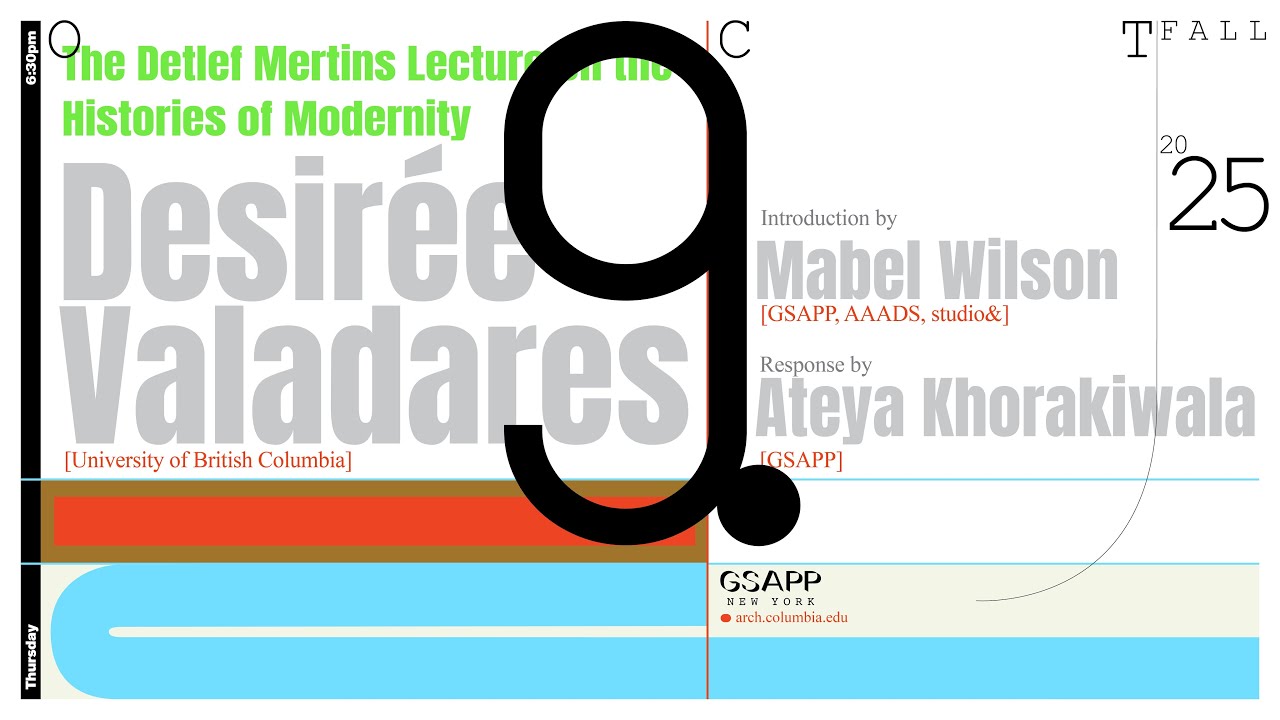
THE DETLEF MERTINS LECTURE ON THE HISTORIES OF MODERNITY: Desiree Valadares
Keywords
Summary
151 words
Critical Evaluation
Value of the Information & Strength of the Argument
The lecture offers valuable insights into the intersection of heritage, land politics, and colonial legacies. Valadares presents a well-structured argument, using specific case studies and material objects to illustrate broader themes. She effectively challenges conventional notions of preservation and public land, drawing on critical theory and indigenous scholarship. The argumentation is solid, though some points could benefit from further elaboration, particularly the practical implications of her proposed alternative methods.
Scientific Rigor, Source Quality, Title Accuracy
The lecture demonstrates strong scholarly rigor, with references to legal documents, archival materials, and academic publications. Valadares cites specific sources, including the Presidential Proclamation 9234, works by Layli Long Soldier, Haunani-Kay Trask, and Audra Simpson, and her own published essays. The title accurately reflects the content, and the lecture is well-aligned with the Detlef Mertins series’ focus on modernity and historical inquiry. The inclusion of a response by Ateya Khorakiwala adds to the scholarly dialogue.
159 words
Title / Content Match
The title accurately reflects the content: a lecture in the Detlef Mertins series on the histories of modernity, focusing on the Hanai Uli Gulch as a case study.
Quality & Reliability
8/10
The lecture is delivered by an academic expert (Desirée Valadares) with a strong publication record. It is based on archival research and legal documents, and includes references to scholarly works and specific sources. However, it is a single lecture with limited peer review, and some claims rely on the speaker's interpretation.
Key Moments
Markers derived by PSI from the transcript: the creator did not define chapters.
- Introduction by Barton Pulman, welcoming attendees and introducing the lecture series.
- Mabel Wilson introduces Desirée Valadares, highlighting her background and research.
- Valadares begins her lecture, paying tribute to Detlef Mertins and his advocacy for modernist architecture in Toronto.
- Valadares introduces the Hanai Uli Gulch National Monument and its designation in 2015.
- Discussion of the material objects: the presidential signing pen and the passport cancellation stamp.
- Critique of 'public land' and 'national heritage' in the context of Hawaii's colonial history.
- Valadares explores the challenges of preserving the site and proposes alternative approaches.
- Conclusion and transition to the response by Ateya Khorakiwala.
Cited Sources
- Presidential Proclamation 9234 — Legal document establishing the Hanai Uli National Monument.
- Thinking Like a Gulch — Essay by Valadares on the Hanai Uli Gulch, referenced in the introduction.
- Whereas — Poetry collection by Layli Long Soldier, cited by Valadares.
- From a Native Daughter — Book by Haunani-Kay Trask, referenced in the lecture.
- Savage States — Public talk by Audra Simpson, mentioned by Valadares.
Concurring Sources
- Presidential Proclamation 9234 — Confirms the legal designation of Hanai Uli as a national monument.
- Thinking Like a Gulch — Valadares's own essay aligns with the lecture's themes.
Dissenting Sources
- No discordant sources found — No sources contradicting the lecture's claims were identified.
Contribution & Novelties
The lecture offers a novel perspective on preservation by focusing on a site that challenges conventional architectural history. Valadares introduces the concept of ‘architecture without aesthetics’ and critiques the commodification of public lands through material objects. Her approach integrates landscape architecture, heritage studies, and critical theory, providing a model for future research.
Pour aller plus loin :
- Antiquities Act of 1906 — Provides legal context for presidential monument designations.
- National Park Service — Official site for understanding federal land management.
- Haunani-Kay Trask — Key scholar on Hawaiian sovereignty and colonial critique.
91 words
Radar Profile
The radar profile shows high scores in quantity and quality of information, with a strong technical level and reliability. This indicates a well-researched and intellectually rigorous lecture, though the niche topic may limit its broader appeal.
💬 No comments were provided for analysis.