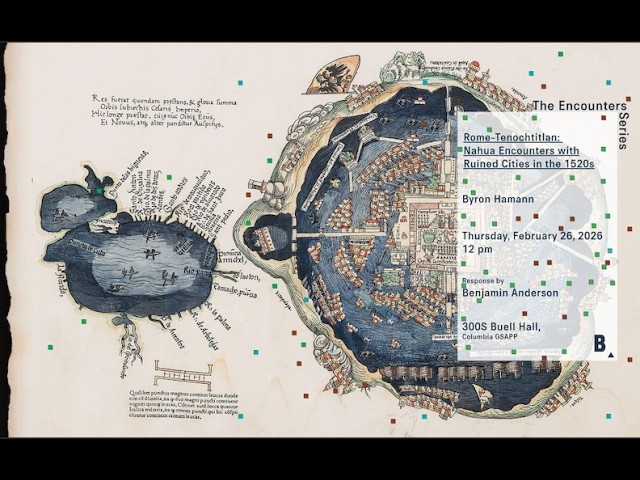
Encounters Series: Rome-Tenochtitlán: Nahua Encounters with Ruined Cities in the 1520s
Keywords
Summary
160 words
Critical Evaluation
Value of the Information & Strength of the Argument
The talk provides valuable insights into a little-known historical episode, offering a fresh perspective on early modern transatlantic connections. Hamann’s argumentation is solid, grounded in extensive archival research and a clear methodological framework. He effectively demonstrates the parallels between the two cities and the significance of the encounter. The use of economic records and papal bulls adds empirical weight to his claims. However, some interpretations, such as the architectural observations attributed to the Nahua visitors, are speculative and based on inference rather than direct evidence. Overall, the value of the information is high, and the argumentation is persuasive, though not without gaps.
Scientific Rigor, Source Quality, Title Accuracy
Hamann demonstrates rigorous scientific practice by clearly explaining his sources and methods. He uses a variety of archival documents, including Vatican registers, economic records, and chronicles, and acknowledges the limitations of these sources. The title accurately reflects the content, focusing on the Nahua encounter with ruined cities. The talk is well-structured and the sources are cited appropriately. However, the presentation is a work-in-progress, and some claims are based on estimates and interpretations that may be revised. The response by Benjamin Anderson provides additional scholarly context. Overall, the scientific rigor is high, and the title-content alignment is strong.
214 words
Title / Content Match
The title accurately reflects the content, focusing on Nahua encounters with ruined cities in the 1520s, specifically Rome and Tenochtitlan.
Quality & Reliability
8/10
The presentation is based on original archival research, with a clear methodological framework and critical handling of sources. The speaker is a recognized scholar in the field. However, the talk is a work-in-progress and some claims rely on estimates and interpretations that are not fully verifiable in the video.
Key Moments
Markers derived by PSI from the transcript: the creator did not define chapters.
- Introduction to the book project 'At the Butterfly House' and the 1529 Nahua voyage to Rome.
- Discussion of the sack of Rome in 1527 and the fall of Tenochtitlan in 1521, highlighting parallels.
- Methodological challenges: studying non-elite housing that no longer survives, using alphabetic documents.
- Analysis of economic records from the Spanish church in Rome to assess damage and recovery.
- Comparison of Rome and Tenochtitlan in terms of size and population, and the impact of destruction.
- The journey of the Nahua ambassadors through Iberia and their arrival in Rome in April 1529.
- The papal bulls granted to support indigenous churches in central Mexico.
- Discussion of the urban recovery of Rome and the experience of the Nahua visitors.
- Conclusion and implications for understanding cross-cultural encounters and urban history.
Cited Sources
- Vatican Archives - Papal Bulls — Copies of papal bulls granted to the Nahua ambassadors in 1529, located in Vatican registry books.
- Archive of the Indies, Seville — Economic records mentioning the Nahua visit to Rome.
- Paolo Giovio, 'Elogia virorum illustrium' (1551) — Two long sentences describing the Nahua visit to Rome.
- Bernal Díaz del Castillo, 'True History of the Conquest of New Spain' (1560s) — Two paragraphs about the Nahua ambassadors in Rome.
- Economic records of the Spanish church of St. James in Rome — Month-by-month economic records from 1486 to 1803, used to assess property damage and recovery.
- Archconfraternity of the Gonfalone economic records — Vatican archives documenting over 100 rental properties in Rome.
Concurring Sources
- Barbara E. Mundy, 'The Death of Aztec Tenochtitlan, the Life of Mexico City' (2015) — A prize-winning book on the transformation of Tenochtitlan into Mexico City, cited as a key reference.
Contribution & Novelties
The talk presents original archival discoveries, including previously forgotten papal bulls and economic records, shedding new light on the 1529 Nahua embassy to Rome. It offers a novel comparative perspective on the urban histories of Rome and Tenochtitlan, emphasizing the parallels in their destruction and reconstruction. The research challenges existing historiography by focusing on the recovery period of Rome, which has been largely neglected. The methodological approach of using alphabetic documents to study non-elite architecture is innovative and applicable to other contexts.
Pour aller plus loin :
- Nahua history — Provides background on the Nahua people and their culture.
- Sack of Rome (1527) — Details the event central to the talk.
- Tenochtitlan — Information on the Aztec capital and its fall.
121 words
Radar Profile
The radar profile shows high scores in quantity and quality of information, reflecting the depth of archival research. The technical level is moderate, indicating the talk is accessible to a general academic audience. Overall reliability is high, consistent with the speaker's expertise and use of primary sources.