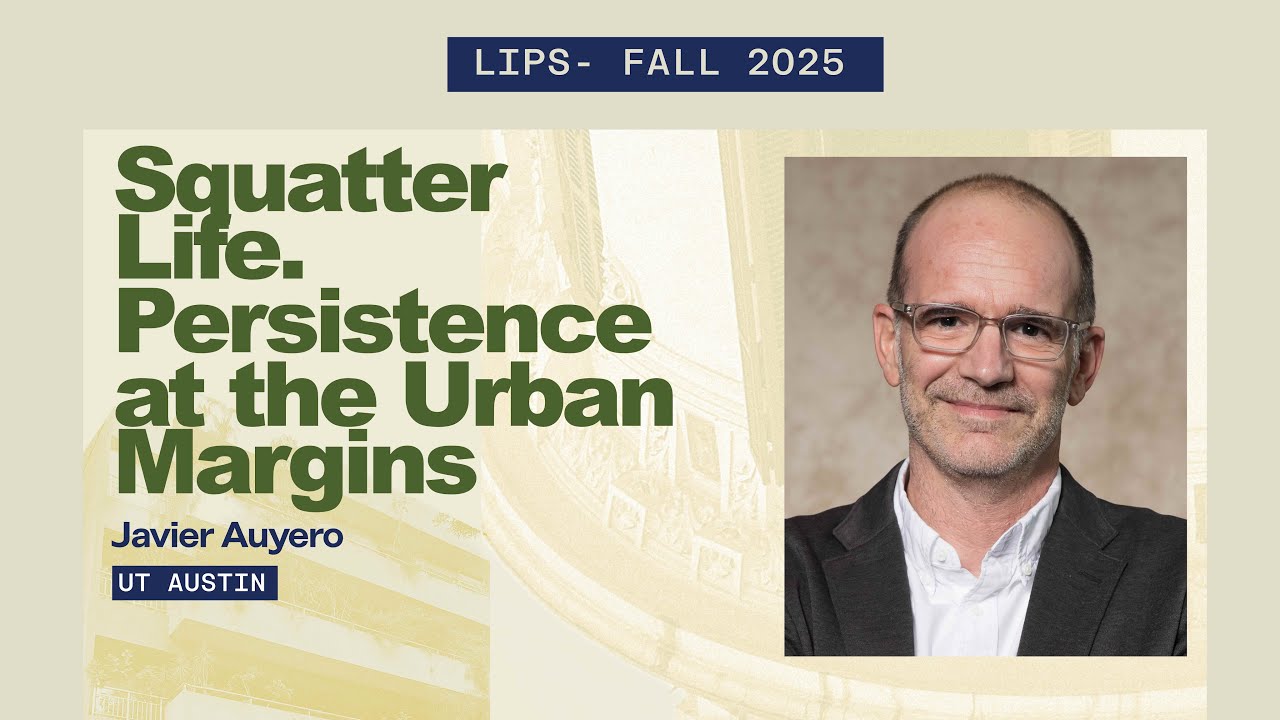
Columbia GSAPP: LiPS - Javier Auyero
Keywords
Summary
128 words
Critical Evaluation
Value of the Information & Strength of the Argument
The lecture provides valuable insights into the survival strategies of the urban poor and introduces the novel concept of ‘dark governance’ to analyze state-crime collusion. Auyero’s argument is well-structured, drawing on his extensive fieldwork and case studies. He effectively challenges the assumption that political power operates in opposition to criminal activity, showing how clandestine relationships can strengthen certain state actors. The discussion of ’things that work’ highlights the often-overlooked agency and labor of marginalized communities. However, the talk covers a lot of ground, and some concepts are introduced but not fully developed, leaving the audience wanting more depth.
Scientific Rigor, Source Quality, Title Accuracy
Auyero demonstrates scientific rigor by grounding his talk in his own ethnographic research and referencing established scholars like Matt Desmond and Norbert Elias. He is transparent about his methods, including participant observation and analysis of wiretapped conversations. The title accurately reflects the content, as it is a lecture on his recent work. However, the talk is more of an overview than a detailed presentation of findings, and some claims would benefit from more explicit citations. The Q&A session, not included in the transcript, might have provided additional clarification.
201 words
Title / Content Match
The title accurately reflects the content: a lecture by Javier Auyero at Columbia GSAPP, part of the LiPS series.
Quality & Reliability
8/10
The speaker is a recognized sociologist with extensive fieldwork and publications. The talk is based on his recent book and ongoing research, with clear methodological explanations. However, it is a lecture rather than a peer-reviewed presentation, and some claims are based on his own interpretation.
Key Moments
Markers derived by PSI from the transcript: the creator did not define chapters.
- Introduction of speaker and book 'Squatter Life'.
- Discussion of research questions and methods.
- Introduction of 'dark governance' concept.
- Examples of dark governance in Ecuador and El Salvador.
- Transition to 'things that work' and soup kitchen ethnography.
- Discussion of persistence and meaning-making.
- Conclusion and Q&A.
Cited Sources
- Squatter Life — Auyero's recent book co-authored with Sofia Servan, presented in the talk.
- Flammable: Environmental Suffering in an Argentine Shantytown — Mentioned as one of Auyero's previous works.
- Patients of the State — Mentioned as one of Auyero's previous works.
- In Harm's Way: The Dynamics of Urban Violence — Mentioned as a co-authored book.
- The Ambivalent State — Mentioned as a co-authored book.
Concurring Sources
- How Democracies Die — Referenced in the talk regarding the weakening of democratic institutions.
Contribution & Novelties
The lecture introduces the concept of ‘dark governance’ as an analytical tool to understand state-crime collusion, which is a novel contribution to the study of governance and urban marginality. It also emphasizes the importance of studying ‘persistence’ rather than just subsistence, highlighting the efforts of the poor to maintain dignity and meaning. The talk bridges ethnographic detail with broader theoretical implications, offering a fresh perspective on how power operates in marginalized communities.
Pour aller plus loin :
- Urban Ethnography — Provides background on the ethnographic method used in the research.
- State-Crime Nexus — Related concept in criminology.
- Informal Economy — Relevant to the survival strategies discussed.
106 words
Radar Profile
The radar profile shows high scores in information quantity, quality, and technical level, indicating a dense and substantive lecture. The fiabilite_globale is also high, reflecting the speaker's expertise. The overall note of 4 stars is justified by the depth of content and the speaker's authority.
💬 No comments were provided for analysis.