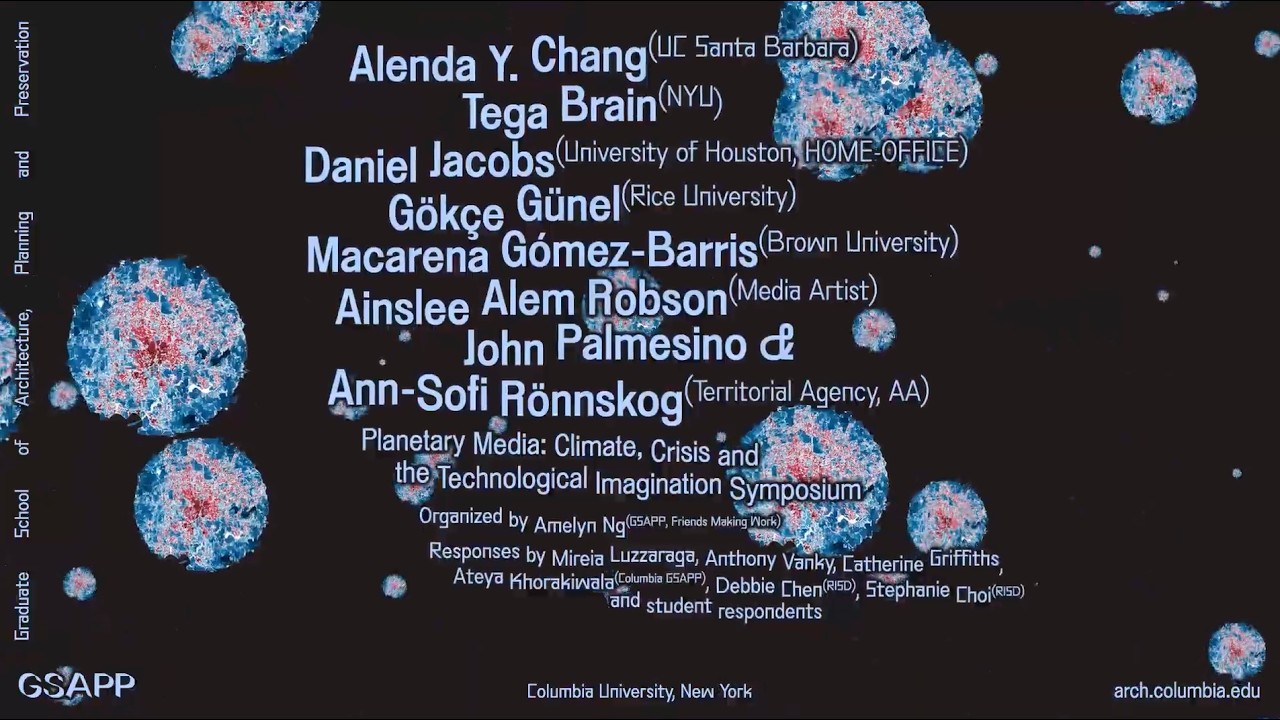
Planetary Media Symposium - Afternoon Session
Keywords
Summary
135 words
Critical Evaluation
Value of the Information & Strength of the Argument
The presentations offer valuable insights into decolonial and feminist perspectives on environmental media, challenging dominant narratives of the planetary. Gomez-Barris’s argumentation is compelling, weaving together art, history, and theory to propose alternative methods. The discussion highlights the importance of embodied and situated knowledge, and the need to address the colonial underpinnings of environmental crises. The arguments are well-supported by references to artists, thinkers, and historical events, though some claims are more suggestive than empirically grounded.
Scientific Rigor, Source Quality, Title Accuracy
The speakers are credible academics and practitioners, and they reference their own works and other scholarly sources. The title accurately reflects the content. The session is well-structured, with clear presentations and responses. However, the reliance on theoretical frameworks and artistic interpretations may limit the scientific rigor for some audiences. The sources cited are relevant and appropriately used, but the lack of empirical data or case studies reduces the overall scientific robustness.
161 words
Title / Content Match
The title accurately reflects the content, which is an afternoon session of a symposium on planetary media, featuring presentations and discussions.
Quality & Reliability
7/10
The session features academic speakers with established credentials, discussing theoretical and artistic perspectives on planetary media. Arguments are well-structured and grounded in scholarly references, though the content is largely theoretical and lacks empirical verification.
Key Moments
Markers derived by PSI from the transcript: the creator did not define chapters.
- Introduction and recap of morning session
- Introduction of speakers
- Macarena Gomez-Barris begins her presentation on 'Decompositions at the Sea's Edge'
- Discussion of May Stevens' water paintings and their political significance
- Gomez-Barris discusses her friendship with May Stevens and the Headlands Center for the Arts
- Transition to Ainslee Alam Robson's presentation (not detailed in transcript)
- Territorial Agency's remote presentation on Anthropocene territories
- Responses from faculty and students
- Q&A session begins
Cited Sources
- The Extractive Zone: Social Ecologies and Decolonial Perspectives — Gomez-Barris's book, referenced as a key work in her presentation.
- Beyond the Pink Tide: Art and Political Undercurrents in the Americas — Another book by Gomez-Barris, mentioned in her introduction.
- Where Memory Dwells: Culture and State Violence in Chile — Gomez-Barris's earlier work, referenced in her introduction.
- Toward a Sociology of the Trace — Co-edited volume by Gomez-Barris, mentioned in her introduction.
- May Stevens' water paintings — Artworks discussed by Gomez-Barris as examples of counter-archival practice.
Concurring Sources
- The Extractive Zone — Gomez-Barris's book aligns with the themes of extractivism and decoloniality discussed.
- Territorial Agency's projects — Their work on Anthropocene territories resonates with the symposium's focus.
Dissenting Sources
- None — No discordant sources were identified within the session.
Contribution & Novelties
The session contributes to the discourse on planetary media by centering decolonial and feminist perspectives, emphasizing embodied and poetic methods. It challenges the dominant techno-scientific framing of the planetary and offers alternative ways of knowing and being. The discussion of May Stevens’ work and the concept of ‘wet ethnographies’ provide novel approaches to environmental humanities.
Pour aller plus loin :
- Decolonial theory — Overview of decolonial thought.
- Feminist environmental humanities — Intersection of feminism and environmentalism.
- Anthropocene — Geological epoch concept.
- Territorial Agency — Official website of the architectural practice.
90 words
Radar Profile
The radar profile shows high scores in quality of information and global reliability, reflecting the academic rigor and expertise of the speakers. The lower score in technical level indicates that the content is more theoretical and accessible, while the quantity of information is moderate due to the limited number of presentations.
💬 No comments were provided for analysis.