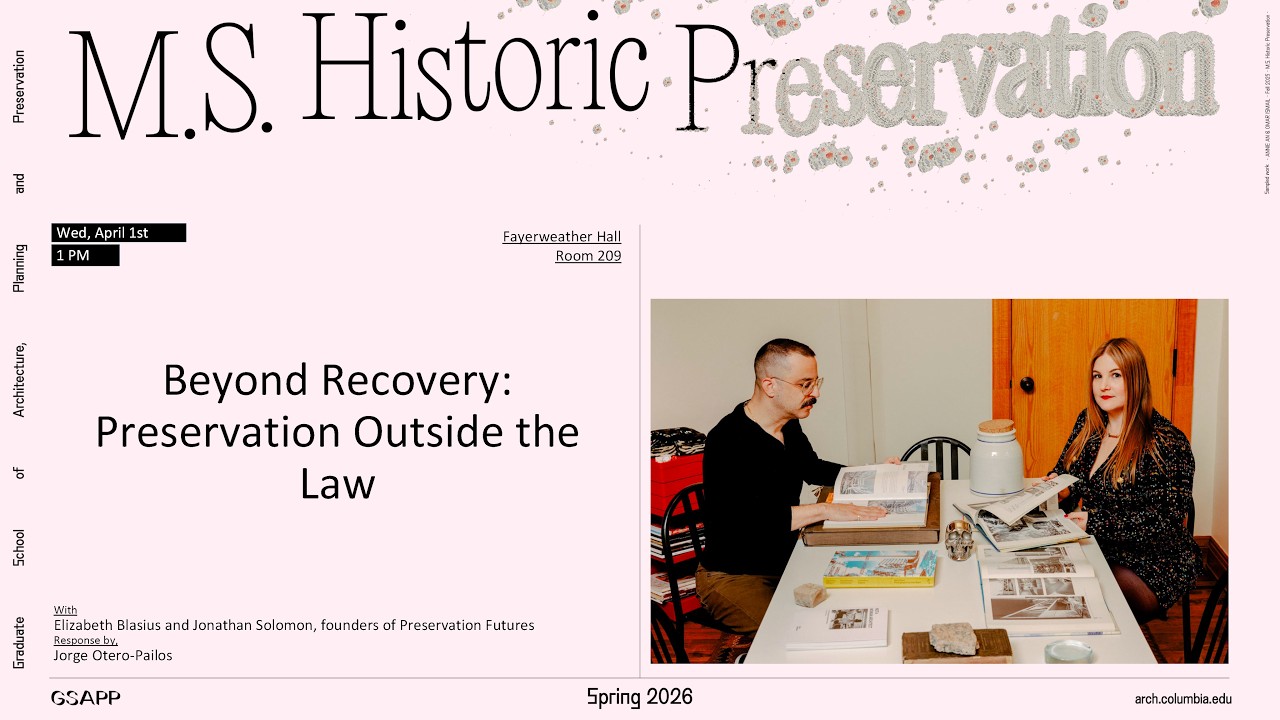
Columbia GSAPP Preservation Lecture Series: Preservation Futures
Keywords
Summary
218 words
Critical Evaluation
Value of the Information & Strength of the Argument
The lecture provides valuable insights into the limitations of current preservation laws and offers concrete examples of alternative practices. The argumentation is strong, grounded in historical analysis and professional experience. The speakers effectively critique the systemic biases in preservation and advocate for a more inclusive approach. They support their claims with specific examples and articulate a clear vision for the future of preservation.
Scientific Rigor, Source Quality, Title Accuracy
The lecture demonstrates high scientific rigor, referencing specific legislation, executive orders, and historical events. The speakers cite the National Historic Preservation Act, the Department of the Interior’s theme studies, and the Home Owners’ Loan Corporation redlining maps. They also reference their own projects and publications. The title accurately reflects the content, focusing on preservation beyond legal frameworks. The lecture is well-structured and the arguments are logically presented.
145 words
Title / Content Match
The title accurately reflects the content: the lecture focuses on the future of preservation, particularly the need to move beyond legal frameworks to address suppressed histories.
Quality & Reliability
8/10
The lecture is delivered by established professionals in preservation, Elizabeth Blasius and Jonathan Solomon, and is hosted by Columbia GSAPP, a reputable academic institution. The content is well-structured, referencing specific historical events, legislation, and case studies. The speakers demonstrate deep expertise and provide a critical analysis of preservation practices. While the lecture is opinionated and advocacy-oriented, it is grounded in documented history and professional experience.
Key Moments
Markers derived by PSI from the transcript: the creator did not define chapters.
- Introduction by Columbia GSAPP faculty, highlighting the importance of experimental preservation.
- Elizabeth Blasius introduces the topic 'Beyond Recovery: Preservation Outside the Law' and discusses the Trump administration's executive order on 'Restoring Truth and Sanity to American History'.
- Discussion of the two liabilities of preservation: predetermined historical values and alignment with neoliberal development.
- Introduction of the first case study: the Clark-Ford House, Chicago's oldest house, saved by Bishop Louis Henry Ford.
- Detailed history of the Clark-Ford House and the erasure of Black contributions in its interpretation.
- Second case study: the Emmett Till and Mamie Till-Mobley House, and Preservation Futures' work on landmarking and context studies.
- Third case study: the Illinois Black Panther Party Heritage Trail, highlighting community engagement and alternative preservation methods.
- Conclusion and conversation with Jorge Otero-Pailos, discussing the future of preservation.
Cited Sources
- National Historic Preservation Act (NHPA) — Referenced as the foundational law for preservation, critiqued for its biases.
- Executive Order on Restoring Truth and Sanity to American History — Cited as the trigger for the lecture's discussion on preservation outside the law.
- National Register of Historic Places — Discussed as a mechanism that favors wealthy developers and excludes certain histories.
- Home Owners' Loan Corporation (HOLC) redlining maps — Mentioned in the context of the Clark-Ford House neighborhood's disinvestment.
- Emmett Till and Mamie Till-Mobley House — Case study of Preservation Futures' work.
- Illinois Black Panther Party Heritage Trail — Case study of Preservation Futures' work.
Concurring Sources
- National Trust for Historic Preservation — The Trust has also raised concerns about threats to preservation, aligning with the lecture's critique.
- Landmarks Illinois — A local organization that responded to the executive order, similar to the lecture's concerns.
Dissenting Sources
Contribution & Novelties
The lecture offers a critical perspective on preservation, arguing that legal frameworks inherently exclude marginalized histories and that preservation must operate outside the law to be inclusive. It provides concrete examples from Chicago, demonstrating how preservation can be reimagined through community engagement and creative storytelling. The speakers propose a shift from a focus on landmark buildings to a broader interpretation of historical narratives.
Pour aller plus loin :
- Critical Heritage Studies — This field examines the political and social dimensions of heritage, aligning with the lecture’s critique.
- The National Trust for Historic Preservation — An organization that often works within legal frameworks but also advocates for inclusive preservation.
- The 1966 National Historic Preservation Act — The law critiqued in the lecture; understanding its provisions is essential.
- Redlining — The practice of discriminatory lending that affected neighborhoods like the one around the Clark-Ford House.
143 words
Radar Profile
The radar profile shows high scores in information quantity, quality, and technical level, with a slightly lower but still strong score in overall reliability. This indicates a well-researched and informative lecture that is technically accessible to a professional audience, with a solid foundation in evidence and expertise.
💬 No comments were provided for analysis.