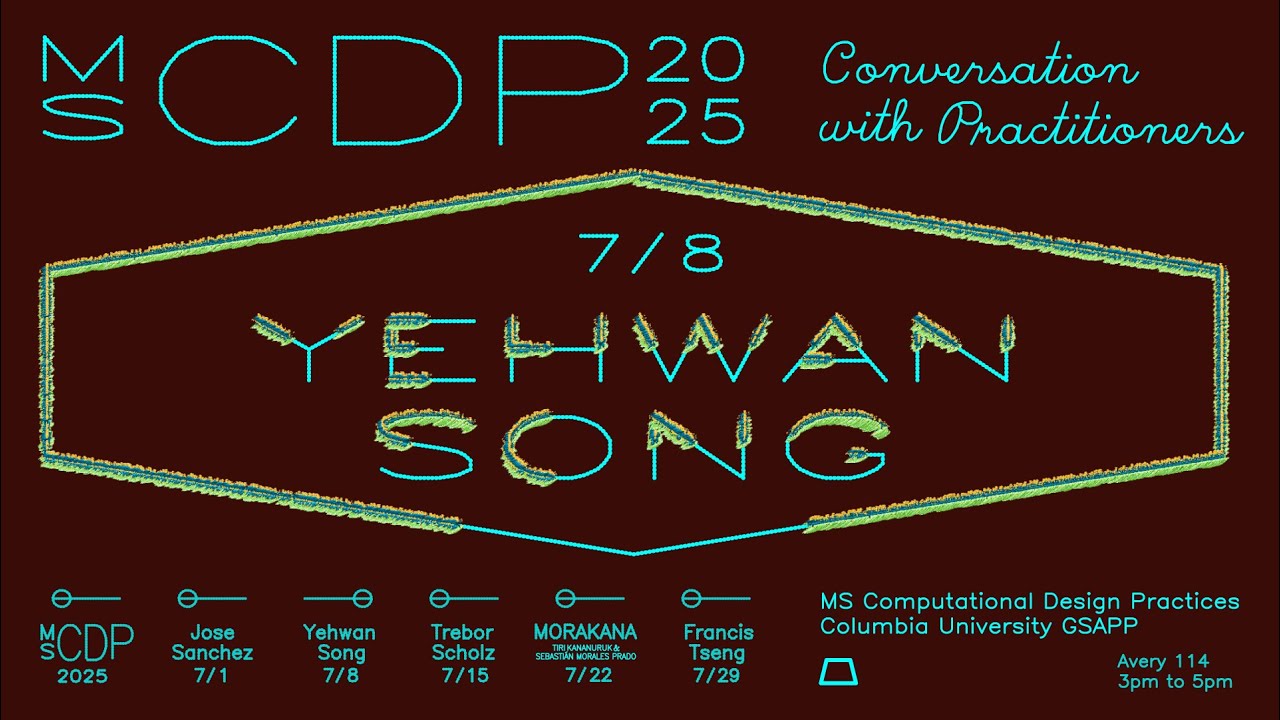
Columbia GSAPP CDP Conversation with Practitioners: Yehwan Song
Keywords
Summary
146 words
Critical Evaluation
Value of the Information & Strength of the Argument
The talk provides valuable insights into the creative process of a web artist and the conceptual underpinnings of anti-user-friendly design. Song’s argumentation is coherent and well-illustrated with concrete examples from her work. She effectively critiques the limitations of traditional UX/UI design and advocates for more experimental and empathetic approaches. The value lies in the originality of her perspective and the practical demonstrations of her concepts. However, the argumentation is primarily anecdotal and lacks rigorous theoretical or empirical support, which limits its generalizability.
Scientific Rigor, Source Quality, Title Accuracy
The talk is a practitioner’s account and does not cite external sources. The quality of sources is therefore limited to the artist’s own work and experience. The title accurately reflects the content, as it is a conversation with a practitioner. The talk is well-structured and the artist provides clear explanations of her projects, but the lack of citations and formal references reduces its scientific rigor. No comments were provided for analysis.
168 words
Title / Content Match
The title accurately reflects the content: a conversation with practitioner Yehwan Song about her web art and design practice.
Quality & Reliability
7/10
The talk is a practitioner's account of their artistic and design practice, with no formal citations or peer-reviewed references. The information is based on personal experience and creative work, which is reliable for understanding the artist's perspective but not for generalizable scientific claims.
Key Moments
Markers derived by PSI from the transcript: the creator did not define chapters.
- Introduction of Yehwan Song by the host, highlighting her anti-user-friendly practice.
- Song begins her talk with a quote from Cedric Price and discusses her background as a UX/UI designer.
- Presentation of early anti-user-friendly websites, including one requiring four-finger touch and device rotation.
- Discussion of COVID-era projects, including a remote touch website and a lip-touch emergency website.
- Experiments with conductive materials, water, and touch screens, including a water gun interaction.
- Exploration of 3D websites using multiple devices and physical installations.
- Introduction of 'narrative architecture' concept and examples of websites that represent content structure.
- Presentation of client projects, including a museum website with a rotating cube and a random-generated website.
- Q&A session begins, with questions about creative process and client collaboration.
Cited Sources
- Yehwan Song's website — Artist's portfolio and archive of her web projects.
Concurring Sources
- Yehwan Song's website — Artist's portfolio and archive of her web projects.
Contribution & Novelties
The talk offers a unique perspective on web design, challenging conventional user-friendly paradigms and proposing a more experimental, empathetic approach. Song’s concept of ’narrative architecture’ is an original contribution, linking web design to architectural thinking. Her practice demonstrates the potential of using device sensors and gestures to create more engaging and meaningful web experiences.
Pour aller plus loin :
- Anti-user-friendly design — Wikipedia article on user-centered design, which contrasts with Song’s approach.
- Critical design — Wikipedia article on critical design, which uses design to critique societal norms.
- Interactive art — Wikipedia article on interactive art, relevant to Song’s installations and performances.
101 words
Radar Profile
The radar profile shows high scores in quantity and quality of information, reflecting the rich content and clear presentation. The technical level is moderate, suitable for a general audience, while the reliability is high for a practitioner's account, though not based on formal research.