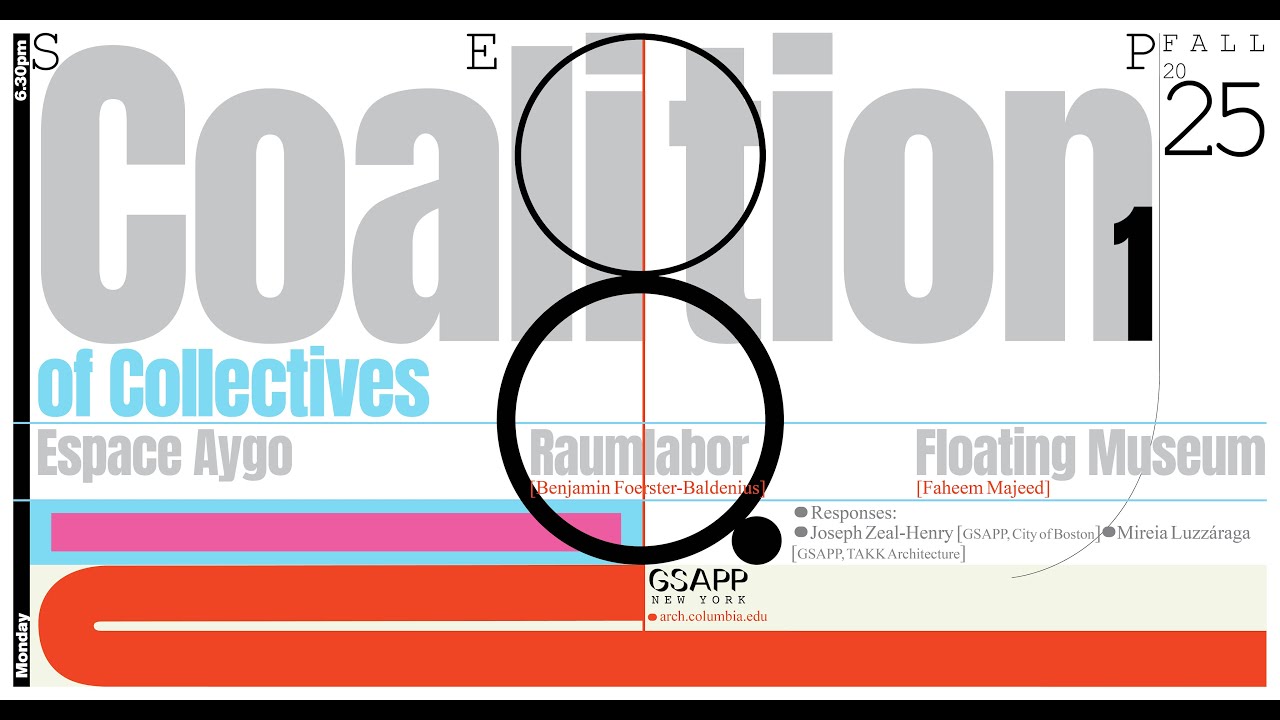
GSAPP Coalition 1: Coalition of Collectives w/ Espace Aygo, the Floating Museum, & Raumlabor
Keywords
Summary
166 words
Critical Evaluation
Value of the Information & Strength of the Argument
The value of the information lies in the firsthand accounts of practitioners who have successfully implemented alternative models of architectural and artistic practice. The argumentation is grounded in concrete examples and personal experiences, making it compelling and credible. The speakers emphasize the importance of collaboration, community engagement, and flexibility in addressing urban challenges. The discussion is not heavily theoretical but rather practical, offering insights into how collectives can operate effectively within existing systems while challenging them.
Scientific Rigor, Source Quality, Title Accuracy
The scientific rigor is moderate; the speakers are recognized experts in their fields, but the format is a discussion rather than a formal presentation with citations. The sources cited are primarily the speakers’ own projects and experiences, which are well-documented in the public domain. The title accurately reflects the content, which is a coalition of collectives discussing their practices. The discussion is coherent and stays on topic, with each speaker contributing to the overarching theme of collective action in the built environment.
173 words
Title / Content Match
The title accurately reflects the content, which is the first in a series of coalition discussions featuring three collective practices.
Quality & Reliability
7/10
The discussion features established practitioners with significant institutional recognition, but it is a conversational panel without formal citations or peer-reviewed sources. The content is experiential and practice-based, with high credibility in the field but limited verifiability.
Key Moments
Markers derived by PSI from the transcript: the creator did not define chapters.
- Introduction by the dean, emphasizing the need for coalitions and dispersed interventions.
- Faheem Majeed introduces The Floating Museum and shows a video about their projects.
- Faheem discusses the Mecca Flats installation and the Burrow's Residency Program.
- Benjamin Foerster-Baldenius begins his presentation, sharing his personal history with collectives.
- Benjamin discusses Raumlabor's projects and the concept of cohabitation.
- Espace Aygo presents their house in Brussels and their approach to total design.
- Q&A session begins with questions from Joseph Zeal-Henry and Mireia Luzzárraga.
- Audience questions and discussion on collective practices and community engagement.
Cited Sources
- The Floating Museum — Faheem Majeed discusses the organization's projects and mission.
- Raumlabor — Benjamin Foerster-Baldenius mentions the collective's work and projects.
- Espace Aygo — Salome Sperling and Line Murken present their collective and house in Brussels.
Concurring Sources
- The Floating Museum — The organization's official website provides detailed information on their projects and philosophy.
- Raumlabor — The collective's website showcases their diverse projects and publications.
- Espace Aygo — The collective's website describes their house and design philosophy.
Contribution & Novelties
The video provides a unique insight into the operational strategies of three distinct collectives, highlighting common principles such as working ‘with and not for’ communities, using space as a material, and embracing cohabitation. It offers a practical perspective on how collectives can navigate institutional frameworks and create meaningful impact. The discussion also introduces the concept of ‘coalitions’ as a new format for public programming, which could inspire similar initiatives in other institutions.
Pour aller plus loin :
- The Floating Museum — Official website with project documentation.
- Raumlabor — Official website with project descriptions and publications.
- Espace Aygo — Official website with details on their house and practice.
- Floating University Berlin — Project by Raumlabor, winner of the Golden Lion at the Venice Architecture Biennale 2023.
- Chicago Architecture Biennial — Faheem Majeed curated the 5th edition; relevant to the discussion.
139 words
Radar Profile
The radar profile shows high scores in quantity and quality of information, moderate technical level, and high reliability. This indicates a well-rounded discussion with substantial content, accessible to a general audience, and based on credible practitioner experiences.
💬 Sur les 0 commentaires analysés, aucune tendance n'est disponible.