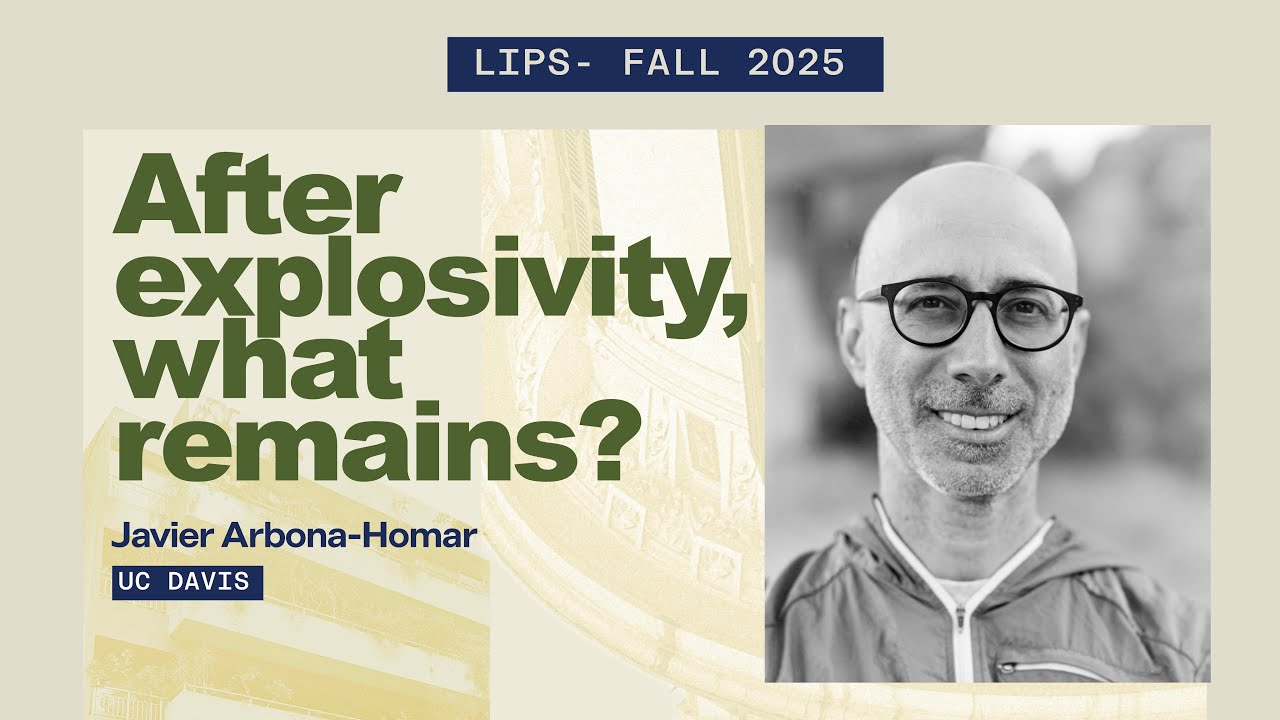
Columbia GSAPP: LiPS - Javier Arbona-Homar
Keywords
Summary
158 words
Critical Evaluation
Value of the Information & Strength of the Argument
The talk provides valuable insights into the spatial politics of explosions, offering a novel framework (’explosivity’) that connects historical events to contemporary landscapes. The argument is well-supported with specific case studies and references to scholarly work, such as Seth Lunan’s statistics on dynamite manufacturing. The speaker’s interdisciplinary approach (geography, American studies, design) enriches the analysis. However, the argumentation is largely theoretical and relies on the speaker’s own interpretations, which may not be universally accepted. The talk is more of an expert opinion than a systematic study, but it is compelling and thought-provoking.
Scientific Rigor, Source Quality, Title Accuracy
The speaker demonstrates scientific rigor by grounding his research in archival work, site visits, and engagement with existing literature. He cites specific sources, such as the Robert Allen papers and works by scholars like Seth Lunan and Dravka Seulich Milik. The title accurately reflects the content, as it is a lecture in the LiPS series at Columbia GSAPP. The talk is well-structured, with clear references to his book and ongoing research. However, the presentation is not peer-reviewed, and some claims are based on personal interpretation. The speaker acknowledges the limitations and the need for further research.
203 words
Title / Content Match
The title accurately reflects the content: a lecture by Javier Arbona-Homar at Columbia GSAPP's LiPS series.
Quality & Reliability
8/10
The speaker is a recognized academic (associate professor) presenting his book and research, with clear methodology and references to archival work and scholarly sources. The talk is well-structured and grounded in specific case studies, though it is an expert opinion rather than a peer-reviewed presentation.
Key Moments
Markers derived by PSI from the transcript: the creator did not define chapters.
- Introduction by moderator Daniela, introducing Javier Arbona-Homar.
- Speaker begins talk, discusses his background and the concept of appearances and disappearances in landscapes.
- Introduction of the book 'Explosivity' and its focus on the San Francisco Bay Area.
- Discussion of the Port Chicago explosion and the memorial, and the concept of following what remains.
- Introduction of other case studies: Wells Fargo depot, Western Fuse, Judy Barry, and Mythbusters.
- Exploration of the concept of explosivity and its scales, including the analogy with aneurysms.
- Discussion of the Mythbusters episode and the cultural embrace of explosivity.
- Explanation of the methodology, including site walks and the artistic collaboration Demilits.
- Analysis of the Bay Area as a unique case study for explosivity and its racial logistics.
- Conclusion and transition to Q&A.
Cited Sources
- Explosivity: Following What Remains — The speaker's own book, which is the main subject of the talk.
- Robert Allen papers — Archival source containing photographs of Port Chicago survivors.
- Seth Lunan — Geographer cited for statistics on dynamite manufacturing in California.
- Dravka Seulich Milik and Philip Satler — Architectural historians quoted on colonial practices and minerals.
Concurring Sources
- Port Chicago Naval Magazine National Memorial — Official National Park Service site providing historical context for the Port Chicago explosion.
- Demilits — Website of the artistic collaboration co-founded by the speaker, relevant to his methodology.
Contribution & Novelties
The talk introduces the concept of ’explosivity’ as a lens to understand landscapes shaped by explosions, offering a novel framework that connects historical events to contemporary issues of race, colonialism, and memory. It challenges the notion that empire hides in landscapes, arguing instead that it is visible in everyday traces. The methodology of ‘following what remains’ and site walks provides a practical approach to studying dispersed archives. The talk also highlights the particulate and granular scales of evidence, which are often overlooked.
Pour aller plus loin :
- Port Chicago Naval Magazine National Memorial — Official site for the memorial discussed in the talk.
- Demilits — Artistic collaboration co-founded by the speaker, focusing on decoding military landscapes.
- MythBusters — Wikipedia page for the show, relevant to the case study discussed.
129 words
Radar Profile
The radar profile shows high scores in information quantity, quality, and reliability, with a slightly lower technical level due to the humanities focus. The overall shape indicates a well-rounded, credible presentation with strong content and sources.
💬 No comments were provided for analysis.