Lainey Bloom - Urban Agriculture and Climate Resilience - MAS CSP 2026 Symposium
Keywords
Summary
178 words
Critical Evaluation
Value of the Information & Strength of the Argument
The value of the information is high, as it provides direct insights from urban farmers, a perspective often missing in climate resilience research. The argumentation is solid, grounded in qualitative data with specific examples and quotes. The presentation logically connects climate impacts to farmer experiences, adaptation strategies, and barriers, building a coherent case for policy support. The research is well-structured and transparent about its methods, enhancing its credibility.
Scientific Rigor, Source Quality, Title Accuracy
The scientific rigor is good for a qualitative study: the methodology is clearly described, and the findings are presented with evidence. The sources cited are primarily the interviews themselves, which are appropriate for this type of research. The title accurately reflects the content. The presentation is part of an academic symposium, and the research is affiliated with UC San Diego, adding to its credibility. However, as a single case study, the generalizability is limited, and the lack of peer review means some details are not fully verified.
170 words
Title / Content Match
The title accurately reflects the content, which focuses on urban agriculture and climate resilience in San Diego County.
Quality & Reliability
8/10
The presentation is based on original qualitative research involving interviews and site visits with 10 urban farms, providing direct empirical evidence. The methodology is clearly described, and the findings are presented with specific examples and quotes. The research is part of an academic program (MAS CSP) and is supported by a recognized institution (UC San Diego). However, it is a single case study with a small sample size, and the results may not be generalizable. The presentation is a symposium talk, not a peer-reviewed publication, so some details of the analysis are not fully disclosed.
Key Moments
Markers derived by PSI from the transcript: the creator did not define chapters.
- Introduction and research context on climate change and food systems
- Definition of urban agriculture and its potential benefits
- Research questions and methodology: interviews with 10 urban farms
- Findings: climate impacts on farms, including heat, flooding, and fire risk
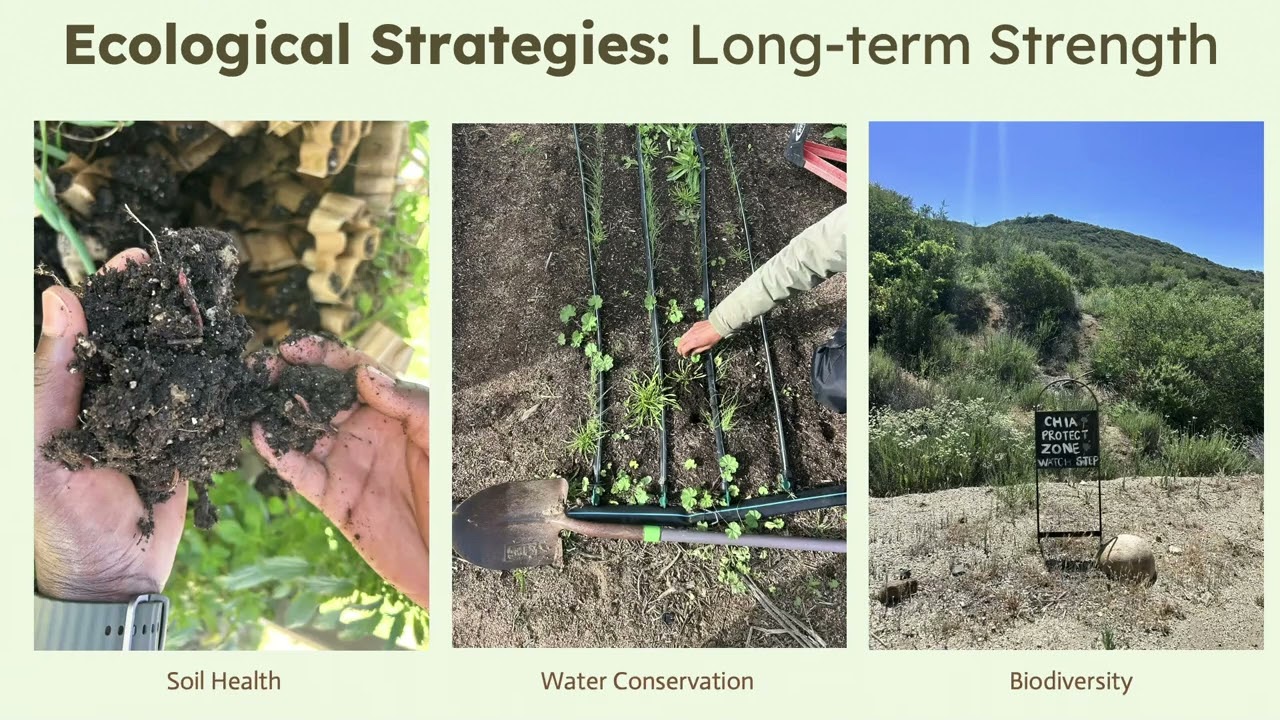
- Adaptation strategies: infrastructure, ecological practices, and biodiversity
- Community resilience: food access, education, and knowledge sharing
- Barriers to resilience: financial strain, labor, and land insecurity
- Support programs and policy recommendations
- Conclusion and acknowledgments
Cited Sources
- Growing Equity program — Program led by UC San Diego's Center for Community Health that supports urban farms in San Diego.
- Food Shed Cooperative — Organization that purchases from local farms and distributes to food banks.
- San Diego Food System Alliance — Organization leading policy and advocacy for local food systems, created Food Vision 2030.
Concurring Sources
- Growing Equity program — Program that supports urban farms, providing funding and technical assistance.
Contribution & Novelties
This research provides a unique perspective by centering the lived experiences of urban farmers in San Diego, which is often overlooked in climate resilience discourse. It highlights specific adaptation strategies and barriers, offering actionable insights for policy and funding. The study contributes to the growing body of literature on urban agriculture and climate adaptation, emphasizing the need for long-term, flexible support.
Pour aller plus loin :
- Urban agriculture — Overview of urban agriculture and its benefits.
- Climate resilience — Definition and frameworks for climate resilience.
- Food systems and climate change — IPCC report on climate change and land, including food systems.
101 words
Radar Profile
The radar profile shows high scores in information quantity, quality, and reliability, with a moderate technical level. This indicates a well-researched presentation that is accessible to a broad audience while maintaining scientific depth.