Michael Stevens - Extreme Heat and Dust at California's Salton Sea - MAS CSP 2026 Symposium
Keywords
Summary
172 words
Critical Evaluation
Value of the Information & Strength of the Argument
The presentation provides valuable insights into the compound exposure of heat and dust, a topic with limited prior research. The argumentation is solid, based on quantitative analysis with clear definitions and methodology. The use of a dust-heat index and disproportionality analysis strengthens the case for environmental injustice. The speaker effectively connects the findings to broader implications for other drying lakes, such as the Great Salt Lake.
Scientific Rigor, Source Quality, Title Accuracy
The scientific rigor is moderate: the study uses credible data sources (CDC, proprietary datasets) and transparent methods, but it is a student project without peer review. The title accurately reflects the content. The presentation acknowledges limitations, including the lack of recent data and the need for causal evidence. No external sources are cited beyond the data providers.
138 words
Title / Content Match
The title accurately reflects the content, focusing on extreme heat and dust at the Salton Sea.
Quality & Reliability
7/10
The presentation is a capstone project with clear methodology, data sources, and limitations. However, it is a student presentation, not peer-reviewed, and relies on proprietary datasets not fully described.
Key Moments
Markers derived by PSI from the transcript: the creator did not define chapters.
- Introduction to the Salton Sea and its history
- Explanation of the 2003 Quantification Settlement Agreement
- Definition of compound exposure and research questions
- Methodology: data sources and analysis definitions
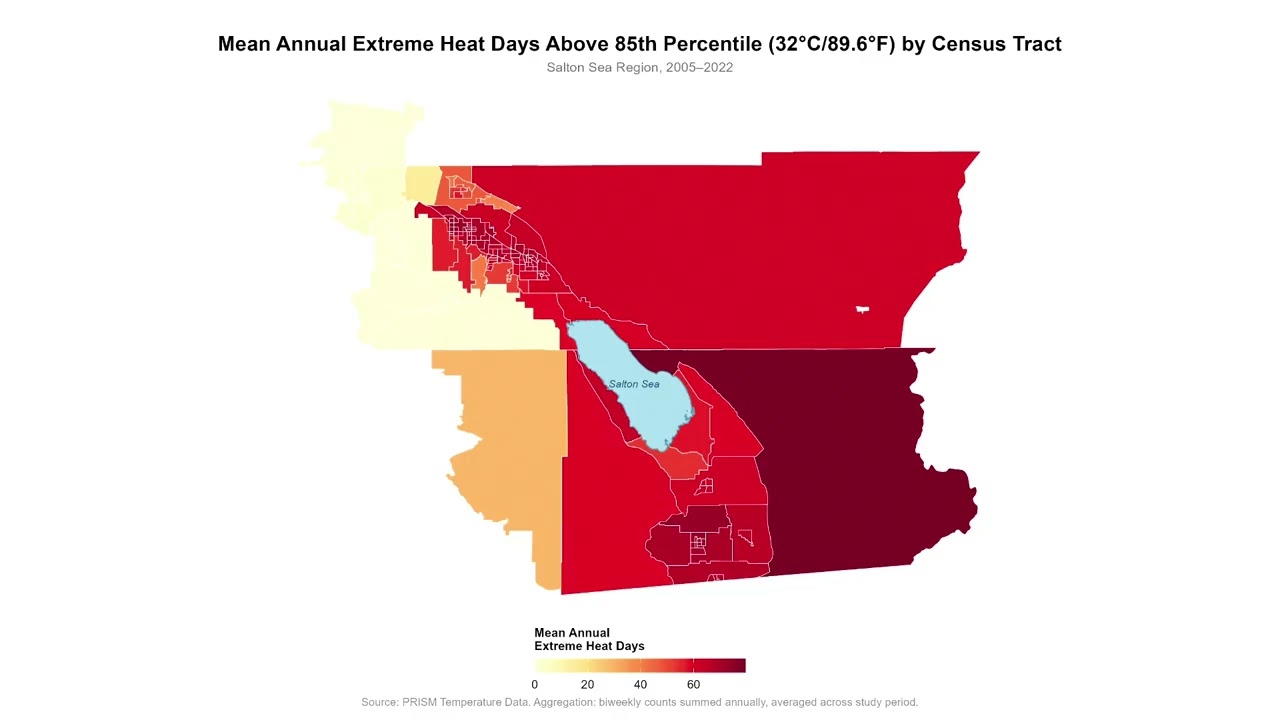
- Results: spatial patterns of heat and dust
- Disproportionality analysis by social vulnerability
- Demographic predictors and asthma analysis
- Conclusions and limitations
- Future work and Q&A
Cited Sources
- CDC Social Vulnerability Index — Used to assess community vulnerability.
- Michael Cohen's water optimization proposal — Mentioned as a restoration solution.
Concurring Sources
- CDC Social Vulnerability Index — Supports the use of SVI in vulnerability assessment.
Contribution & Novelties
The study provides a novel analysis of compound exposure to extreme heat and dust at the Salton Sea, highlighting environmental justice implications. It quantifies disproportionate impacts on vulnerable populations, particularly racial minorities. The dust-heat index is an innovative metric.
Pour aller plus loin :
- Salton Sea — Background on the lake’s history and environmental issues.
- Environmental justice — Framework for understanding disproportionate impacts.
- Quantification Settlement Agreement — Context on water transfer policies.
72 words
Radar Profile
The radar profile shows high scores in quantity of information and technical level, but lower in reliability due to the non-peer-reviewed nature. The balance suggests a detailed but not fully validated study.