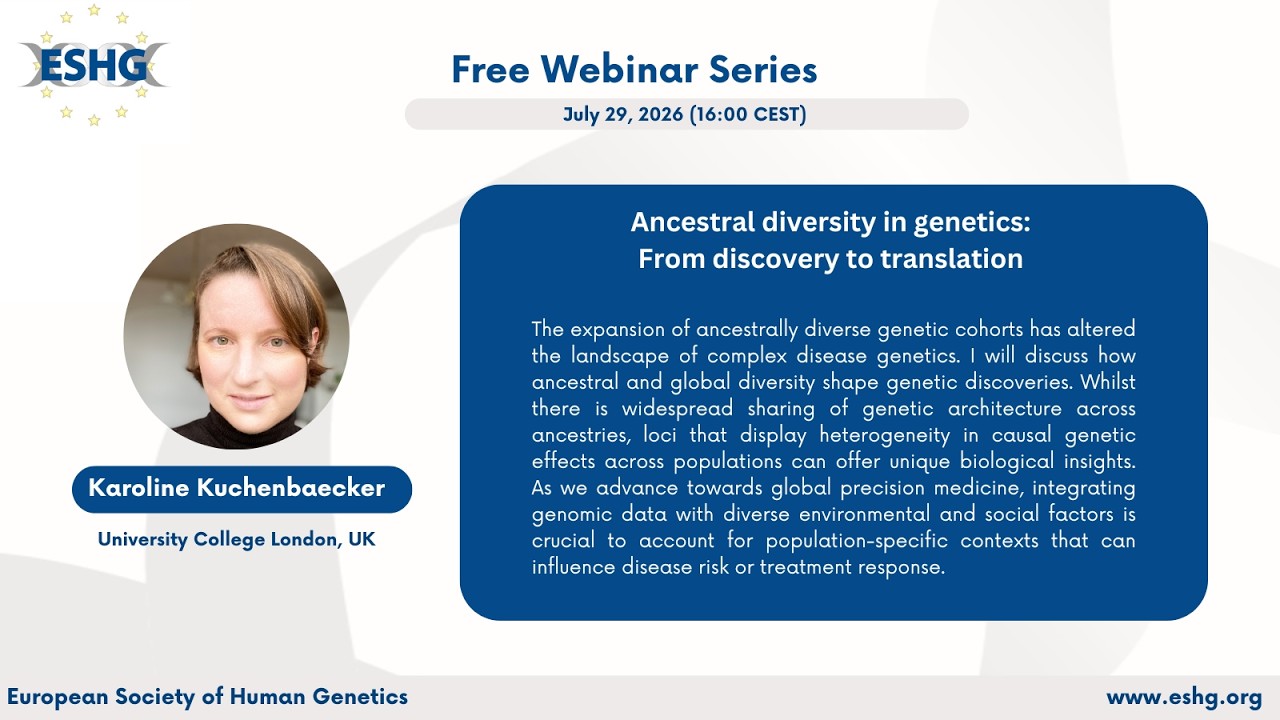
ESHG Webinar Series Season 2 Episode 6 with Karoline Kuchenbaecker
Keywords
Summary
165 words
Critical Evaluation
Value of the Information & Strength of the Argument
The talk provides a valuable overview of the current state and importance of ancestral diversity in genetics. The argumentation is solid, based on published research and large-scale studies. The speaker effectively uses population genetics principles to explain observed patterns and predictions. She presents concrete examples and data to support her claims, such as the increased number of variants found in diverse cohorts and the improved fine mapping resolution. The discussion of the CETP locus illustrates the complexity of cross-ancestry effects and the need for caution in translation. The argumentation is balanced, acknowledging both the universality of most genetic effects and the existence of exceptions.
Scientific Rigor, Source Quality, Title Accuracy
The speaker demonstrates scientific rigor by referencing specific studies and datasets, such as the Pan UK Biobank, AWI-Gen, and the 100,000 Genomes Project. She also mentions her own published work in Nature Reviews Genetics. The sources are credible and relevant. The title accurately reflects the content, which covers both discovery and translational aspects. The talk is well-structured and the claims are supported by evidence, though some details are not fully elaborated due to time constraints.
194 words
Title / Content Match
The title accurately reflects the content, which focuses on ancestral diversity in genetics from discovery to translation.
Quality & Reliability
8/10
The talk is given by a professor of genetic epidemiology at UCL and scientific lead for diverse data at Genomics England, with clear expertise. The content is based on published research and large-scale studies, but is presented as an overview and personal perspective, with some claims not fully detailed.
Key Moments
Markers derived by PSI from the transcript: the creator did not define chapters.
- Introduction and overview of the talk's focus on ancestral diversity in disease genetics.
- Discussion of the historical bias towards European ancestry in genetic studies and the lack of improvement.
- Explanation of population genetics concepts: allele frequency differences, linkage disequilibrium, and their implications.
- Presentation of evidence for more genomic variation in diverse populations, including examples from the Million Veterans Program and All of Us.
- Discussion of the Pan UK Biobank study showing additional discoveries from including diverse ancestries.
- Example of a depression-associated variant found in African ancestry individuals, highlighting the MCH2 gene.
- Benefits of ancestral diversity for fine mapping, with examples from depression and breast cancer.
- Discussion of transferability of findings, including the CETP locus example and its implications for drug development.
- Transition to rare disease genomics and the role of the 100,000 Genomes Project.
- Description of the variant prioritization pipeline and the impact of ancestry on diagnostic yield.
Cited Sources
- Nature Reviews Genetics publication on ancestral diversity — Mentioned as published earlier this year, likely by the speaker and colleagues.
- Pan UK Biobank — Referenced for showing additional discoveries from diverse ancestries.
- AWI-Gen study — Referenced for pulse pressure associations in African populations.
- Genes and Health — Referenced for British South Asian cohort and CETP locus findings.
- China Kadoorie Biobank — Referenced for similar CETP findings in East Asian populations.
- 100,000 Genomes Project — Referenced as the pilot dataset for the National Genomic Research Library.
- Million Veterans Program — Referenced for finding 50% more variants in diverse vs European-only analysis.
- All of Us Research Program — Referenced for discovering 275 million novel variants.
Concurring Sources
- Nature Reviews Genetics publication on ancestral diversity — The speaker's own work, likely summarizing the field.
- Pan UK Biobank — Study showing additional discoveries from diverse ancestries.
- AWI-Gen study — African study showing novel associations.
Dissenting Sources
- CETP locus findings — The speaker notes that the association with LDL cholesterol is not observed in South Asian and East Asian populations, contrary to European findings.
Contribution & Novelties
The talk provides a comprehensive overview of the current state and importance of ancestral diversity in genetics, synthesizing recent findings and highlighting key challenges. It emphasizes the translational implications for genomic medicine, particularly in rare disease diagnosis. The speaker’s perspective as a leader in diverse data initiatives adds practical insight.
Pour aller plus loin :
- Genome-wide association studies — Provides background on GWAS methodology and limitations.
- Linkage disequilibrium — Explains the concept central to the talk’s population genetics framework.
- Polygenic risk scores — Discusses the transferability issues mentioned in the talk.
- 100,000 Genomes Project — Details the UK initiative referenced in the talk.
- Genomics England — Official site for the organization leading the 100,000 Genomes Project.
116 words
Radar Profile
The radar profile shows high scores in information quantity, quality, and reliability, with a slightly lower technical level, indicating a comprehensive and credible talk that is accessible to a broad audience.
💬 No comments were provided for analysis.