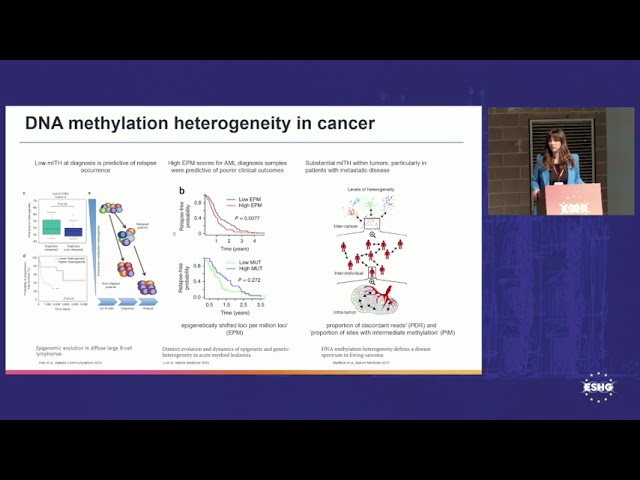
E03.1 - epiTRACERx: Dissecting the genomic-epigenomic evolution in non-small-cell lung cancer
Keywords
Summary
195 words
Critical Evaluation
Value of the Information & Strength of the Argument
The talk provides valuable insights into the role of epigenetics in cancer evolution, presenting original data from the epiTRACERx study. The argumentation is solid, grounded in evolutionary theory and supported by rigorous methodology. The speaker clearly explains the rationale for choosing RRBS and the importance of considering methylation heterogeneity at the haplotype level. The findings on neoantigen silencing and allele-specific methylation are novel and significant. The presentation is well-structured, building from basic concepts to specific results, and effectively communicates the complexity of the system.
Scientific Rigor, Source Quality, Title Accuracy
The scientific rigor is high, with detailed descriptions of experimental design and benchmarking. The speaker references the TRACERx consortium and its publications, though specific citations are not provided in the talk. The title accurately reflects the content. The presentation is based on original research, and the speaker is a member of the consortium, lending credibility. However, as a conference talk, it lacks the peer-review scrutiny of a journal publication.
168 words
Title / Content Match
The title accurately reflects the content, focusing on the epiTRACERx project and its investigation of genomic-epigenomic evolution in non-small-cell lung cancer.
Quality & Reliability
8/10
Presentation of original research from the TRACERx consortium, with detailed methodology and benchmarking. The speaker is a researcher directly involved in the study, providing primary data. However, the talk is a conference presentation, not a peer-reviewed publication, and some claims are presented without full statistical context.
Key Moments
Markers derived by PSI from the transcript: the creator did not define chapters.
- Introduction to evolutionary theory and the extended evolutionary synthesis.
- Explanation of DNA methylation as an epigenetic mark and its role in cancer.
- Overview of the TRACERx consortium and the epiTRACERx project.
- Comparison of DNA methylation profiling technologies and selection of RRBS.
- Methods for quantifying methylation heterogeneity and reconstructing phylogenies.
- Findings on neoantigen silencing via promoter hypermethylation.
- Analysis of allele-specific methylation and its impact on gene expression.
- Methylation heterogeneity across tumor regions and correlation with copy number heterogeneity.
- Conclusions and implications for understanding tumor evolution.
Cited Sources
- TRACERx consortium — The speaker mentions the TRACERx study and its sequel TRACERx EVO, funded by Cancer Research UK.
Concurring Sources
- TRACERx consortium — The talk is part of the TRACERx consortium's research, and the consortium's website provides information on the study.
Contribution & Novelties
The talk presents novel findings from the epiTRACERx project, including the discovery that promoter hypermethylation silences a significant proportion of clonal neoantigens, providing a new mechanism of immune evasion. It also demonstrates that allele-specific methylation is a major driver of allele-specific expression in lung cancer, more so than mutations. The integration of methylation data with genomic and transcriptomic data reveals convergent evolution between copy number alterations and epigenetic silencing. The talk also provides a thorough benchmarking of methylation profiling technologies, offering practical guidance for future studies.
Pour aller plus loin :
- Extended Evolutionary Synthesis — Discusses the theoretical framework that incorporates epigenetic inheritance.
- DNA methylation — Overview of the epigenetic mark central to the talk.
- TRACERx study — Key publication from the TRACERx consortium on lung cancer evolution.
128 words
Radar Profile
The radar profile shows high scores across all dimensions, indicating a well-rounded presentation with substantial information, high technical depth, and strong reliability. The talk excels in providing original data and methodological rigor, making it a valuable resource for researchers in cancer genomics.