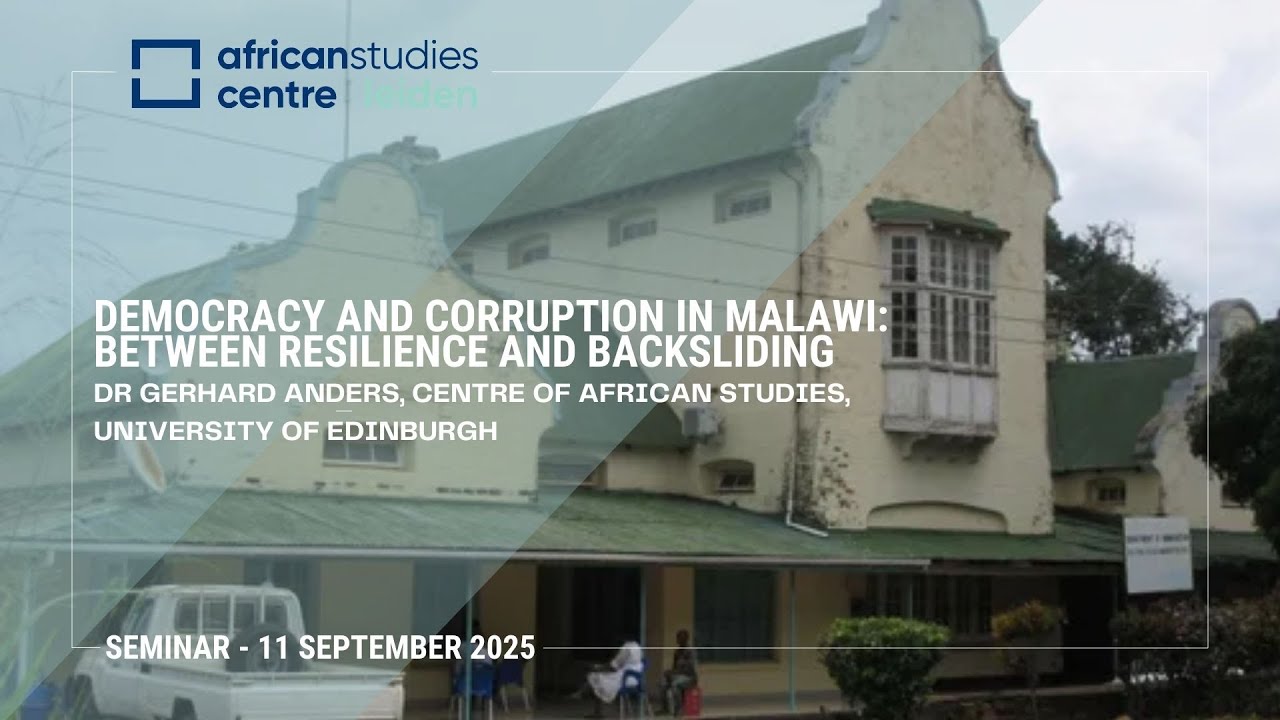
Democracy and corruption in Malawi: between resilience and backsliding
Keywords
Summary
170 words
Critical Evaluation
Value of the Information & Strength of the Argument
The lecture provides valuable insights into the complex relationship between democracy and corruption, using Malawi as a case study. Anders presents a nuanced argument that democracy can both foster and combat corruption, supported by empirical evidence from the Cashgate scandal and subsequent legal efforts. The argumentation is solid, drawing on his own research and existing scholarship, and he effectively challenges the simplistic narrative of democratic resilience by highlighting the persistence of high-level corruption. The comparative perspective with neighboring countries adds depth, though it is brief.
Scientific Rigor, Source Quality, Title Accuracy
The speaker demonstrates scientific rigor by grounding his analysis in his own research, including interviews and document analysis, and by referencing academic literature. The sources cited are primarily his own publications and the work of other scholars, though specific citations are not provided in the talk. The title accurately reflects the content, and the lecture is well-structured. The talk is based on a forthcoming book, which adds credibility, but the lack of explicit source citations in the presentation limits the ability to verify all claims.
185 words
Title / Content Match
The title accurately reflects the content, which examines the interplay between democratic resilience and corruption in Malawi.
Quality & Reliability
8/10
The speaker is a Senior Lecturer with extensive research on corruption and governance in Africa, and the talk is based on a forthcoming book. The content is well-structured and grounded in empirical research, though it is an expert opinion rather than a peer-reviewed study.
Key Moments
Markers derived by PSI from the transcript: the creator did not define chapters.
- Introduction to the lecture and the context of the upcoming elections.
- Overview of the argument: focusing on law enforcement against high-level corruption.
- Discussion of the Cashgate scandal and its impact.
- The role of donors and the forensic audit.
- Analysis of political parties and patronage dynamics.
- The influence of civil society and churches.
- Law enforcement efforts and their decline.
- Corruption and democracy since 2020.
- Comparative perspective with neighboring countries.
- Conclusion and final remarks.
Cited Sources
- In the Shadow of Good Governance: An Ethnography of Civil Service Reform in Africa — Author's book, mentioned as background.
- Corruption and the Secret of Law: A Legal Anthropological Perspective — Co-edited volume, mentioned as background.
- Transition and Justice: Negotiating the Terms of New Beginnings in Africa — Co-edited volume, mentioned as background.
Concurring Sources
- Cheeseman, N. (2018). Democracy in Africa: Successes, Failures, and the Struggle for Political Reform — Referenced as part of the revisionist trend in Africanist scholarship.
Contribution & Novelties
The lecture contributes to the study of democratic resilience by focusing on law enforcement against high-level corruption, an often-neglected aspect. It provides a detailed case study of Malawi’s Cashgate scandal and its aftermath, offering insights into the challenges of anti-corruption efforts in a young democracy. The argument that democracy can both enable and combat corruption is a valuable contribution to the debate on democratic backsliding.
Pour aller plus loin :
- Democratic backsliding — Overview of the concept.
- Cashgate scandal — Detailed information on the scandal.
- Anti-Corruption Bureau (Malawi) — The institution’s role and challenges.
94 words
Radar Profile
The radar profile shows high scores in information quantity, quality, and technical level, indicating a well-researched and informative lecture. The reliability score is also high, reflecting the speaker's expertise. The overall balance suggests a comprehensive and credible presentation.
💬 No comments were provided for analysis.