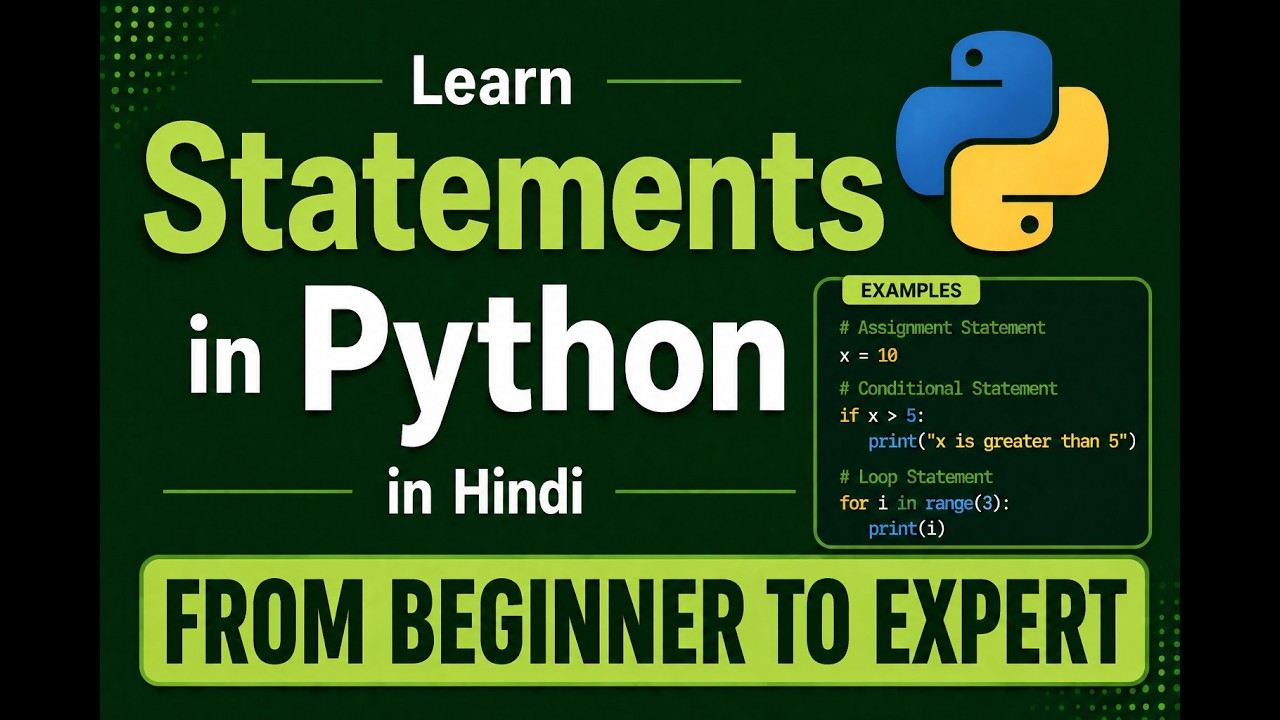
Syntax with print & format string formatting functions in Python Made Easy in Hindi
Keywords
Summary
140 words
Critical Evaluation
Value of the Information & Strength of the Argument
The video provides a comprehensive and practical introduction to Python string formatting, which is a fundamental skill for any programmer. The explanations are clear, with step-by-step demonstrations and visual outputs. The instructor effectively contrasts different formatting methods, highlighting the efficiency of f-strings. The argumentation is solid, as each concept is explained with examples and the reasoning behind the syntax is clarified. However, the video lacks a critical evaluation of the methods or discussion of best practices in different scenarios, which could enhance its value.
Scientific Rigor, Source Quality, Title Accuracy
The video is a tutorial and does not cite external sources, but it provides a link to the source code in the description. The content is accurate and aligns with Python documentation, though it does not explicitly reference official resources. The title accurately describes the content, focusing on syntax and string formatting. The video is well-structured, with a logical progression from basic syntax to advanced formatting. No comments were provided for analysis.
171 words
Title / Content Match
The title accurately reflects the content, which focuses on Python syntax and string formatting functions.
Quality & Reliability
7/10
The video provides a clear and accurate explanation of Python statements, expressions, and string formatting functions. The content is technically correct and well-structured, with practical examples. However, it lacks citations to external authoritative sources and is presented in a tutorial style without peer review.
Key Moments
Markers derived by PSI from the transcript: the creator did not define chapters.
- Introduction and channel overview
- Explanation of expressions vs statements
- Compound statements and indentation
- Multiple statements on one line with semicolons
- Multiline statements using parentheses
- Introduction to print() function and its parameters
- Printing to a file using file parameter
- String formatting with f-strings
- String formatting with % operator
- Scientific notation formatting and conclusion
Cited Sources
- Source code for the video — The video description provides a link to download the source code used in the tutorial.
Concurring Sources
- Python documentation on string formatting — The video's content aligns with the official Python documentation on string formatting methods.
Contribution & Novelties
The video offers a clear and structured tutorial on Python string formatting, which is a fundamental topic. It provides practical examples and contrasts different methods, which is helpful for beginners. The content is not novel but serves as a good educational resource.
Pour aller plus loin :
- Python documentation on f-strings — Official reference for formatted string literals.
- Python documentation on print() — Official documentation for the print function.
- PEP 498 – Literal String Interpolation — The proposal that introduced f-strings in Python 3.6.
84 words
Radar Profile
The radar profile shows high scores in quantity of information and technical level, indicating a detailed and moderately advanced tutorial. The quality and reliability scores are slightly lower, reflecting the lack of external citations and the tutorial nature. Overall, the video is a solid educational resource for Python beginners.