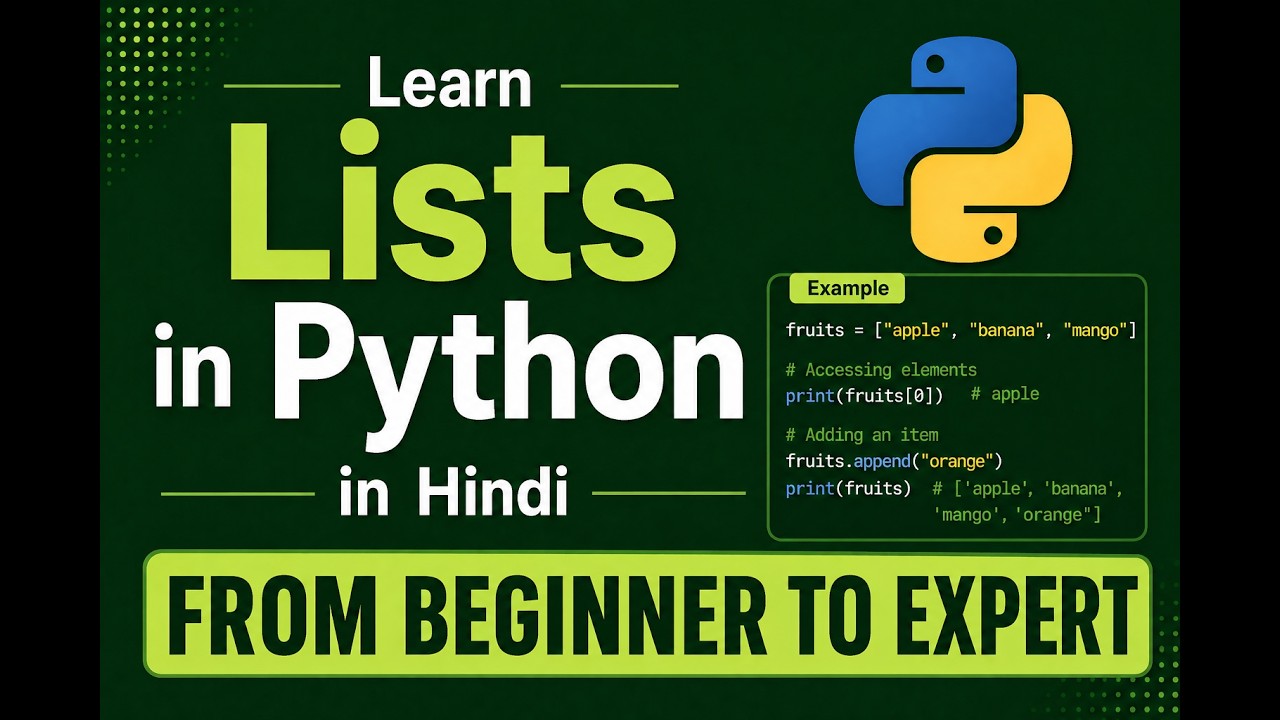
Part 2: Additional features & functions of List and List comprehension in Python made easy
Keywords
Summary
170 words
Critical Evaluation
Value of the Information & Strength of the Argument
The video provides valuable, practical knowledge for Python beginners, especially those interested in data manipulation. The explanations are clear and the examples are well-chosen to illustrate each concept. The argumentation is solid, as the instructor builds on each concept logically, from basic list indexing to more complex comprehensions and generator expressions. The use of visual aids and code demonstrations enhances understanding. However, the video lacks depth in discussing potential pitfalls or alternative approaches, and the pace may be slow for more advanced learners.
Scientific Rigor, Source Quality, Title Accuracy
The scientific rigor is adequate for a tutorial; the code examples are correct and the explanations are accurate. The video does not cite external sources, but it provides a link to source code in the description, which is useful for verification. The title accurately reflects the content, which is focused on additional list features and comprehensions. The production quality is basic, with no chapters or visual enhancements, but the content is well-structured.
170 words
Title / Content Match
The title accurately reflects the content, which covers additional features of lists and list comprehensions in Python.
Quality & Reliability
7/10
The tutorial is clear and accurate, with practical examples. However, it lacks citations to external sources and the production quality is basic. The content is correct and well-explained for beginners.
Key Moments
Markers derived by PSI from the transcript: the creator did not define chapters.
- Introduction to nested lists (matrices) and their structure.
- Accessing rows and individual elements in a matrix using indexing.
- Introduction to list comprehensions with a string repetition example.
- List comprehension for squaring numbers and using if conditions.
- Creating nested lists using list comprehensions.
- Extracting columns and diagonal elements from a matrix using comprehensions.
- Using range with step size and building a list of lists with arithmetic.
- Generator expressions and using sum function on rows.
- Creating a dictionary from row sums using a loop.
Cited Sources
- Source code for this video — Provided in the video description for downloading the code examples.
Concurring Sources
- Python Official Documentation — The concepts of lists and comprehensions are standard Python features, consistent with official documentation.
Contribution & Novelties
The video offers a clear, step-by-step tutorial on Python list comprehensions and nested lists, which is particularly useful for beginners. It demonstrates practical applications like matrix operations and data extraction, which are foundational for data science. The explanations are in Hindi, making it accessible to a wider audience.
Pour aller plus loin :
- Python List Comprehensions — Official Python documentation on list comprehensions.
- Nested List Comprehensions — Official documentation on nested list comprehensions.
- Python range() Function — Official documentation on the range function.
83 words
Radar Profile
The radar profile shows high scores in quantity and quality of information, with moderate technical depth and reliability. This indicates a solid introductory tutorial that is informative and accurate, but not highly advanced.
💬 No comments were provided for analysis.