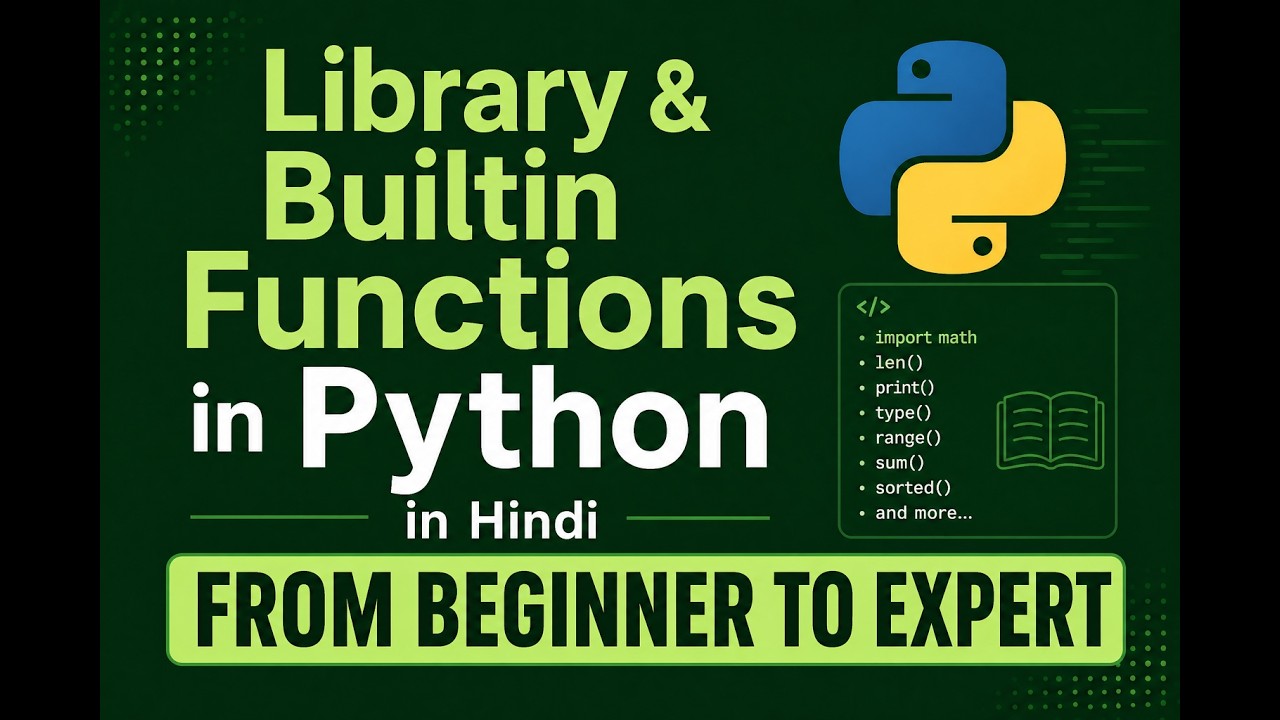
Part 1: map, filter, shuffle, random, range etc. library functions in Python in Hindi
Keywords
Summary
132 words
Critical Evaluation
Value of the Information & Strength of the Argument
The video provides a comprehensive overview of essential Python functions, with clear explanations and practical examples. The instructor demonstrates each function with code snippets, making it easy to follow. The argumentation is straightforward, focusing on how each function works and its typical use cases. However, the video lacks depth in discussing edge cases or performance considerations. The value lies in its accessibility for beginners, but it does not offer advanced insights or novel perspectives.
Scientific Rigor, Source Quality, Title Accuracy
The video does not cite external sources, but it provides a link to the source code in the description. The content is accurate and aligns with Python documentation, though the presentation is informal. The title accurately reflects the content, covering the mentioned functions. The video is a tutorial, so it does not claim to present original research. The lack of citations reduces its scientific rigor, but the examples are correct and well-explained.
161 words
Title / Content Match
The title accurately reflects the content, which covers map, filter, shuffle, random, range, and other functions.
Quality & Reliability
6/10
The video is a tutorial on Python built-in and library functions, with clear explanations and examples. However, it lacks citations to official documentation or authoritative sources, and the presentation is informal. The content is accurate but not deeply rigorous.
Key Moments
Markers derived by PSI from the transcript: the creator did not define chapters.
- Introduction to built-in vs library functions
- Math functions: sqrt, factorial, pow, ceil, floor
- Built-in functions: abs, min, max, sum, round
- Trigonometric functions: sin, cos, tan, degrees, radians
- Random module: random, randrange, choice, randint, shuffle, seed, uniform, choices
- Range function: parameters and examples
- Zip function: combining lists, tuples, strings, and files
- Enumerate function: indexing and iteration
- List comprehension with enumerate
Cited Sources
- Source code with explanations — Link provided in the video description for downloading the source code.
Concurring Sources
- Python documentation on built-in functions — Official documentation that confirms the behavior of built-in functions like range, zip, and enumerate.
- Python random module documentation — Official documentation for the random module, covering functions like seed, shuffle, and choices.
Contribution & Novelties
The video offers a beginner-friendly introduction to Python’s built-in and library functions, with practical examples. Its novelty is limited as it covers standard material, but it is useful for Hindi-speaking learners. For deeper understanding, one can explore the official Python documentation, the itertools module for advanced iteration, and the functools module for higher-order functions.
Pour aller plus loin :
- Python documentation on built-in functions — Official reference for all built-in functions.
- Python random module documentation — Detailed explanation of random functions.
- Python itertools module — Advanced iteration tools that complement the functions discussed.
93 words
Radar Profile
The radar profile shows moderate scores across all dimensions, with quantity of information being the highest. This indicates a tutorial that provides a good amount of content but lacks depth and rigor. The technical level is moderate, suitable for beginners, but not for advanced users.
💬 No comments were provided for analysis.