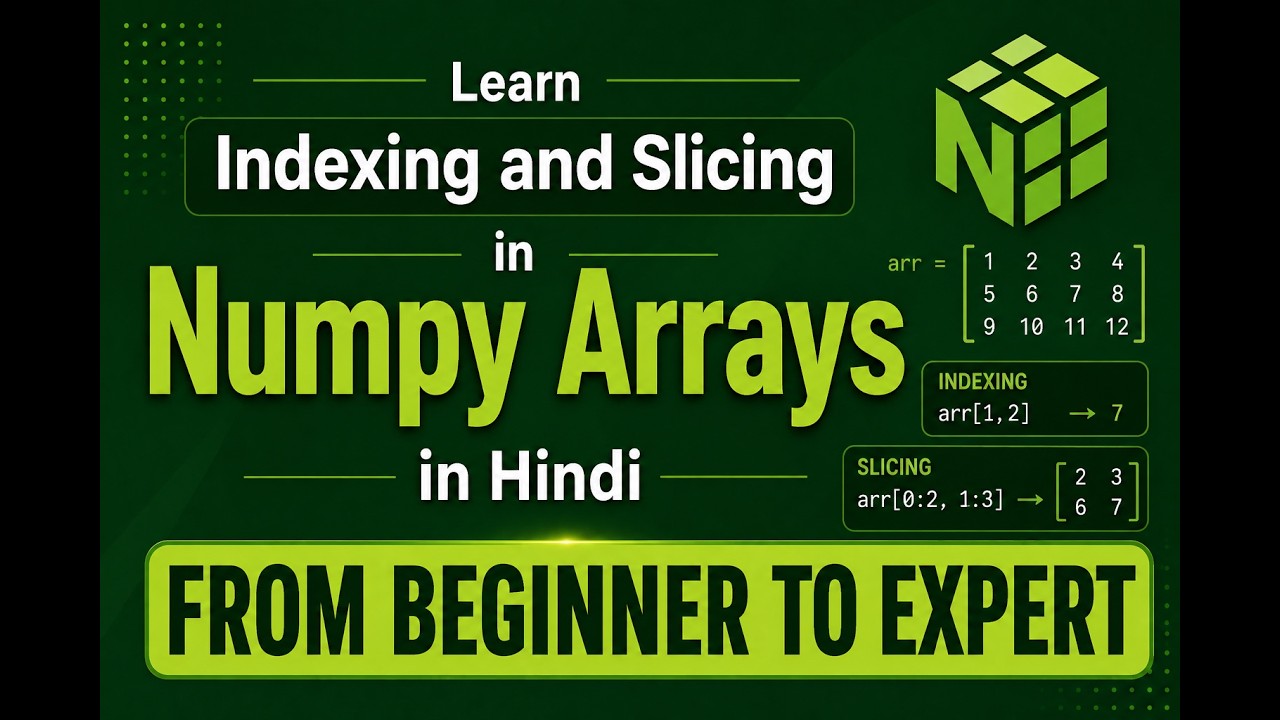
Part 2: Syntax and features of Indexing and Slicing in Numpy Arrays in Hindi
Keywords
Summary
171 words
Critical Evaluation
Value of the Information & Strength of the Argument
The video provides a thorough and systematic explanation of indexing and slicing in NumPy, which is essential for data manipulation. The instructor uses clear examples and visual aids (like the Excel sheet analogy) to illustrate concepts. The argumentation is solid, as each concept is introduced with a rationale and then demonstrated with code. The progression from 1D to 3D arrays is logical and helps build understanding. The explanation of negative indexing and step sizes is particularly valuable, as these are often confusing for beginners. The tutorial also shows how to modify array elements and copy arrays, which are practical operations. However, the video lacks a critical discussion of potential pitfalls or performance considerations, and it does not compare with alternative methods (e.g., using boolean indexing). Overall, the information is accurate and well-presented, making it a valuable resource for learners.
Scientific Rigor, Source Quality, Title Accuracy
The tutorial is scientifically rigorous in its technical accuracy; the syntax and behavior of NumPy indexing and slicing are correctly explained. The only source provided is a Google Drive link to the source code, which is appropriate for a tutorial. The title accurately reflects the content, and the video is well-structured. However, the video does not cite external references or documentation, which is acceptable for a tutorial but limits its depth. The content is consistent with official NumPy documentation, though no explicit citations are given. The video’s production quality is decent, with clear audio and screen captures, but the lack of chapters may hinder navigation. Overall, the tutorial is reliable for its intended purpose.
268 words
Title / Content Match
The title accurately reflects the content: it covers the syntax and features of indexing and slicing in NumPy arrays, as promised.
Quality & Reliability
7/10
The tutorial is clear, structured, and provides many examples. It covers indexing and slicing in 1D, 2D, and 3D NumPy arrays, including negative indexing and step sizes. The explanations are accurate and align with standard NumPy documentation. However, the video is in Hindi, which may limit accessibility, and it lacks citations to external sources.
Key Moments
Markers derived by PSI from the transcript: the creator did not define chapters.
- Introduction to indexing and slicing, need for slicing in large datasets.
- Explanation of indexing: rows and columns start at 0.
- Syntax of slicing: array[start:stop:step], with start and step optional.
- Example of slicing a 1D array with start, stop, and step.
- Using while loop to access elements via indexing.
- Modifying slice elements by assigning a constant value.
- Negative indexing: last element is -1, and reverse traversal.
- Complex slicing with negative step and reverse direction.
- Introduction to 2D arrays: indexing rows and columns.
- Accessing elements in 2D arrays with two indices.
- Introduction to 3D arrays: combination of 2D arrays.
- Accessing and modifying elements in 3D arrays.
- Copying a slice to a variable and modifying it.
Cited Sources
- Source code for this video — The instructor provides the source code used in the video for download.
Concurring Sources
- NumPy Documentation on Indexing — The official NumPy documentation confirms the syntax and behavior of indexing and slicing.
Contribution & Novelties
This tutorial provides a comprehensive and accessible introduction to indexing and slicing in NumPy, specifically tailored for Hindi-speaking learners. It covers 1D, 2D, and 3D arrays with numerous examples, making it a valuable resource for beginners. The explanation of negative indexing and step sizes is particularly clear. The video also demonstrates practical operations like modifying slices and copying arrays.
Pour aller plus loin :
- NumPy Indexing Documentation — Official documentation on indexing, including advanced indexing and boolean indexing.
- NumPy Slicing Tutorial — A concise tutorial on slicing with examples.
- Python List Slicing — Python’s list slicing is similar; understanding it helps with NumPy arrays.
104 words
Radar Profile
The radar profile shows high scores in quantity of information and technical level, indicating a content-rich tutorial. The quality and reliability scores are moderate, reflecting the lack of external citations but accurate content. The overall balance suggests a solid educational resource for beginners.