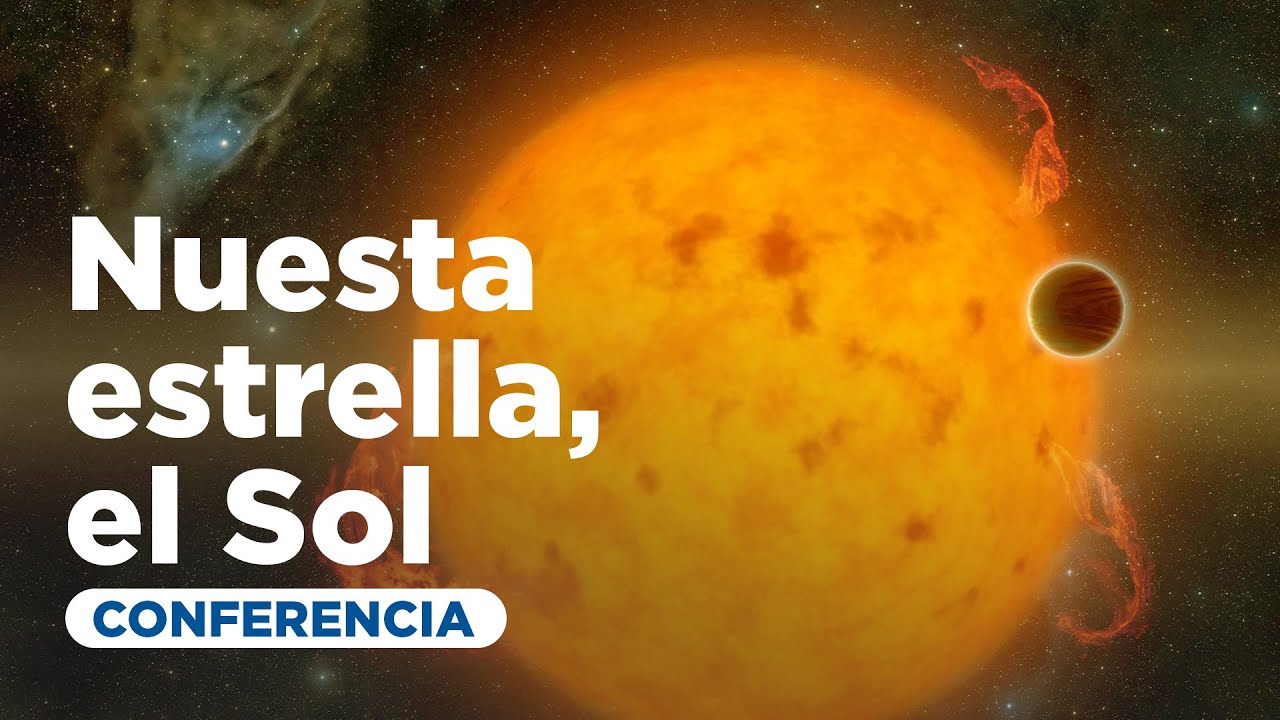
Nuestra estrella, el Sol | Conferencia de Javier Alonso, astrofísico
Keywords
Summary
174 words
Critical Evaluation
The lecture by Javier Alonso is a well-structured and scientifically accurate presentation on the Sun, suitable for a general audience with some scientific background. As an astrophysicist at INAF, Alonso brings credible expertise, and his explanations are grounded in established astrophysical knowledge. The content covers key aspects: the Sun’s classification, physical properties, internal structure, fusion processes, and solar activity, culminating in the Sun-Earth relationship.
The strength of the talk lies in its clarity and logical progression. Alonso begins with basic facts (distance, size, mass) and gradually introduces more complex concepts like differential rotation and nuclear fusion. He uses analogies (e.g., comparing star sizes to ant-human-elephant populations) to make abstract ideas relatable. The explanation of the proton-proton chain and CNO cycle is accurate, though it may be challenging for complete novices. The inclusion of a magnetogram to illustrate sunspot magnetism is a good visual aid.
However, the talk lacks explicit citations to scientific sources, which would enhance its credibility for those seeking further reading. The speaker does not mention specific studies or publications, relying instead on his expertise. This is common in public lectures but limits the ability to verify claims independently.
The title accurately reflects the content, and the talk fulfills its promise of explaining the Sun’s workings. The pacing is appropriate, and the speaker engages the audience with personal anecdotes (e.g., his own photo of a sunspot).
Overall, the information is reliable and well-presented, though it does not break new ground. It serves as an excellent educational resource for understanding our star. The lack of citations is a minor drawback, but the speaker’s authority and the accuracy of the content compensate for it.
274 words
Title / Content Match
The title accurately reflects the content, which is a detailed lecture about the Sun, its structure, and its relationship with Earth.
Quality & Reliability
8/10
The speaker is a professional astrophysicist with a PhD, presenting established scientific facts about the Sun. The content is accurate and well-structured, though it lacks citations to specific sources during the talk. The information is consistent with current scientific understanding.
Key Moments
Markers derived by PSI from the transcript: the creator did not define chapters.
- Introduction to the Sun's importance and the lecture's structure.
- Explanation of the Sun as a G-type main-sequence star and its basic properties.
- Discussion of the Sun's differential rotation and its role in solar activity.
- Comparison of the Sun's size and mass with other stars and planets.
- Description of the Sun's internal structure: core, radiative zone, convective zone.
- Explanation of nuclear fusion reactions: proton-proton chain and CNO cycle.
- Details about the photosphere, sunspots, and limb darkening.
- Magnetic field measurements and their connection to sunspots.
- Solar activity and its effects on Earth, including space weather.
- Conclusion and summary of the Sun-Earth relationship.
Cited Sources
- UBUInvestiga Blog — The channel's blog, mentioned in the description as a source for more scientific outreach content.
Concurring Sources
- NASA Solar Physics — NASA's official page on the Sun, providing accurate and up-to-date information consistent with the lecture.
Contribution & Novelties
The lecture provides a comprehensive and accessible overview of the Sun, synthesizing well-known astrophysical facts into a coherent narrative. It does not present new research but serves as an excellent educational resource. The speaker’s expertise adds credibility, and the use of analogies aids understanding.
Pour aller plus loin :
- Solar structure and fusion — Detailed explanation of the Sun’s core and fusion processes.
- Sunspot — Overview of sunspots and their magnetic nature.
- Space weather — Effects of solar activity on Earth’s technology and environment.
84 words
Radar Profile
The radar profile shows high scores in information quantity, quality, and reliability, with a slightly lower technical level, indicating a well-balanced lecture that is both informative and accessible.